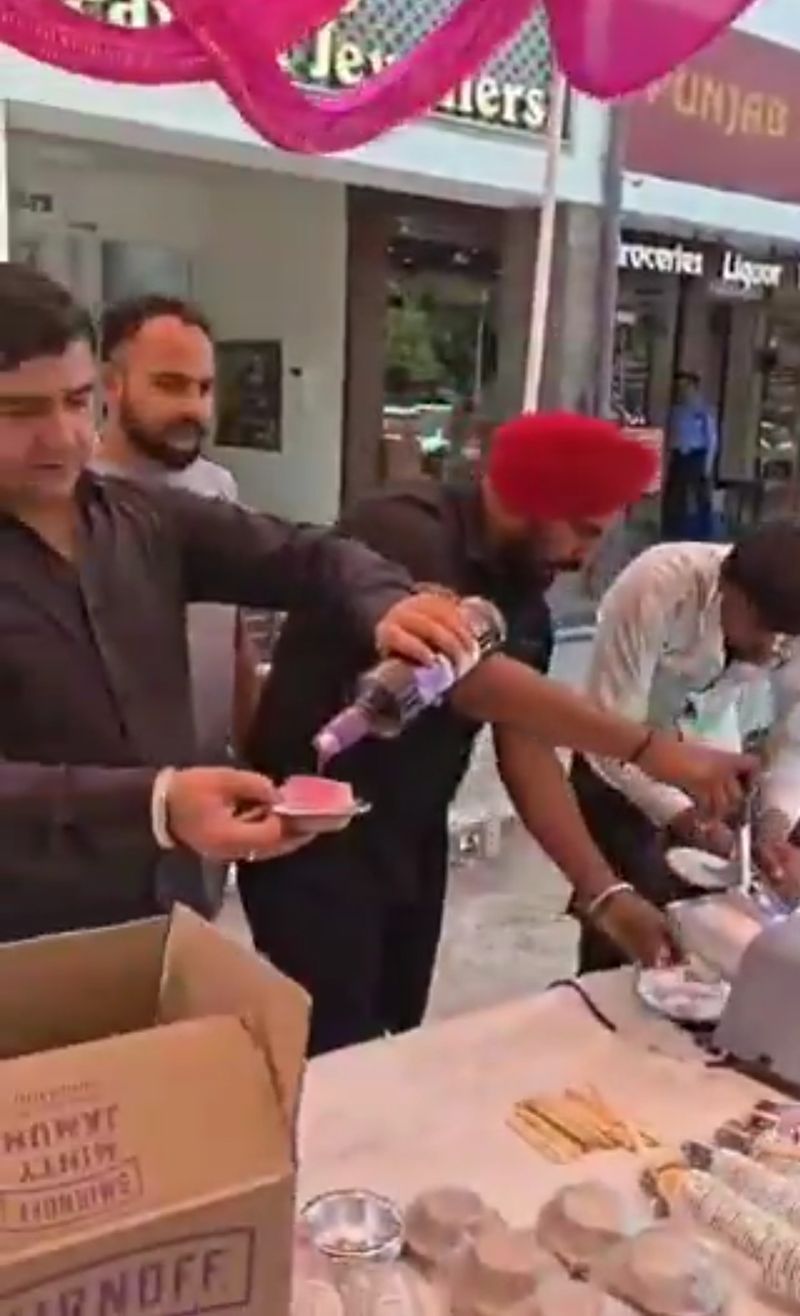

On the afternoon of May 23, at around 2 pm, something unusual was happening outside a liquor shop in Sector 9’s inner market in Chandigarh. A group of men had set up what looked, at first glance, like a street-side refreshment stall — not an uncommon sight in a scorching north Indian summer. But instead of plain sharbat or nimbu pani, the chuski (ice gola) being handed out to passersby had something extra in it: vodka.Specifically, the vodka brand being mixed into the crushed-ice cones was Smirnoff Minty Jamun — a flavoured vodka variant. And the distribution was entirely free of charge.Someone recorded it, put it on Instagram, and the clip went viral almost instantly. By the time the dust settled, there was an FIR, two administration show-cause notices, a city-wide crackdown meeting chaired by the Deputy Commissioner himself, and the phrase “liquor langar” — coined by social media users drawing a darkly ironic comparison to the sacred Sikh tradition of free community meals — had gone around the world.Who did it, where, and when — exactly?The incident took place outside the retail liquor vend operated by M/s Bajaj Spirits Pvt. Ltd. at the inner market, Sector 9, Chandigarh. The company holds an L-2/L-14A retail liquor licence — the standard vend licence — under Licensing Unit 06.The man arrested in connection with the incident is Rajesh Sachdeva, 53, a resident of House No. 456, Saketri village in Panchkula (Haryana), who is the proprietor of Liquor World Wine Shop in Sector 9. He was arrested two days after the video surfaced and lodged in police lock-up.Date: May 23. Time: approximately 2 pm. Location: Sector 9 inner market, Chandigarh.What is Smirnoff Minty Jamun Vodka & why was it chosen for this stunt?Smirnoff is one of the world’s best-known vodka brands, manufactured by Diageo. The Minty Jamun variant is a flavoured vodka — a fruit-and-mint infused version targeted at younger, first-time, and casual drinkers who may find plain vodka too sharp. Its sweet-tart flavour profile and lower perceived potency make it an accessible gateway product.Mixing it into crushed ice golas was, by all appearances, a calculated promotional choice. The summer heat, the sweet-flavoured vodka, the familiar desi snack format — the combination was designed to be appealing, photogenic, shareable, and to reach people who might not otherwise walk into a liquor vend. It was street-level alcohol marketing dressed up as a neighbourhood treat.Whether this was an initiative taken by the vend operator alone or whether the brand manufacturer was also involved is part of the ongoing police investigation. The FIR names the vodka manufacturer, and police are probing their role.Was this just a promotional stunt or something more concerning?On the surface, yes: this appears to have been a brand-promotion exercise, the kind of below-the-line marketing that liquor companies sometimes organise in coordination with retail outlets. But under Chandigarh’s Excise Policy 2026-27 and the applicable liquor licence rules, what happened that afternoon was not merely a marketing misstep — it was a multi-layered legal violation.Here is why.Why is it a violation? What does the law say?The Chandigarh Excise and Taxation Department has laid out the violations in unambiguous terms across two show-cause notices issued to M/s Bajaj Spirits Pvt. Ltd.The notices invoke two specific rules under the Punjab Liquor Licence Rules, 1956, as applicable to the Union Territory of Chandigarh:Rule 37(2) prohibits a licensee from carrying on any business connected with their licence, or storing any liquor for sale, outside the premises specified in their licence. Serving vodka in ice golas on the street outside the shop is, by definition, operating outside the licensed premises.Rule 37(10) is equally direct: a licensee shall not give any customer a free dole of liquor, nor any perquisite or inducement on the price of liquor sold. Giving away vodka-laced golas free of cost to the public is, on its face, precisely what this rule prohibits.Beyond the licence rules, the incident also violates Clause 68 of the Excise Policy 2026-27, which prohibits licensees from advertising or promoting liquor by any means, including social media. Crucially, the policy holds the licensee directly responsible for any photo, video or digital content depicting the sale or promotion of liquor from their premises — even if the content was created by a third party. The burden of proving innocence lies entirely with the licensee, not the department.What can the violator face — minimum and maximum?The consequences are serious and multi-directional.Under the Excise Policy, each instance of digital content depicting liquor promotion from a licensed vend attracts a penalty of Rs 5 lakh. Given the number of videos and reels that circulated from this single event, the financial exposure from this provision alone is significant.More gravely, both show-cause notices invoke Section 36 of the Punjab Excise Act, 1914, under which the Collector (Excise) has the power to suspend or cancel the licence of a violating licensee. M/s Bajaj Spirits Pvt. Ltd. has been directed to appear before the Collector (Excise) on June 1, 2026, at 3 pm, to submit a written explanation. The notices make clear that if no appearance is made, proceedings will be decided ex-parte — meaning the case will be decided without their input.Non-appearance, in other words, could directly lead to licence cancellation.The Deputy Commissioner and Excise Commissioner Nishant Kumar Yadav, who chaired a city-wide licensee meeting on May 26 in the wake of the incident, went a step further: he warned that offenders may not only have their licences cancelled but could be blacklisted from future allotment and licensing processes entirely — effectively a permanent ban from the trade.What police action has been taken?An FIR bearing No. 49 has been registered at Police Station Sector 3, Chandigarh, on the complaint of Constable Harish (No. 542/CP), against Rajesh Sachdeva — proprietor of Liquor World Wine Shop, Sector 9 — under the following provisions:— Section 68-1-14 of the Punjab Excise Act, 1914 (pertaining to liquor distribution violations)— Section 61(2) of the Bharatiya Nyaya Sanhita (BNS) — the criminal conspiracy chargeSachdeva was arrested and lodged in police lock-up. Separately, Deputy Superintendent of Police (Central) Dalbir Singh confirmed the FIR also names the company that manufactures Smirnoff, and that their role is under investigation. Police are scanning CCTV footage from the area and verifying the roles of other staff at the vend.What has the chandigarh administration done in response?The administration’s response has been swift and three-pronged.First, the two show-cause notices to M/s Bajaj Spirits (one to Licensing Unit 06 at Sector 9 Internal Market, the second to Licensing Unit 57 at Sector 43 Market — both held by the same company) were issued within two days of the incident, on May 25.Second, a city-wide meeting of all liquor licensees was convened on May 26 under the chairmanship of Deputy Commissioner-cum-Excise Commissioner Nishant Kumar Yadav — an unusual step that signals how seriously the administration is treating this as a systemic issue rather than an isolated incident.In that meeting, the DC reiterated that the Excise Department has rolled out a Real-Time Stock Updation System — a digital monitoring platform that requires licensees to update their liquor stock in real time — to ensure transparency and deter misuse. He directed all licensees to comply with minimum sale price rules, and made it clear that zero tolerance is not a phrase; it is departmental policy.Third, the FIR against the proprietor was the criminal arm of the response — separate from the licensing consequences, and potentially leading to prosecution.Is this incident connected to the record number of liquor vends in chandigarh this year?It is worth asking. For 2026-27, the Chandigarh Administration has auctioned 97 retail liquor vends — the highest number in at least six years. As of mid-May, 96 of those 97 have been allotted and are operational. The bid premium this year — 24.63 per cent over the reserve price, with total bids of Rs 560.85 crore against a reserve of Rs 450 crore — is the steepest in four years, indicating intense competition for licences.When competition is fierce and every licensee is fighting for market share, the temptation to resort to aggressive — and sometimes illegal — promotion is greater. The “liquor langar” incident, whatever else it was, fits the pattern of a licensee trying to drive footfall and build brand recall in a crowded, competitive market. Chandigarh’s excise boom creates winners; it also creates pressure.And the heatwave angle — was this deliberately timed for summer?Almost certainly yes — from a promotional standpoint, if not from a legally defensible one. Ice golas in the middle of a scorching May afternoon, in a city experiencing punishing heat, handed out for free with a sweet flavoured vodka inside: the timing was not accidental. It was designed to maximise visibility, footfall, and shareability.The irony is compounding. Chandigarh is already, by every available measure, India’s thirstiest city. With a population of 12.5 lakh, it has consumed 13 crore bottles of liquor over the past five years — roughly 20 bottles per resident per year, compared to a national average of four. Its excise revenue crossed Rs 1,000 crore for the first time in 2025-26 and is on course to hit Rs 1,200 crore this fiscal. Nobody in Chandigarh is going without a drink for lack of supply.So the “liquor langar” was not filling a gap. It was fighting for market share in a city already swimming in regulated supply. The Administration’s position is that this kind of competition — aggressive, illegal, boundary-breaking — is precisely what the Excise Policy is designed to prevent, regardless of how hot it gets outside.The bottom lineA promotional vodka stunt in a busy and elite market, recorded and shared on Instagram, has triggered an FIR, two show-cause notices threatening licence cancellation, a city-wide crackdown meeting, and the very real prospect of a Rs 5-lakh-per-instance fine for the licensee. The “liquor langar” has become a stress test of Chandigarh’s excise governance — and the Administration’s response suggests it intends to pass it.The lesson, as the Deputy Commissioner put it at Monday’s meeting: in Chandigarh, you can sell your liquor. You cannot give it away. And you certainly cannot do it on Instagram.