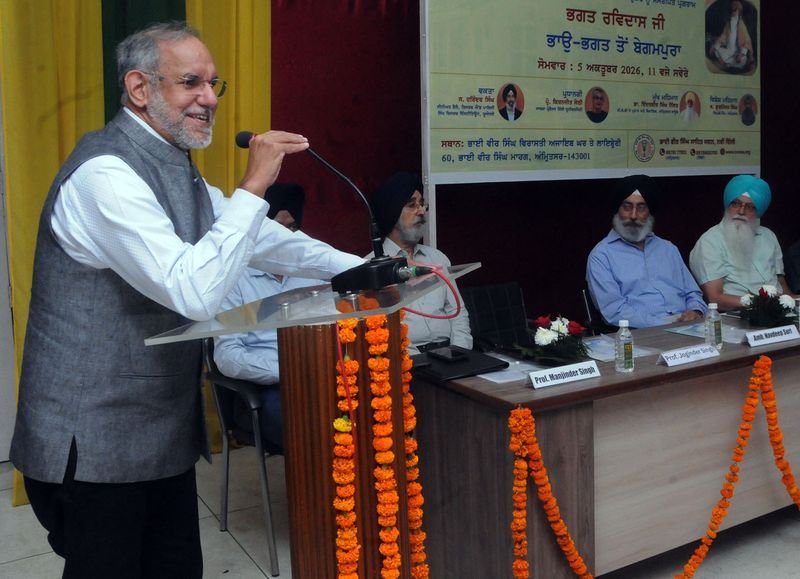

Bhagat Ravidass’s vision of “Begumpura” imagined a society free from social, political and economic hierarchies. Centuries later, his legacy has become central to the assertion of a community whose political significance carries weight in Punjab’s electoral politics. With the state government earmarking Rs 100 crore to mark his 650th birth anniversary, a larger question has emerged over how his spiritual vision of equality is being interpreted within electoral politics.Harinder Singh, scholar and founder of SikhRI, USA, said the problem began with how Ravidass was understood. Delivering a lecture at Bhai Vir Singh Niwas Sthaan as part of the 650th birth anniversary celebrations organised by the Bhai Vir Singh Heritage Museum and Library, he said debates over whether to describe him as Bhagat, Sant or Guru Ravidass had overshadowed his vision of an egalitarian society.Singh said Ravidass’s message challenged caste hierarchy, inherited status, exclusion and political and religious domination. He noted that although Ravidass lived within a caste order that marginalised his community, his compositions were preserved in the Guru Granth Sahib alongside the bani of the Sikh Gurus.According to Singh, this demonstrated that spiritual authority was not derived from caste but from the truth and wisdom of the word.Drawing parallels with the Ravidassia movement of the 1930s, Singh said members of the marginalised community remained largely landless and excluded from social, economic and political resources. He questioned whether political assertion since then had translated into substantive social transformation.The discussion also examined issues beyond Ravidass and Begumpura, including beadbi, institutional credibility and accountability within the Sikh community. Former ambassador Navdeep Suri, Sikh scholars H.S. Gill and MLA Amritsar South Dr Inderbir Singh Nijjar participated in the discussion.Singh linked beadbi with the broader concept of adab, or reverence, arguing that justice and reverence must be reflected in thought, word and action. He said contemporary debates should also examine institutional responsibility and whether Sikh authority remains connected to the ethical values of Gurbani.The lecture ultimately centred on not merely how Punjab remembers Ravidass, but how it engages with his message of equality.