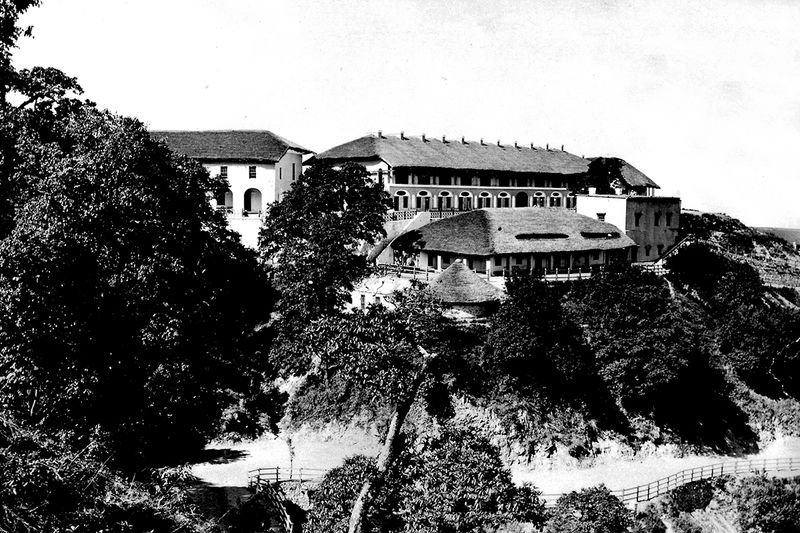

Mussoorie nostalgia: A legacy of two hundred yearsby Anmol Jain.Rupa.Pages 232. Rs 595‘Such an influx of settlers reminds one of the gold-fields. Only in this case health, not wealth, was the magnet.’ — EH AshworthThey came searching for game and ended up founding one of India’s most picturesque hill stations! It was in 1823 — two centuries ago — when two officers set foot on soil that would soon become the Britishers’ getaway from the searing heat of the subcontinental plains and the administrative burden of managing the Indian empire.Captain Frederick Young, accompanied by Superintendent of Dehradun FJ Shore, went hunting in the hills adjoining Dehradun. They trekked up to the north of the Doon Valley, scrambling up narrow goat paths to reach a high ridge, where they were met with a stunning view. The valley sprawled beneath them, a rich and verdant canvas of untainted flora, bounded by the Shivalik peaks to the south; to the north, snow-clad mountain ranges shimmered in a soft, golden, balmy sunlight.Captain Frederick Young, the founder of Mussoorie and Landour, also the founder of Sirmoor Rifles.Game was abundant, the weather splendid. With time, their visits uphill became frequent. And soon, it was time to ‘leave their mark’ on the soon-to-be town of Mussoorie. The duo erected a ‘shooting box’ on a hill — not on the Camel’s Back Road, but near the present-day Christ Church — facing the Doon Valley. Before long, hordes of Europeans trudged up the hills of the horseshoe-shaped ridge, following eagerly in the footsteps of Young and Shore. The Europeans bore the same desires: to hunt and to absorb the stimulating climate.Today’s Mussoorie is crowded… but things were apparently much different in the formative years of this town; heavily forested slopes offered little scope to erect any kind of lodging. The Mussoorie of yesteryears comprised densely forested slopes, cradling lush canopies of deodar and oak.Come spring, crimson rhododendron flowers would break the monotony of endless green. The only semblance of any construction to be found were a few scattered huts belonging to villagers from nearby Kyar Kuli, Bhatta, Dudhli and some other villages.Interestingly, the British empire did not own these hills. The ownership lay with: a) the Raja of Tehri Garhwal — of lands on the northern slopes of Mussoorie and Landour hills; b) the Mahant of Guru Ram Rai shrine at Dehradun — who owned lands to the east and also at the present-day Happy Valley area; and c) zamindars from nearby Kyar Kuli and Dudhli villages — who owned a major part of the southern slopes of Mussoorie, including the present-day Mall Road, Jharipani, Barlowganj, and also Cloud’s End and Hathipaon to the west.As the Europeans lumbered up these hills, they looked to find suitable sites for their summer abodes. While the sloping mountain landscape offered little leeway for erecting any kind of lodging, their only option were the few ‘flats’ where local villagers had built small hutments to house their cattle during the summers.There were around seven large ‘flats’ on the Mussoorie Ridge. Besides, there were a number of smaller flats. The large flats caught the fancy of European settlers. And thus began a ‘rat-race’ to own a property in these sublime hills. Most of the sought-after flats were owned by local village folk, and the Europeans ‘constantly cajoled or badgered’ them to sell their lands. Many ‘sahebs’ deployed their servants to do the bargaining for them, promising them large tips if they were able to close the deals at low rates. The native zamindars had to eventually bow before the might of the empire, most of them receiving ridiculously low compensation.The construction of a ‘convalescent depot’ for European soldiers, an idea floated by Young to his superiors in the army, was started at Landour in 1827, and made operational in 1829. Mussoorie and Landour were initially two separate townships.The number of houses had increased to about 480 (340 European and 140 Indian residences) by 1882-1883, which swelled to 1,406 by 1935. I earnestly endeavoured to find the number of houses at present, but miserably failed in the attempt. Under strict confidence, an official disclosed that there might be hundreds of illegal buildings of which the municipality has no record! But just to give an indication, at present, there are around 4,200 residential and 1,200 commercial water connections in the town — and please keep in mind that every building might not have a separate water connection.Frederick John Shore, the joint magistrate and superintendent of Dehradun from 1823 to 1829.As the number of settlers swelled, along came a Jewish gentleman called Lawrence, perhaps the first entrepreneur to set foot in the budding town in 1829 with merchandise for the European community. If anyone so much as glanced in his direction, the zealous salesman would shout, ‘comin’, ‘comin’, and rush towards them. Lawrence was soon nicknamed ‘Comin’. Until our salesman decided he had had enough! He promptly dropped his Jewish surname and rechristened himself Lawrence Cumming.Lawrence’s venture came to a full circle and within a few years, he managed to open a store on the Mall, at the site where currently the head post office is. In 1830, Henry Bohle, a distiller from Meerut, rushed to the hills to take advantage of the cool climate and the wild yeast strains for brewing beer. Bohle wasn’t successful in his first attempt at brewing, and a tiff with Captain Young forced him to shut down in 1832. But he did lay the roots for a successful brewery business in Mussoorie that continued till the end of the 19th century.As the ‘invalids’ (a colloquial term used by the British for sick soldiers) began to arrive at Landour’s convalescent depot, a market appeared in the town, primarily to cater to soldiers and other settlers. Shortly after this, the ‘Kulri Bazaar’ was established, with shops near the present-day head post office and LIC building (erstwhile State Bank of India). As settlers swarmed, the founding fathers fretted about the need to develop civic amenities. In 1842, they requested the North-Western Provinces government to introduce the Municipal Act in Mussoorie. A 12-member Mussoorie Municipal Committee was constituted in 1842 — the first such body amongst the hill stations.After Bohle shut down his brewery in 1832, his property was purchased by Mr Parsons and from him by Bohle’s son-in-law, John Mackinnon. Mackinnon established Masuri Seminary School in 1834 at the site of the old brewery near Hathipaon. Regarded as the first school for Europeans in the Himalayas, the school continued at the site of the old brewery until 1850, when it was shifted to the site where Hotel Savoy currently is.The Mussoorie Library was made operational in 1843-1844 through subscriptions to meet the cost of the building and the cost of books. This library is a treasure trove of more than 16,000 books that include old travelogues, surveys, journals and rare books.The Himalaya Club was formed in 1841 with 148 members, and the town’s founder Colonel Young was the first president. It was very expensive, exclusive and naturally, in high demand. Situated atop a steep ridge above the road that led to Landour, the club offered stunning views. Membership was open only for ‘men’ of European origin. By the early 1880s, the membership had swelled to 759 (including 258 temporary members), and it was regarded as one of the best clubs in India. The club closed down after WorldWar I, and the property was put up for sale.A racecourse in the mountains! Yes, as early as in the 19th century, there was a racecourse in Mussoorie — albeit small — at Happy Valley. The Estate was purchased by Vincent Mackinnon, a rich brewer, in April 1904. Shortly thereafter, it was decided to establish an amusement club at Happy Valley. The club meant the death knell for the racecourse as its area was taken over for developing tennis courts, along with a billiards room, card room, reading room, a library and a field for cricket and hockey.Apparently, the Europeans did not fancy a club without equestrian sports. Soon, a hillside was dug up near Herne Del — about a mile below Happy Valley — to make way for a new racecourse and polo ground. Soon the ‘Polo Ground’ became quite popular for holding equestrian events, a ‘gymkhana’. The last gymkhana was held at the Polo Ground on 19 June 1943 to raise funds for the Red Cross during the war. In the subsequent years, the club was closed and the property put up for sale.In 1959, a part of the Happy Valley Club was acquired by the government to establish the Lal Bahadur Shastri National Academy of Administration (LBSNAA) for training civil servants. A horse riding ground, a shooting range and the sports club of LBSNAA have come up on the premises of the erstwhile club.As a child, the spelling of our town befuddled me. ‘Why do you always forget that it is spelled with a double “s” and double “o”?’ Mrs Shepherd, my language teacher, would point out. ‘Perhaps the name has a British, Irish or Scottish origin and hence the quirky spelling,’ I’d muse. I was pleasantly surprised that our town’s name has an Indian origin — named after a shrub called Mansur or Mansuri (botanical name Coriaria nepalensis), which was plentiful in these hills (not anymore, though).The native population called these hills ‘Mansuri’ and the Europeans simply dropped the ‘n’. Over the years, the spelling was completely distorted by the British. The town assumed various written forms: ‘Masuri’, ‘Mussoori’ and even ‘Mussooree’. The current spelling was made popular by a local advertisement bulletin, which started writing ‘Masuri’ as ‘Mussoorie’.— Excerpted from ‘Mussoorie Nostalgia’, with permission from Rupa