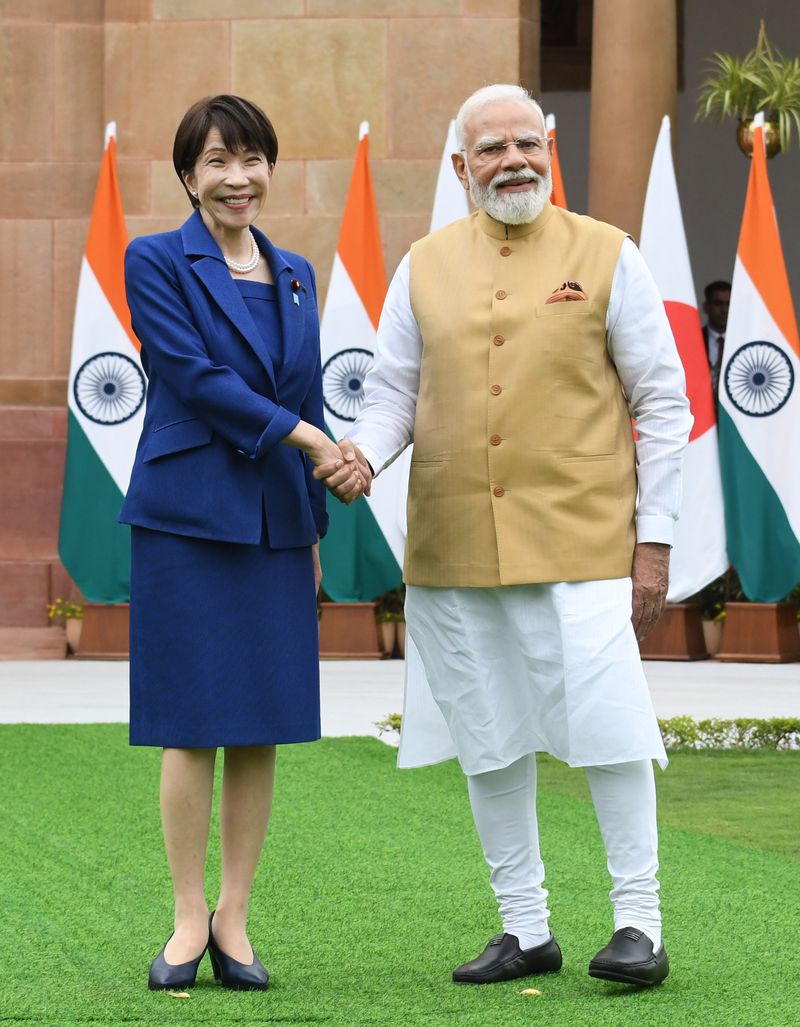

India and Japan on Thursday unveiled a relationship-transforming agenda, moving from a traditional infrastructure-led partnership into a technology-led alliance spanning several sectors.Prime Minister Narendra Modi and his Japanese counterpart, Sanae Takaichi, took part in the 16th India-Japan Annual Summit, which culminated in the adoption of three landmark policy documents: a Joint Declaration on Economic Security, a Joint Statement on Cooperation in Artificial Intelligence and a Joint Statement on Energy Resilience.This roadmap is aimed at securing supply chains for critical minerals, bolstering energy supply and strengthening strategic petroleum stockpiles and working on advanced materials, quantum computing, semiconductors and defence equipment.A central pillar of the summit was Tokyo’s promise of a Rs 1 lakh crore investment across sectors. Modi said, “In the past year alone, about 120 new business agreements have been signed, which will bring more than USD 10 billion of Japanese investment to India.”Modi and Takaichi agreed to review and update the 2011 India-Japan Comprehensive Economic Partnership Agreement (CEPA). The Prime Minister referred to the CEPA and cited how bilateral trade between India and Japan was in the range of USD 25-27 billion and needed to go up.The high-profile summit comes at a time when Japan and India are facing energy supply chain disruptions due to the crisis in West Asia and shifting alignments in the Indo-Pacific, with the US resetting its priorities.As technology emerges as the centrepiece for any growth engine. The leaders initiated a blueprint to merge Japan’s precision hardware and engineering with India’s massive software talent pool to drive development of artificial intelligence (AI).At a press briefing, Foreign Secretary Vikram Misri said, “With regard to AI, we have seen some very crucial agreements between India and Japan on the development of large language models.””There is an ongoing framework for cooperation and Japanese companies are looking to set up rare earth magnet producing facilities in India,” he added.On energy, the two leaders launched the India-Japan Biogas Initiative. This will see the installation of 1,000 biogas and organic fertiliser plants across rural India to support village livelihoods and clean energy transitions.Misri said, “It would leverage the vast network of dairy cooperatives that exist in India. These plants will produce bio-CNG and organic fertiliser using the abundant untapped resources of rural biomass.”The two sides are also looking at stockpiling systems and reserve mechanisms for crude oil and petroleum products. An India-Japan Joint Working Group on Petroleum and Natural Gas will explore mutually beneficial opportunities for cooperation.The two countries, which are partners in the Quad with Australia and the US, expressed “serious concern” over the situation in the East China Sea and the South China Sea. They reiterated their strong opposition to any unilateral actions that endanger the safety as well as freedom of navigation and overflight and attempts to change the status quo by force or coercion.In strategic circles, the phrase “freedom of navigation and overflight” is a euphemism for opposing Chinese hegemony and attempts to impede traffic at sea and in air.