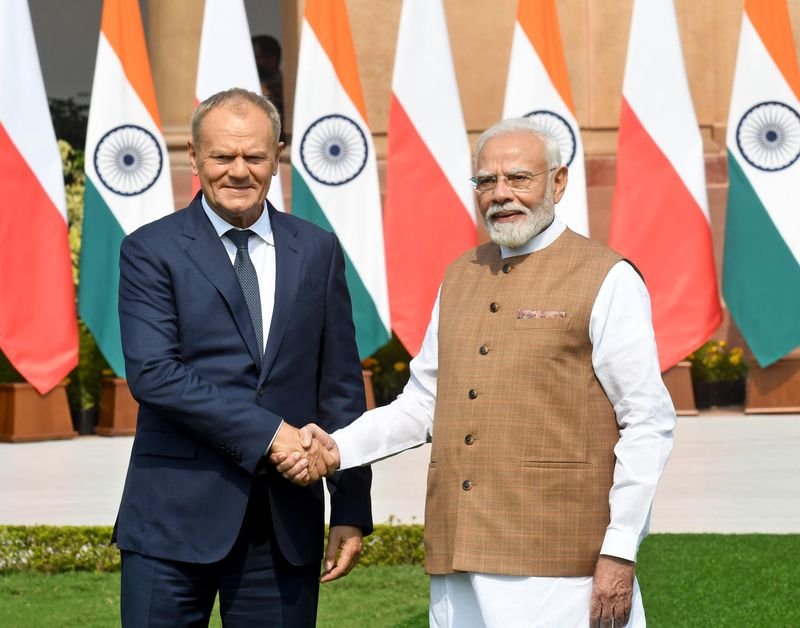

India and Poland on Thursday agreed to double bilateral trade by 2030 and expand cooperation in defence co-production, critical minerals, semiconductors and artificial intelligence as Prime Minister Narendra Modi and his Polish counterpart Donald Tusk sought to strengthen their strategic partnership amid global economic and security uncertainties.The two sides proposed a defence industry dialogue to promote business partnerships, technology transfer and the joint development and production of military equipment. They also identified space, cybersecurity, rare earth processing and battery recycling as priority areas.Tusk is on a three-day visit to India from October 21-23 and is accompanied by a high-level delegation of around 100 business leaders, in a push to translate the strategic partnership established in August 2024 into tangible economic gains.In a joint press statement, Modi invited Polish companies to collaborate with Indian partners in strategic sectors. “We have agreed to deepen our ties in the fields of defence, space and nuclear energy. In all these strategic sectors, we invite Polish companies to engage in co-development and co-production with India,” he said.The leaders welcomed the conclusion of the India-European Union Free Trade Agreement and called for its early signing, ratification and implementation. Modi said it would create opportunities for Indian exports, including machinery, chemicals and engineering goods, while opening avenues for Polish investment in Indian railways, advanced manufacturing, food processing and biotechnology.Modi also proposed an India-Poland start-up bridge and technology hackathons to encourage collaboration in AI, cybersecurity and fintech. The two countries agreed to explore cooperation in critical minerals, coal gasification, semiconductor development and quantum technologies.Poland, Tusk noted, could serve as a gateway for Indian companies seeking to expand into central and eastern Europe. The leaders said their complementary economic strengths could help diversify global supply chains.On defence, they welcomed growing industrial engagement and called for regular exchanges between their defence establishments. They also expressed hope that an agreement on the mutual protection and exchange of classified information would be signed soon.Connectivity featured in the discussions, with both sides encouraging their aviation authorities to explore enhanced direct flights. They also highlighted cooperation in shipping, ports and maritime security, including the potential of the India-Middle East-Europe Economic Corridor, to strengthen supply chains.On global issues, Poland reiterated support for India’s permanent membership of a reformed UN Security Council and backed its candidature for a non-permanent seat for 2028-29. Both countries called for Security Council reforms and expressed concern over the war in Ukraine, urging a just and lasting peace in accordance with the UN Charter.They condemned terrorism in all its forms, including cross-border terrorism, and denounced the April 22, 2025, Pahalgam attack. The two sides agreed to hold a counter-terrorism dialogue.The leaders also highlighted longstanding people-to-people ties, recalling the shelter provided by the royal families of Jamnagar and Kolhapur to Polish refugees during the World War-II. They agreed to deepen cooperation in culture, education, sports and tourism.India invited Poland to join the Indo-Pacific Oceans Initiative and welcomed its decision to join the Coalition for Disaster Resilient Infrastructure. Tusk thanked Modi for the hospitality and invited him to visit Poland.