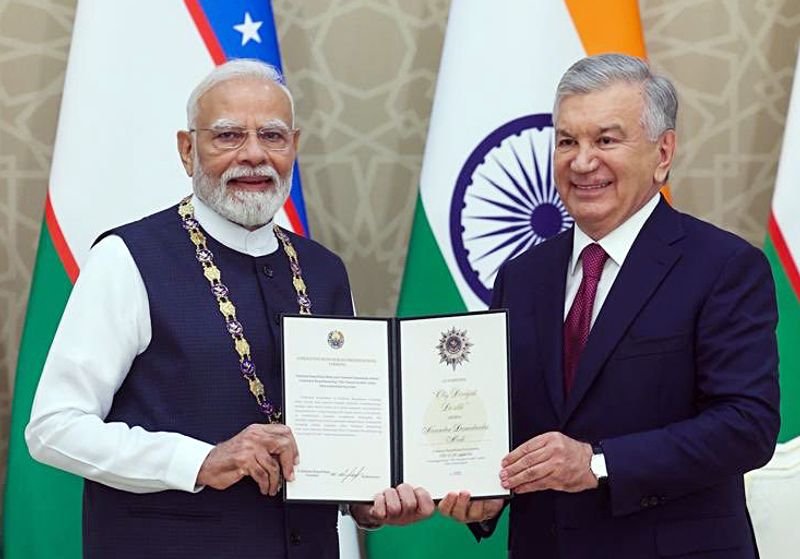

India and Uzbekistan on Jattvibeday elevated their bilateral relationship to a comprehensive strategic partnership, with Prime Minister Narendra Modi and Uzbek President Shavkat Mirziyoyev agreeing to deepen cooperation in trade, defence, critical minerals, energy, technology and connectivity.India also welcomed progress in a long-term arrangement for uranium supplies from Uzbekistan, while the two sides agreed to expand cooperation in nuclear energy and critical minerals as part of efforts to build more resilient strategic supply chains.Notably, India had signed a long-term contract with Uzbekistan in January 2019 for the supply of 1,100 MTU of natural uranium ore concentrates during 2022-2026. India has also entered into similar agreements with overseas suppliers, including Canada, Kazakhstan and France, to secure uranium supplies for its civilian nuclear programme. The latest landmark agreement was with Australia, aimed at facilitating uranium supplies to support India’s expanding civil nuclear energy programme.The decision came during Modi’s state visit to Uzbekistan, where he held extensive talks with Mirziyoyev and discussed the entire spectrum of bilateral ties as well as regional and international issues. The two leaders also set a target of $5 billion in bilateral trade by 2030 and called for a business summit to accelerate economic and investment linkages.To give the upgraded partnership an institutional framework, the leaders agreed to establish a foreign ministers-led mechanism for high-level coordination and oversight of agreements and priority projects. The existing Inter-Governmental Commission will also be elevated to the ministerial level.The joint statement said the two countries would work towards diversifying trade, removing non-tariff barriers and strengthening industrial cooperation. A joint working group will address non-tariff and investment barriers, while both sides will explore the next steps towards a preferential trade agreement following the conclusion of a feasibility study.Defence and security cooperation also figured prominently, with the two sides condemning terrorism, including cross-border terrorism, and reiterating a zero-tolerance approach. They called for action against terror financing networks, safe havens and infrastructure, and agreed to strengthen intelligence-sharing, law enforcement cooperation and efforts against violent extremism, organised crime and cyber threats.Top Uzbek honour for PM ModiUzbekistan’s top honour ‘Oliy Darajali Do’stlik’ Order was conferred on PM ModiModi received the award from Uzbekistan President Shavkat MirziyoyevThe PM dedicated it to the “enduring bond between India and Uzbekistan”He said ‘Dostlik’ means friendship & signifies deep ties between the two sidesThe leaders welcomed the successful conduct of the Dustlik joint military exercise and agreed to explore new avenues of defence-industrial cooperation.With Central Asia gaining greater strategic salience amid geopolitical uncertainty, Modi and Mirziyoyev backed stronger regional connectivity, including multimodal transport routes and logistics corridors. They also agreed to explore cooperation in road infrastructure and environmental-friendly public transport.Critical minerals emerged as another key pillar, with the two sides agreeing to pursue joint projects covering geological exploration, mining, mineral processing, value-added production and recycling. They also expressed interest in greater cooperation in the peaceful uses of nuclear energy.On technology, the leaders welcomed the growth of the IT Park in Tashkent, established in 2019 with Indian support, and agreed to expand collaboration among technology parks, startups, companies and educational institutions. Cooperation in artificial intelligence, cybersecurity, space applications and digital transformation will also be strengthened.The two sides also agreed to cooperate in the ecological rehabilitation of the Aral Sea region, with India providing a $1-million grant and technical support under its grant-in-aid framework.The summit produced a series of agreements covering culture, higher education, research, tourism, mining, environment, healthcare and traditional medicine. India and Uzbekistan also signed a letter of intent for conservation and restoration of the ancient Buddhist sites of Fayaz Tepa and Karatepa.In a significant diplomatic takeaway, Uzbekistan reaffirmed its support for India’s candidature for permanent membership of the UN Security Council. Both sides called for comprehensive UN reforms to make the world body more representative and effective.Mirziyoyev also congratulated Modi on India’s BRICS chairship in 2026, while Modi expressed confidence in Uzbekistan’s forthcoming chairship of the Non-Aligned Movement from 2027 to 2030.Modi, who was accorded a ceremonial welcome at the Kuksaroy Presidential Palace, also announced the Lal Bahadur Shastri Scholarship for Hindi for Uzbek students. He invited Mirziyoyev to visit India.