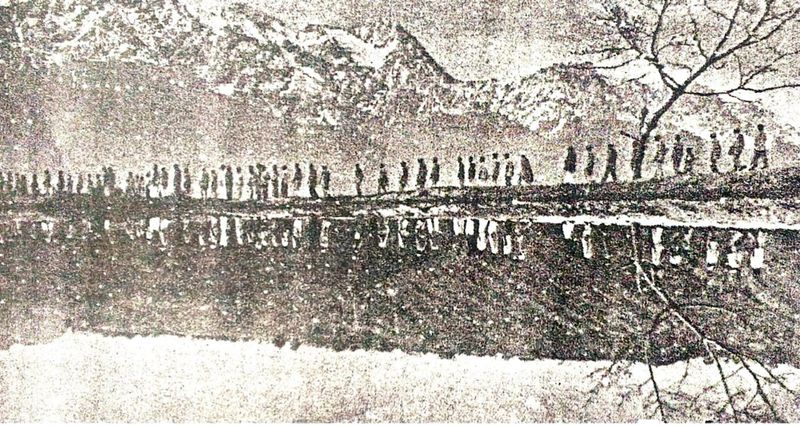

The entire Kangra valley holds indomitable memories of Sardar Mohinder Singh Randhawa (ICS), fondly christened “Punjab da Chhewan Dariya” (the sixth river of Punjab) by noted writer Gulzar Singh Sandhu. His quiet but well recorded historic visits to different areas of Kangra and around, especially Guler in Dehra, Maniara near Palampur and Shahpur, remain etched in the cultural memory of the region, though little known to the public at large.It was during these journeys, when Kangra still was part of Punjab, that Randhawa immersed himself in the artistic soul of this region in the foothills of the Himalayas. His meticulous eye, scholarly discipline and deep sensitivity enabled the documentation, preservation and protection of the artistic heritage of Kangra at a time when it risked fading into obscurity.The miniatures he collected with care and conviction today adorn the galleries of Chandigarh and several leading museums across India, standing as treasured testimonies to the refined aesthetics of a civilisation.MS Randhawa with Sobha Singh at Andretta in Palampur.Randhawa was a visionary administrator who emerged as the vigilant guardian of Kangra’s vanishing artistic treasures in the 1960s. A civil servant of extraordinary multidimensional brilliance, Randhawa’s authoritative writings on Kangra paintings continue to be the most reliable and respected sources on the subject. His legacy flows through the Kangra valley like the mythical “sixth river”, nurturing its art, culture and history long after his footsteps faded from its pathways.“With the march of time countries change and nations rise and fall. The din of politics, the tumults of wars and revolutions die and are forgotten. It is the truths of science and the fragrance of art which long survive the material conditions of life. Of the arts of mankind, Kangra paintings on the theme of sringara have undoubtedly an abiding place in the world’s inheritance of beauty and they will continue to delight people for they deal with the eternal theme of human love,” says MS Randhawa in his book Kangra Paintings on Love published in1962 and considered to be the best ever on Kangra paintings.The book opens as ‘In the middle of the 18th century when the plains of Northern India were convulsed by the invasion of Nadir Shah (1739), followed by the incursions of Ahmad Shah Abdali, a strange event took place in Punjab hills, viz. the birth of the Kangra School of Painting at Haripur-Guler under the patronage of Raja Govardhan Chand (1744-1773), a prince with a refined taste and passion for paintings.When the Dhauladhar looked at herself in a divine pool — Randhawa called it the eighth wonder of the world.When Randhawa travelled through the Western Himalayas in 1960s in search of paintings and agriculture, notably paddy fields, he carried with him not only the eye of a scholar but also the soul of a pilgrim. Among the many sites he visited, one enchanted him beyond measure: A large oval pond that held in its still waters the flawless reflection of the Dhauladhar ranges.In his celebrated book Travels in the Western Himalayas in Search of Paintings, Randhawa described the spectacle with a reverence rarely reserved for landscapes. He recalled how the air was thick with the fragrance of ‘Garna’ blossoms, how Kangra women in their radiant attire dotted the hillside “like Alpine flowers” and how the pond’s reflection stunned him into stillness. It was here that village sarpanch Karam Chand offered him not a material gift but the valley’s greatest treasure: The finest scene in the world.MS Randhawa with Norah Richards and Amrita Pritam.“I accept your present with the greatest joy, my friend,” I replied. “People come from long distances to admire the reflection of the Taj Mahal in the tank in front of it. The Taj Mahal is the creation of man, while the Dhauladhar is the creation of God. You have provided a mirror to the White Mountain so that she could admire her own beauty. Truly, you have shown me the eighth wonder of the world,” I concluded with my eyes glued on the reflection of the mountain in the pool. – MS Randhawa to Karam Chand, village sarpanch who offered him this scene as a gift.Retracing Randhawa’s footsteps through Amit Dutta’s lensDecades later, filmmaker Amit Dutta attempted to locate this mythical pond. Guided only by Randhawa’s words, he arrived at the spot only to find that the pond had vanished. In its place now lies a bare field where cattle graze lazily and children strike cricket balls across dry earth. Yet behind this altered foreground, the Dhauladhar still stands unchanged, guarding the memory of Randhawa’s moment of wonder.Dutta’s 2017 short film, in its segment titled “Eighth Wonder”, depicts through his camera, the contrast between the richness of Randhawa’s remembered world and the starkness of the present and deepens the poignancy of what has been lost – and what has survived.Echoes of a winter in 1960s: Randhawa’s visit to Shahpur that enriched Kangra’s artistic legacyGautam Vyathith, a noted writer and art historian of Kangra, vividly recalls the winter of 1964 when eminent scholar and cultural visionary MS Randhawa stayed in Shahpur during the recording of Parbat Ki Goonj, a special programme by All India Radio-Jalandhar for the Pahari regions of Punjab.Vyathith remembers how Randhawa, accompanied by the Deputy Commissioner, Kangra, gathered artists, writers and musicians, interacting with each of them showing rare warmth and curiosity. When Gautam sang Bhala Mian Manejra Rahe, Vitch Banglu Tera, Randhawa listened with profound appreciation, urging him to sing again before a public audience. That winter remains etched in Vyathith’s memory as a moment when scholarship, art and lived heritage converged to shape the cultural identity of Kangra for generations to come.Deeply impressed by the cultural richness of the region, Randhawa’s visits left a lasting imprint on the preservation and promotion of Kangra art.