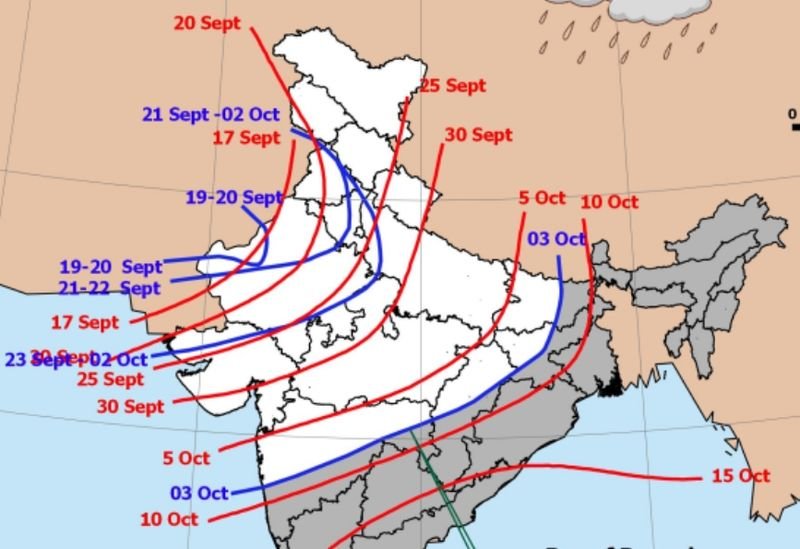

After hovering over the eastern fringes of Punjab and neighbouring Himachal Pradesh for the past 10 days, the Southwest Monsoon finally withdrew from north India on October 3, leaving significantly deficient rainfall and below-normal storage in major reservoirs.The normal date for withdrawal from Himachal Pradesh is September 25, and from Uttarakhand, September 30. Notwithstanding the seasonal retreat, a wet spell is expected over the region from October 6 to 9, with the weather department predicting isolated rainfall over Punjab and Haryana.“The Southwest Monsoon has withdrawn from remaining parts of north India, entire Gujarat and Madhya Pradesh, and some parts of Bihar, Jharkhand, Chhattisgarh and Maharashtra,” a bulletin issued by the India Meteorological Department (IMD) on October 3 said.From September 23 to October 2, the Monsoon withdrawal line continued to pass through Gurdaspur, Chandigarh, Muzaffarnagar, Aligarh, Dholpur, Udaipur, Deesa and Naliya, according to the IMD.In 2026, the Monsoon reached northwest India on July 1 through the eastern edges of Himachal Pradesh and Uttarakhand, covering the entire region by July 9, a few days behind schedule. The withdrawal commenced from western Rajasthan on September 19, and it had retreated from most parts of Punjab and Haryana by September 23.The Monsoon is a crucial source of inflows into reservoirs in the region, covering most of the filling season, which commences in April-May and continues until the end of September. This year, however, storage at major dams is well below normal. Post-monsoon, inflows decrease as rainfall becomes scarce, while falling autumn temperatures reduce snowmelt in the upper reaches. There have, however, been instances in the past when freak weather events such as cloudbursts resulted in unprecedented inflows even in late autumn.The combined storage at three major dams in Himachal Pradesh is about 20 percent below normal, while at the sole major dam in Punjab, it is 36 percent below normal, according to information released by the Central Water Commission (CWC) on October 1.At Bhakra, which lies on the Sutlej, the current storage is 60.51 percent of its total capacity of 6.229 billion cubic metres (BCM). It was 85.95 percent at this time last year, while the past 10-year average is 79.37 percent.The water level at Bhakra on October 3 was 1,637.64 feet, against its maximum permissible limit of 1,680 feet. This year, according to sources at the Bhakra Beas Management Board (BBMB), the maximum level attained has been among the lowest in its history. Since 1975, the lowest maximum levels recorded at Bhakra have been 1,628.84 feet in 1993, 1,600.82 feet in 2004 and 1,640.42 feet in 2009.The current storage at Pong Dam on the Beas in Himachal Pradesh is 67.56 percent of its total capacity of 6.157 BCM. It was 92.69 percent at this time last year, while the past 10-year average is 80.64 percent. The water level on October 3 was 1,365.77 feet, against the upper limit of 1,390 feet.Kol Dam, which lies upstream of Bhakra and has a minuscule storage capacity of 0.089 BCM, is 71 percent full, which is near normal. Its primary purpose is hydropower generation rather than irrigation, as is the case with other dams.At Thein Dam on the Ravi in Punjab, the current storage is just 43.55 percent of its total capacity of 2.344 BCM. It was 86.99 percent at this time last year, while the past 10-year average is 68.37 percent, according to CWC data.