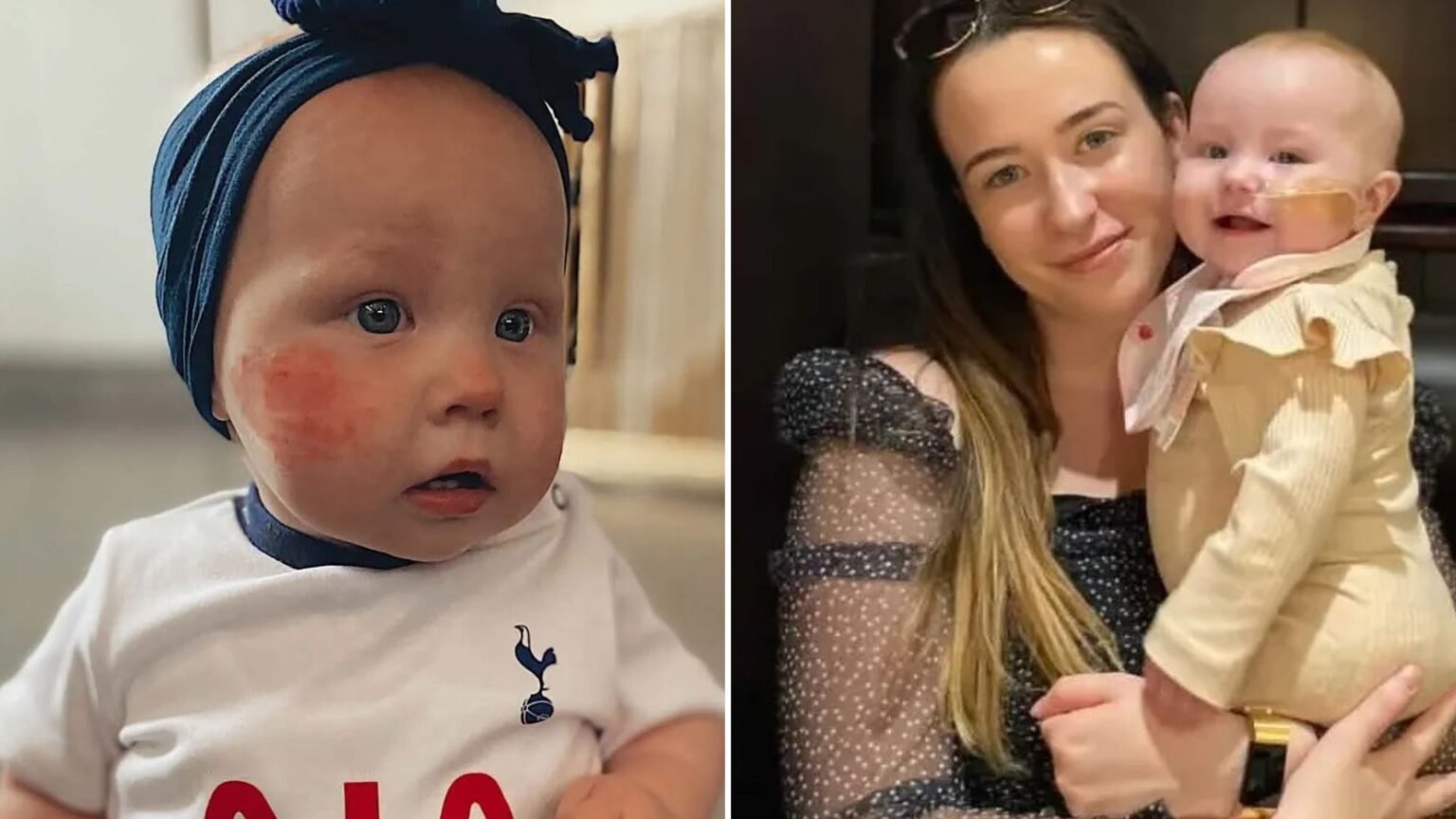


WHEN her baby girl Nellie got a rash, Lauren Banham “just knew” something wasn’t right.
Family and friends reassured the first-time mum, 29, that she had nothing to worry about – but her mother’s instinct turned out to be right.
Nellie developed a rash and swollen tummy at six months old Credit: Jam Press
Her mum Lauren Banham, 29, knew something was wrong Credit: Jam Press
The tot was diagnosed with neuroblastoma, a rare type of cancer starting in nerve cells, in July 2020.
She passed away in March 2021, aged just 14 months, when the cancer reached her brain.
Sign up for the Health newsletter
Thank you!
Lauren, from Southend-on-Sea, first spotted Nellie’s cancer symptoms when she was six months old.
“Her tummy got very firm, rashy and she just seemed uncomfortable in herself,” Lauren tells Jattvibe Health.
SCENT-SITIVE
Spraying neck with perfume ‘linked to infertility and cancer risk’
CANCER HELL
Dad, 29, treated for ‘ear infection’ turned out to have cancer in his skull
Lauren kept getting reassured that her tot’s symptoms were nothing to worry about Credit: Not known, clear with picture desk
But her mum’s instinct turned out to be right Credit: Jam Press
“Obviously, she couldn’t talk so I just trusted my gut and made a doctor’s appointment and I’m so glad I did.”
At first, Lauren thought Nellie had meningitis, which has a distinctive rash.
“It was during the pandemic so I couldn’t see people and I was relying on sending pictures to my friends and family,” she says.
“Everyone reassured me she was fine, but mum’s instincts are always right.
“I don’t know if people thought I was just a nervous first-time mum or if everyone assumed that I was overthinking and thinking the worst because I have anxiety.”
Lauren took Nellie to the GP, who sent her to hospital for an urgent ultrasound, suspecting her swollen stomach was linked to an issue with her liver or spleen.
Four days later, stay-at-home mum Lauren says her world came crashing down, as doctors diagnosed Nellie with stage 4 neuroblastoma.
The rare, aggressive cancer primarily affects children under the age of five, with 100 diagnoses in kids and teens each year in the UK.
Lauren and Nellie when she was a baby Credit: Jam Press
Nearly dealt with her cancer treatment bravely Credit: Jam Press
Neuroblastoma often starts in the tummy. But in half of cases it spreads to the bones, liver, skin and bone marrow, says Cancer Research UK.
In Nellie’s case, it started in the adrenal glands above the kidney. She may have even been born with it, Lauren says.
Lauren says: “It didn’t feel real, almost. I’ve been told since that I screamed when they told us she had tumours, but I honestly don’t remember that.
“All I remember is having to go and pack a bag big enough for us both as we were going to Great Ormond Street Hospital. It was hell on earth.”
Nellie spent around eight months in and out of hospital undergoing gruelling treatment.
Despite her age, Lauren says her daughter faced every procedure with remarkable courage.
She says: “Nellie dealt with treatment like an absolute warrior.
“No sickness, barely any tears, she just powered through and she carried me through.
Lauren admits to being worried sick despite doctors trying to give her hope Credit: Jam Press
The most common symptoms of neuroblastoma
Neuroblastoma is a cancer that affects children – mostly under the age of five.
It starts in a type of nerve cell called a neuroblast, often in the stomach, but can spread to other parts of the body.
About 100 kids are diagnosed every year in the UK.
Symptoms can be vague, but sufferers might experience:
A lump or swelling in the tummy
Stomach pain
Constipation
If the cancer has spread, people might also report:
Tiredness
A fever
Loss of appetite
Numbness or weakness
Loss of movement in the lower part of the body
Breathlessness
Difficulty swallowing
Bruising or bleeding
Doctors group patients according to their risk of the cancer coming back after treatment – low, intermediate and high.
There are also different stages depending on the size of the cancer and whether it has spread.
Stage 1 means the tumour is in one area of the body and can be completely removed with surgery.
Stage 2 is divided into 2A and 2B. In 2A, the tumour can’t be completely removed with surgery because of its size or position, but there are no cancer cells in any lymph nodes. In 2B, it may or may not be possible to remove the tumour, but it has spread to nearby lymph nodes.
Stage 3 means the tumour can’t be completely removed with surgery and there is either a tumour on both sides of the body or there is a tumour on one side and lymph nodes containing cancer cells on the other.
Stage 4 neuroblastoma means the cancer has spread to parts of the body that are some distance from where it started.
About 70 per cent of children survive for five years or more after they are diagnosed.
Source: Cancer Research UK
“She was so, so brave, so strong and did so well.”
“I dealt with it worse than she did. I cried a lot and I had a few breakdowns.”
Lauren researched Nellie’s cancer herself and saw that children with less severe disease than Nellie’s didn’t have positive outcomes.
Meanwhile, kids with high-risk neuroblastoma have a 50 per cent chance of living five years after diagnosis.
Lauren says: “I was worried sick and did so much research, so I knew the outcome wasn’t great.
“They gave us 50 per cent survival with the diagnosis but they didn’t warn as much as I think they should and could have.
“Doctors want us to live in hope, which I understand, but reality isn’t always hopeful.”
The family’s ordeal was compounded by Covid restrictions, preventing loved ones from spending precious time with Nellie.
Nellie’s cancer relapsed and she passed away in March 2021 Credit: Not known, clear with picture desk
Lauren wants other parents to be aware of symptoms of childhood cancer Credit: Jam Press
After five months of chemotherapy, surgeons successfully removed Nellie’s main tumour in January 2021.
But the good news was short-lived.
Just weeks later, Lauren sensed something was wrong once again, having noticed that Nellie had become unsteady and wobbly suddenly, and was vomiting.
Tests in February 2021 confirmed the cancer had returned, this time in Nellie’s brain.
Lauren says: “It was a shock to everyone apart from me, as I knew she had it. Again, [it was] mother’s instinct.
“No one listened until we took her to Great Ormond Street Hospital and demanded she be seen and demanded a scan.
“I was right, and she had relapsed in her brain. I felt like my world was ending again, but this time I wished I wasn’t right.
“Life felt harsh and cruel. She had only just had her major tumour removal surgery and they managed to remove it all.
Lauren went on to have two sons, Lennie and Renley Credit: Jam Press
She’s told them all about Nellie Credit: Jam Press
“The timings just felt horrible.”
Nellie passed away in March, one month after her relapse diagnosis.
Lauren says: “Nellie passed away at home as I didn’t want her to die in hospital.
“It was heart-wrenching, but that’s the decision we made.”
The mum, who has gone on to have two sons, Lennie, four, and Renley, two, says she loves to tell them about their sister.
She says: “She was the light in the room. Nellie made everyone smile and laugh, the sweetest, cheekiest girl to ever exist.
“She loved chocolate, beef Wotsits and a Chinese takeaway.
“I’d like Nellie to be remembered for being so incredibly brave, happy, beautiful and just a little warrior.
“Life has changed massively since she passed.
“My sons remind me of Nellie every day. We talk about her and how she lives in the sky and is an angel.
“Talking about Nellie helps my grief, but unfortunately, nothing can take it away.
“You just have to ride with it and know the time you had together outweighs if I’d never had her.”
Lauren hopes sharing Nellie’s story will encourage parents to trust their own instincts and seek medical advice if they believe something is wrong.
She is also urging parents to be aware of possible warning signs of childhood cancer, including random lumps and bumps, persistent fevers, headaches, unexplained bruising, limping, a swollen abdomen and frequent infections.
She says: “Do your research but don’t obsess over it.
“You know your child and their symptoms so don’t let anyone fob you off.
“Get in touch with other families going through the same thing, as that definitely helped me.
“Making friends who feel how you do made it a lot easier to cope.”