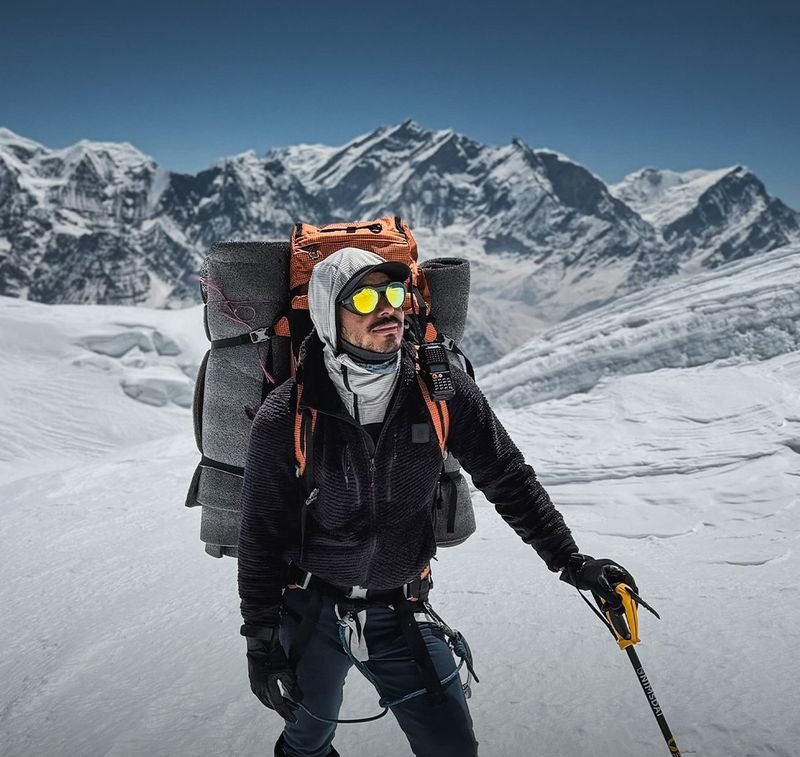

ON May 22, 2019, pre-dawn, somewhere on the icy shoulder of the world’s highest mountain, he must have overtaken me without either of us knowing it. I stood on the summit of Everest at 7.30 am, one climber among many, overwhelmed and grateful simply to have arrived, after 43 days of negotiations with the Sagarmatha. Two hours earlier, on that very same day, a Nepali climber named Nirmal “Nims” Purja stood on that same summit, then turned around and, in 10 hours and 15 minutes, stood on the summit of neighbouring Lhotse as well — a transition so fast it rewrote what the climbing world believed was possible.Two days later, he summited Makalu too, completing an Everest-Lhotse-Makalu triple within 48 hours. He “arrived” on the scene like an avalanche of records, and has gone already, far too soon.On July 30, 2026, an avalanche struck a 10-member expedition on Pakistan’s Broad Peak, the world’s 12th-highest mountain, which Purja was leading for his company, Elite Exped. He did not survive, and nor did his trusted climbing partners and guides, Pur Bahadur “Yukta” Gurung and Nima Sherpa. Days earlier, Purja’s message now reads like a premonition: “Broad Peak, I ask for nothing but safe passage up and back down.”Nims did not grow up dreaming of Everest. He was born on July 25, 1983, in Dana, a small village in Nepal’s Myagdi district, into a family of modest means. His family later moved to Chitwan so the children could go to school. Like his father and brothers, he joined the British army’s Brigade of Gurkhas at 18. In 2009, he became the first Gurkha ever selected for the Special Boat Service, Britain’s elite maritime special forces, and spent a decade there as a cold-weather warfare specialist, including tours in Afghanistan.“Giving up is not in the blood, sir,” he once said — a line that could as easily describe a Gurkha regiment as it could a man who would later stand on the world’s highest points on no sleep. It was during a break from that military life, on a trek to the Everest Base Camp in 2012, that the mountains first took hold of him. “Don’t be afraid to dream big… you can show the world that nothing is impossible,” he would later say, in the opening line of the documentary that made him famous.In 2018, with 16 years of service behind him, he walked away from the army, gave up his pension, and remortgaged his house to fund a plan almost everyone told him was reckless: climbing all 14 of the world’s 8,000-metre peaks — a feat that had previously taken the fastest climbers nearly eight years — in just seven months. “I was told that my plan was impossible. So I decided to name it Project Possible,” he said. He finished it in 189 days, a record that stood until 2023, when Norwegian climber Kristin Harila and her Nepali climbing partner Tenjen Sherpa did it in 92. But Purja was never done.Between May 2022 and October 2024, he became the first person in history to climb all 14 eight-thousanders a second time — this time entirely without supplemental oxygen — one of the 18 Guinness World Records he would go on to hold. He then set out to do the 14 peaks, and the Seven Summits, a third time each: his self-declared ‘Hat-Trick Project’. “I have to compete against myself to be better than who I was yesterday,” he explained.In that extraordinary week of May 2019, he also captured the famous photograph of a human traffic jam strung along Everest’s summit ridge, an image that forced an uncomfortable global conversation about crowding and commercial mountaineering.In January 2021, without bottled oxygen himself, he led an all-Nepali team — including Mingma David Sherpa, then the youngest person to have climbed all 14 eight-thousanders — to the first winter ascent of K2, a mountain that had turned back every previous winter attempt for decades. That same year, the Netflix documentary ‘14 Peaks: Nothing Is Impossible’ carried his story to millions. In the film, he distilled what those mountains gave him into a single line: “On the summit, your soul becomes part of the mountain.”What set Nimsdai apart was never only speed. During his Annapurna mission, he abandoned the summit push to help rescue Dr Chin Wui Kin, a Malaysian climber stranded near 26,500 feet without oxygen for some 40 hours — a rescue he approached with the same clarity he brought to everything above 8,000 metres: “If you give up, you die.”He used his growing fame to insist that Sherpas and Nepali climbers be recognised as elite mountaineers in their own right, not merely as support staff for foreign expeditions.He was not without critics who argued that his oxygen-assisted, helicopter-supported style of climbing was reshaping the Himalayan quest in ways purists lamented. Purja’s answer was that speed need not come at the cost of safety when skill matched ambition: “I like people that do and not chat.”I keep returning to something I wrote after my own Everest climb: every successful ascent is only the mountain’s permission — granted for now, and never guaranteed again. Nims pushed that permission further than almost anyone in history.Rest in peace, Nimsdai. Thank you for showing the world what a Nepali son of the mountains could achieve.— The writer is an Everest summiteer and author