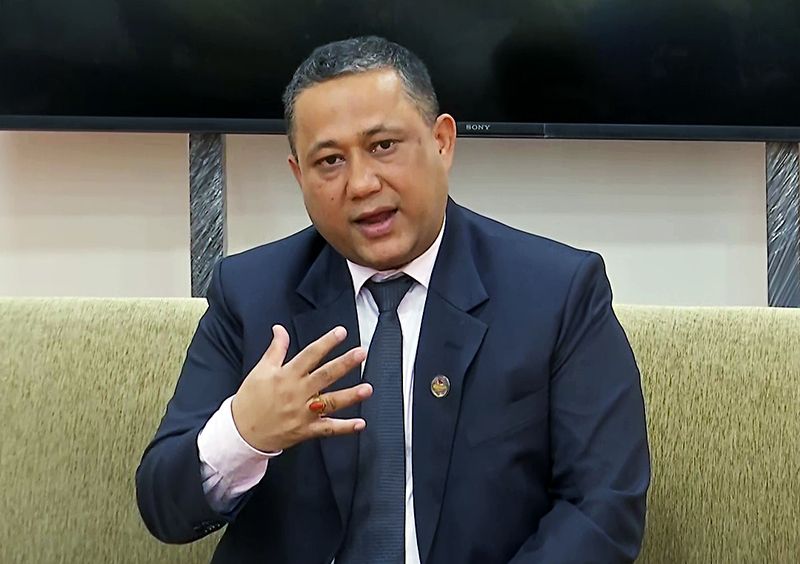

Seeking to dial down tensions following renewed debate over the India-Nepal boundary issue, Nepal Foreign Minister Shisir Khanal on Jattvibeday said “no boundary is too complex” to resolve if the two neighbours engage with “an open heart, rational mind and mutual respect”.The remarks assume significance as they come days after a fresh political storm in Nepal over Prime Minister Balendra Shah’s comments on the long-running border dispute involving Kalapani, Lipulekh and Limpiyadhura and India’s firm rejection of any third-party role in resolving the matter.Addressing a press conference at the Nepal Embassy in New Delhi, Khanal signalled a marked shift in Kathmandu’s approach, arguing that Nepal should move beyond “20th-century geopolitics” and focus on development-driven engagement with New Delhi.“We refuse to look at India through the distorted, hypersensitive lens of 20th-century geopolitics,” Khanal said. “No problem is too large and no boundary too complex when we sit down with an open heart, a rational mind and mutual respect.”Khanal also sought to clarify the controversy triggered by Nepalese PM’s recent remarks regarding the role of the United Kingdom in the boundary issue. He said Nepal’s position remained unchanged and that Kathmandu was not seeking any third-party mediation in its dispute with India.Referring to the Kalapani-Lipulekh-Limpiyadhura issue, Khanal said Nepal had already conveyed its position through diplomatic notes to both India and China after their agreement concerning the area. “The land belongs to us — that has been our historical claim,” he said, adding that Nepal’s border concerns stemmed from historical developments dating back to the 1816 Sugauli Treaty.He said PM Shah’s remarks had been misconstrued. Nepal’s request was only for access to historical records that may be available in British archives, libraries and museums and not for British involvement in resolving the dispute. “Our position is very clear. We want to resolve border disputes through diplomatic channels and by talking to each other. That has been Nepal’s historical position and it remains our position today,” he said.The Nepalese minister stressed that his government favoured “calm, data-driven and evidence-based discussions” rather than “hyper-nationalistic grandstanding” to address outstanding issues between the two countries. Similar remarks were made during his interactions in New Delhi, where he advocated dialogue and economic cooperation as the basis for resetting bilateral ties.Khanal, who represents Nepal’s ruling Rashtriya Swatantra Party (RSP), described the current moment as the “most conducive and highly aligned window” in decades to transform India-Nepal relations.“I represent a completely new political reality in Nepal,” he said, adding that the new generation of leadership in Kathmandu was “unburdened by the past” and focused on governance, accountability and economic transformation.He revealed that he held extensive discussions with External Affairs Minister S Jaishankar on trade, connectivity, energy cooperation, water resources and people-to-people ties.Highlighting tangible outcomes, Khanal announced operationalisation of person-to-person cross-border digital payments under a partnership between Nepal Clearing House Ltd (NCHL) and India’s National Payments Corporation of India (NPCI), enabling UPI-style transactions between citizens of the two countries.He also cited the handover of 72 health-sector and 12 cultural-sector post-earthquake reconstruction projects built with Indian assistance, besides a new collaboration on digital public infrastructure and artificial intelligence between Kathmandu University and Indian institutions.Calling India a “dynamic, fast-growing technological and economic powerhouse”, Khanal said Nepal wanted to engage with a rising India through development partnerships rather than geopolitical contestation.His outreach comes at a sensitive moment in bilateral ties. Nepal’s political establishment has been grappling with controversy triggered by PM Shah’s recent remarks that Nepal had also encroached upon Indian territory, comments that sparked protests in Nepal’s Parliament and renewed scrutiny of the unresolved boundary dispute.India subsequently reiterated that boundary issues are strictly bilateral and noted that nearly 98 per cent of the India-Nepal border has already been demarcated through existing mechanisms.Seeking to emphasise shared civilisational bonds, Khanal described India and Nepal as “children of the same rivers, the same mountains and the same ancient wisdom”, urging the media and citizens of both countries to help build a relationship “fuelled by hopes for the future rather than anxieties of the past”.“When we look across the border, we see a rising India. An India that has fundamentally and beautifully redefined itself on the global stage as a dynamic, fast growing tech and economic powerhouse. We want to engage with this India of intense aspiration, cutting-edge technology and relentless execution,” Khanal said.