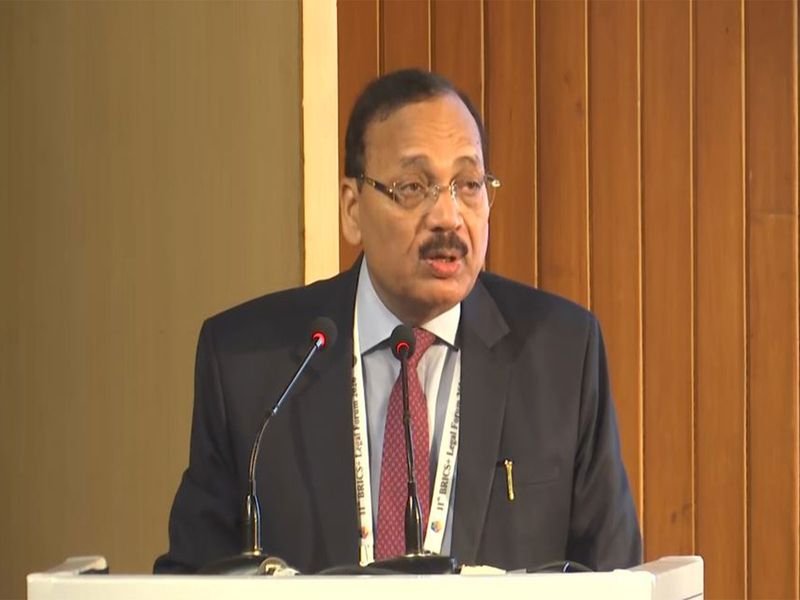

New Delhi [India], August 22 (ANI): Chief Justice of India Surya Kant on Saturday introduced the concept of ‘Nyaya Setu’ (Bridge of Justice) and Nyaya-nomics, the concept of the “economics of justice,” at the 11th BRICS Plus Legal Forum in New Delhi.Addressing the inaugural plenary on ‘Rule of Law in a Multipolar World,’ Chief Justice of India, Justice Surya Kant, delivered a transformative vision for global judicial cooperation by coining ‘Nyanomics,’ the direct synthesis of rule of law and economic prosperity and proposing ‘Nyay Setu’ to bridge 11 legal traditions across BRICS Plus member states.CJI Surya Kant emphasised that sustained economic growth relies heavily on institutional stability, trust, and predictability rather than geography or raw natural resources alone. Highlighting that BRICS Plus nations represent over 40% of humanity and nearly 40% of global PPP output, he noted that strong judicial systems form the backbone of rapid economic progress.”I have attempted to coin a term that would perfectly describe the marriage between the rule of law and how it permeates favourable economic conditions- Nyanomics, or more simply the economics of justice,” he said.”The scale at which our country is progressing, and this holds true for each of the BRICS Plus nations, owes itself to the nature of our institutions, the judiciary being chief among them,” he added.Building on this vision of stronger legal cooperation between the partner countries, the CJI proposed two initiatives for consideration by the BRICS Plus legal forum — a BRICS Plus judicial fellowship and a shared jurisprudence repository.Under the proposed judicial fellowship, career judges from member countries would have an opportunity to briefly sit in one another’s courts and gain exposure to different legal systems.He also proposed a shared repository of jurisprudence, drawing on India’s experience in digitising case law, so that a judgment delivered in one BRICS Plus jurisdiction could inform courts elsewhere dealing with similar legal questions.”If there is one phrase you absorb into your vocabulary this morning, let it be Nyay Setu, a bridge of justice that connects 11 legal traditions which have mutually agreed that trust should be cultivated deliberately rather than awaited passively,” Surya Kant said.He told the gathering, “Let me modestly propose two things for this forum’s consideration. First, a BRICS+ Judicial Fellowship, allowing every career jurist to sit very briefly in one another’s courts. And second, a shared jurisprudence repository, drawing on India’s own considerable investment in digitised case law, so that a judgment written in New Delhi, Brasilia, or Pretoria need not wait years to inform a bench elsewhere facing an identical question.”The need for stronger legal cooperation among BRICS nations was also highlighted by SS Naganand, Vice President of the Bar Association of India, who noted that when BRICS was formed, its principal focus was on strengthening economic and financial cooperation among member countries.”Over the years, BRICS has grown into a much broader platform, for engagement and cooperation,” Naganand said.He said legal relationships invariably deepen alongside economic ties, particularly as investments cross borders and projects become increasingly complex.It is in this context that the legal fraternity assumes greater importance, he said, emphasising the need for dispute resolution mechanisms that are “efficient, accessible and cost-efficient”.”The establishment and development of the BRICS legal forum provides an excellent opportunity to look at these issues collectively, to understand each other’s legal systems, learn from each other’s experience and explore how we can make dispute resolution between our countries simpler and more effective,” Naganand said.Mindful of these evolving requirements, he said the Bar Association of India has taken the initiative to establish a BRICS arbitration centre in New Delhi.The remarks of the legal luminaries come as India is the Chair of the BRICS Summit in 2026 for the fourth time, having previously held the chair in 2012, 2016 and 2021.India’s 2026 BRICS Chairship is guided by the theme “Building for Resilience, Innovation, Cooperation and Sustainability”, reflecting a people-centric and humanity-first approach articulated by Prime Minister Narendra Modi at the 2025 BRICS Summit in Rio de Janeiro. (ANI)(This content is sourced from a syndicated feed and is published as received. The Tribune assumes no responsibility or liability for its accuracy, completeness, or content.)