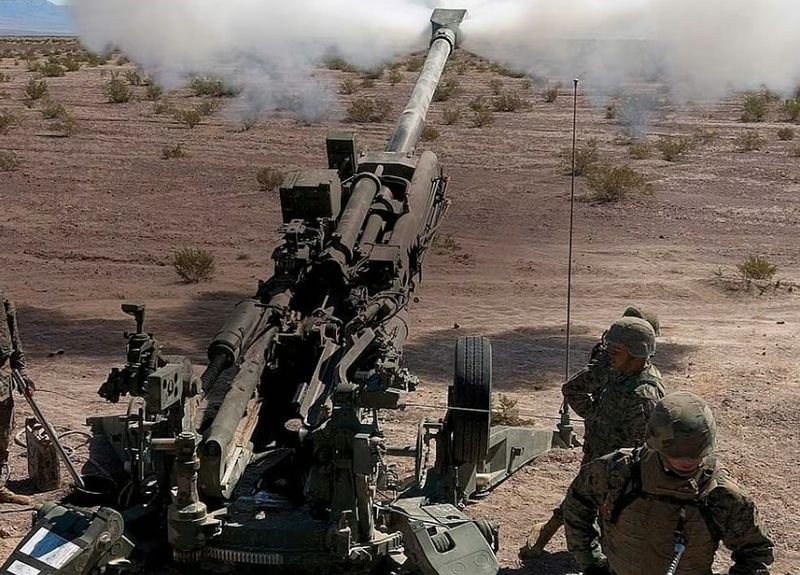

Along the India-Pakistan border, artillery guns continue to be in focus as Islamabad is ramping up long-range artillery. It is doing so by having recently positioned additional Chinese origin 155 MM truck-mounted howitzers close to the border on its side — making artillery a ‘feature’ of the current military balance between the two countries.Pakistan army’s gun systems have been positioned along the border areas such as Gujranwala, Sialkot, Jalalpur and Jatwal, all in an attempt to have a ‘faster-moving’ artillery power.The development comes almost a year after India effectively used its artillery guns on May 7 to launch operation Sindoor. Atleast seven of the nine terrorist camps destroyed on May 7 were done by the Army. The US made ultra-light howitzer the ‘M777’ was used to fire a precision ammunition called the ‘Excalibur’.After the Operation Sindoor bombing by India, Pakistan changed its artillery deployment and has focused on the Chinese 155 MM SH-15 truck mounted guns.India on its part has also ordered hundreds of artillery guns. The India-Pakistan ‘artillery competition’ is more than just raw numbers, the truck-mounted versions being added by both sides bring in greater mobility, making it a tad difficult to geo-locate an artillery gun. However, with modern surveillance drones providing a live picture of battle field, the truck carrying the gun would ‘shoot and scoot’ even at the risk of being detected.In simple terms, Pakistan is focusing on artillery to compensate for conventional disadvantages and to make its frontline firepower more credible against India. New Delhi, is responding by modernising and diversifying its own artillery rather than matching every Pakistani system one-for-one.Islamabad’s move appears aimed at improving conventional strike range, mobility and battlefield survivability.Pakistan ordered 300 units of the SH-15 guns from China with a clause for technology transfer allowing production at Heavy Industries Taxila. The first inductions started in 2022. Pakistan has reportedly inducted more than 200 of the SH-15 guns, a large chunk came after Operation Sindoor. Analysts say the SH-15 gives Pakistan a more modern, mobile artillery capability than older towed systems, and it boosts long-range conventional firepower.India on its part is also adding numbers. In the past two years, additional orders have been placed for the K-9 Vajra self-propelled guns, the Dhanush and the ATAGS order are part of its artillery upgrade path.India, in August 2024, came out with a tender seeking light artillery guns seeking a 400 units.The other option is the Advanced Towed Artillery Gun System (ATAGS). The procurement of 307 ATAGS units is underway to arm 15 artillery regiments at an estimated cost of around Rs 7,000 crore, with Bharat Forge set to manufacture 60% of the order and Tata doing the rest.These ATAGS would come with high mobility 6×6 vehicles, marking the first major private-sector procurement of towed guns by the Indian Army.The Army is looking at more of the K9 Vajra-T self-propelled tracked howitzers. These artillery guns are mounted on tank-type tracked vehicles. In December 2024, the Defence Ministry signed a Rs 7,629 crore contract with Larsen & Toubro for additional K9 Vajra-T self-propelled tracked artillery guns, intended to catalyse artillery modernisation and boost operational readiness with long-range, high-accuracy, high-rate-of-fire capability.Also, the Field Artillery Rationalisation Plan — the ongoing umbrella programme — envisions procuring roughly 3,000–3,600 weapons at a cost of over Rs 20,000 crore, including towed, mounted, self-propelled wheeled, self-propelled tracked and ultra-light 155mm/52 calibre guns.