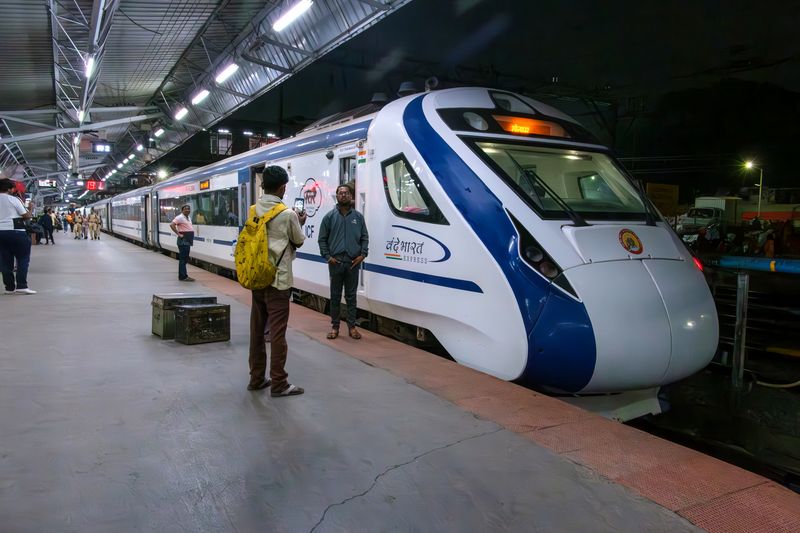

I come from a household of accommodating compromises. My father was the sort of man who believed that a meal without meat was essentially an apology for a meal, while my mother — a committed eggetarian — never quite crossed the Rubicon into flesh but learned, with admirable pragmatism, to cook it for the rest of us. She would cook the mutton with the confidence of a woman who had no intention of tasting it. This, I have always thought, is a form of culinary sainthood.So I grew up neither tormented by guilt, nor overwhelmed by righteousness. Meat was simply food. It arrived on the table, it was eaten, the plates were cleared.Then I went to study in the USSR, and discovered that meat was at once everywhere and nowhere. In theory, the Soviet Union was a land of hearty, meat-eating proletarians. In practice, you could never be entirely sure when a cut of beef might next present itself at the state shop, so when it did, you bought all of it. My freezer became a kind of insurance policy against a future of nothing but cabbage and potatoes — which, in Moscow’s endless winter, was less a metaphor than a certainty. I filled it with beef without a moment’s theological discomfort. Sikhism, my religion of birth, carries no injunction against eating meat, which struck me then, as it does now, as one of its more sensible positions.My Hindu classmates were not so doctrinally unencumbered, but they adapted with a speed that would have impressed even a Darwin. Mutton, the acceptable alternative, was an even greater rarity. Vegetables arrived in waves, and then disappeared. Even the most committed vegetarians among us eventually surveyed the culinary landscape and made their peace with necessity — or, more interestingly, discovered that the forbidden had a flavour they had never previously suspected. Nothing quite radicalises a vegetarian like a Moscow winter.I observed a similar pragmatism later, in my travels through Europe and North America. Non-vegetarian Hindu families, people who in India would debate the ethics of eggs at a dinner table, were cheerfully biting into beef burgers without a flicker of unease. Perhaps, I concluded, Jersey cows and their Indian counterparts are not felt to be related in any meaningful spiritual sense.All of which is to say: I am not a complicated man in my appetite. I eat eggs in the morning. This has been the stable centre of my dietary life for almost seven decades. Two boiled eggs, perhaps an omelette if the occasion demands, and the world is in reasonable order.Enter the Vande Bharat. On my first journey up to Pathankot on the Vande Bharat to Katra, I settled into my seat with the quiet anticipation of a man who expects his morning eggs. What arrived instead was poori chole. I want to be reasonable here: poori chole is a perfectly honourable dish. There are times and places for it. Seven in the morning on a moving train is not among them. There was also the option of a potato cutlet, which I examined with the polite incomprehension of someone who could not fathom this cross between an aloo-tikki and a breaded mess.The train, it turned out, served only vegetarian food. I accepted this with the grace of a man who has eaten cabbage soup for months on end and survived. But then the same vegetarian mandate was extended to the newly launched Jammu-Srinagar Vande Bharat, presumably because its route passes through Katra, the holy city.I understand the logic, up to a point. One understands the symbolic weight of certain places. What one does not quite understand is why my egg — that modest, inoffensive oval — must be sacrificed on the altar of someone else’s religious geography. I am not asking for mutton biryani outside a temple. I am asking for breakfast on a train.Now I find myself doing what anxious people do, which is to extrapolate. The Amritsar-Delhi Shatabdi passes through Kurukshetra, where the Mahabharata was fought and where, one presumes, the cosmic stakes of vegetarianism are even higher. Will a future crusader of dietary purity notice this?I could, technically, opt out of the catering on these trains and carry my own eggs. This is allowed. But here I enter murkier terrain. Two boiled eggs peeled somewhere between Ludhiana and Ambala — this is, I am aware, a provocative act in the current climate. My fellow passenger may be a man of the world, unbothered by the proximity of an egg. Or he may be a gentleman with strong views on the satvikta of his morning, that he feels entitled to press upon the person sitting next to him. I would rather not find out.There is, I think, a reasonable principle buried somewhere in this absurdity: that a secular democracy on a long railway network ought to be able to accommodate both the devout vegetarian and the man who simply wants an egg. These are not incompatible requirements. They have coexisted on Indian trains for decades. The pantry car of a pluralist nation should, one might argue, reflect the actual plurality of its passengers rather than the preferences of its most vocal constituency. But perhaps I am being naive. Perhaps the egg, like so many other things in contemporary India, has become political.In which case, I shall boil mine at home, wrap them carefully, and eat them in whatever silence seems safest. My mother, who cooked meat she never ate and raised a son who merely wants his breakfast, would have found the whole business very funny. I find it slightly less so. But I’m working on it.— Sukirat Singh Anand publishes under the name Sukirat