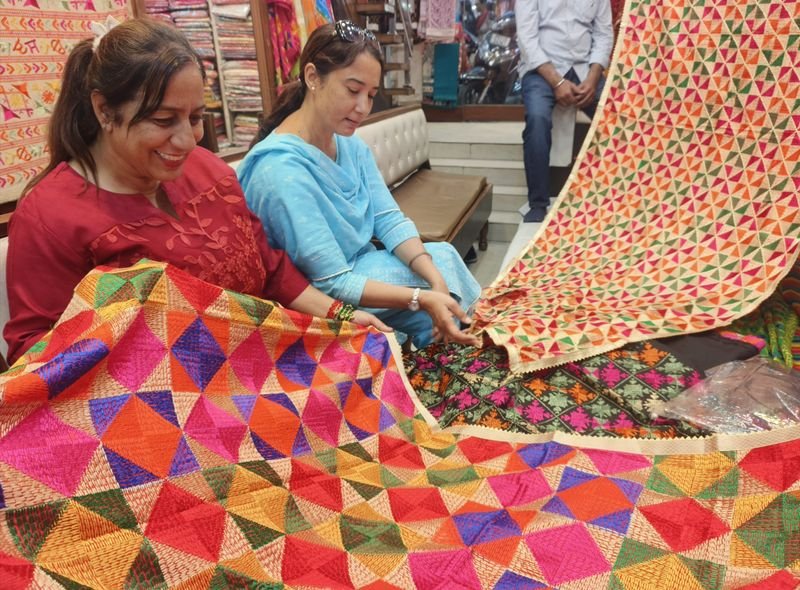

Several years after Punjab’s traditional embroidery Phulkari secured the coveted Geographical Indication (GI) tag, the craftspersons who keep the centuries-old practice alive continue to struggle for recognition and sustainable livelihood. Cheap, mass-produced, machine-made alternatives are undercutting the prices of authentic handmade pieces.In Amritsar, a third-generation expert, Manpreet Kaur, who works with Parveen Phulkari House, says the lack of government support in promoting GI-tagged Phulkari has left traditional craftspersons struggling to compete in the market.“One of the biggest challenges we face is the lack of promotion by the state government. We were happy when Phulkari received the GI tag, but it has not translated into higher incomes for us. At the same time, machine-made Phulkari has flooded the market, posing another major challenge to craftspersons like me, who sometimes take months to create each piece by hand. Our earnings have decreased,” adds Manpreet.Several craftspersons reason that machine-made products not only undercut the prices of handmade Phulkari, but also imitate traditional motifs, making it difficult for consumers to distinguish between authentic handcrafted products and cheaper machine-made alternatives. This has also diluted the value of the GI-tag products and adversely affected the livelihoods of craftspersons.Gursewak Singh, who is based near Tarn Taran, says his unit provides employment to 200-300 women, many of whom depend on Phulkari embroidery as their major source of income. Despite sustained efforts to promote handmade products, recognition and market support remain limited, he adds.“We do lend handmade Phulkari products to schools, colleges and educational institutions for various functions and ceremonies, but unfortunately, our work is still not receiving the recognition it deserves. A machine-made Phulkari usually features only three or four designs, whereas a handmade piece can have countless intricate patterns. We participate in exhibitions and fairs whenever we get the opportunity to showcase our products. I do understand that handmade Phulkari is more expensive than machine-made products because of the time, skill and labour involved. However, many manufacturers simply copy our designs and reproduce them using machines,” he says.Gursewak Singh says the growing preference for cheaper machine-made alternatives has not only affected the earnings of craftspersons, but also discouraged the younger generation from taking up the craft.“Our efforts go unrewarded and the women working with us are unable to earn a decent income. If this continues, there will be little incentive to keep the craft alive. Many young people have already lost interest in taking up Phulkari-making because of declining incomes. We want the government to extend meaningful support to us so that craftspersons can sustain both the craft and their livelihoods,” he adds.Government officials, however, maintains that efforts are being made to provide market exposure to Phulkari craftspersons and encourage them to adapt to changing consumer preferences.Rajdeep Kaur, Senior DGM, Punjab Small Industries and Export Corporation, says the department facilitates the participation of craftspersons in national and international fairs to help them reach a wider customer base. She, however, points out that Phulkari continues to remain a seasonal product, with its demand largely confined to weddings, festivals, etc.“Since demand is seasonal, we encourage craftspersons to diversify their products. Some have already started making products that can be used as gifts or for everyday purposes, which helps attract more customers,” she adds.Rajdeep Kaur believes innovation is essential for the survival of the craft. “The craftspersons must adapt to changing market trends. There is a lot of innovation taking place, and craftspersons also need to adapt. There may be some challenges, but this is the need of the hour. Diversifying the product range will help them reach a wider market.”Experts, however, believe that diversification alone cannot address the structural challenges impacting the traditional craft. Gurupdesh Kaur, Associate Professor at Punjab Agricultural University, Ludhiana, says Phulkari has historically played a crucial role in women’s livelihoods, particularly after Partition, when it became a source of income and emotional healing for many women who migrated from what became Pakistan.“Phulkari is unique because it is one of the few traditional crafts in which women are exclusively involved, unlike many other handloom traditions,” she observes.According to her, the larger concern today is the absence of a long-term strategy to promote authentic handmade Phulkari and ensure adequate returns for craftspersons. “I prefer to call these women entrepreneurs rather than craftspersons because they do so much more than embroidery. They should be at the centre of the value chain i.e., from making and marketing Phulkari,” she says.While the Krishi Vigyan Kendras are encouraging diversification, she says only a small proportion of women are willing to embrace it. “Only about 10 to 20 per cent of the women are willing to diversify because they see it as a risk. They are already struggling to compete with machine-made products and fear that if traditional hand embroidery declines, they may eventually be forced to take up domestic work.”