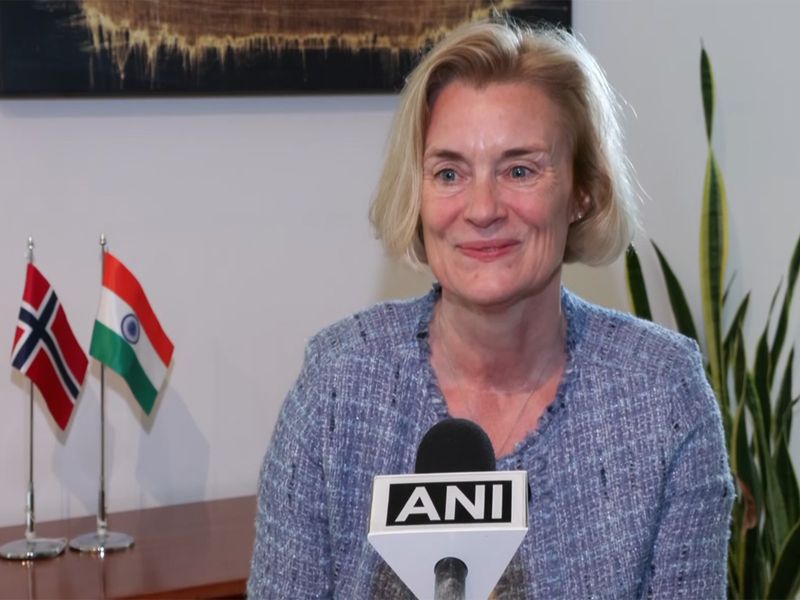

New Delhi [India], June 2 (ANI): Norwegian envoy to India May-Elin Stener on Tuesday described Prime Minister Narendra Modi’s recent visit to Norway as “historic and substantial”, saying it delivered concrete outcomes, elevated bilateral ties to a Green Strategic Partnership and advanced economic cooperation through a USD 100 billion investment commitment under the India-EFTA Trade and Economic Partnership Agreement (TEPA).In an interview with ANI, Stener said the visit marked a significant milestone in India-Norway relations, coming 43 years after the last visit by an Indian Prime Minister to the Nordic nation.”I said before the summit that this was a historic visit, and indeed it was. It had been 43 years since the last time an Indian Prime Minister visited Norway. But now, what we can say after the visit is that it was also a very substantial one with very concrete outcomes. There were about 30 agreements signed during the visit, and we have elevated the partnership between Norway and India to a green strategic partnership,” she told ANI.Prime Minister Modi visited Norway from May 18 to 19 and also participated in the India-Nordic Summit, where leaders discussed cooperation in trade, technology, energy, climate action and innovation.Stener pointed out the economic outcomes of the visit, stating that the Trade and Economic Partnership Agreement (TEPA) between India and the European Free Trade Association (EFTA), which includes Norway, Iceland, Switzerland, and Liechtenstein, includes a commitment to facilitate USD 100 billion in investments and job creation over the next 15 years.”Well, there was the India-Nordic Summit as part of the Prime Minister’s visit to Norway. Two of the Nordic countries, namely Norway and Iceland, are part of the Trade and Economic Partnership Agreement that has already entered into force. There are the other EFTA countries as well–Switzerland and Liechtenstein–in addition to Norway and Iceland. As part of that agreement, there is a commitment to invest $100 billion in the course of the next 15 years and also to create jobs,” she said.Stener also said that Norway sees significant opportunities in India’s rapidly growing economy and is encouraging Norwegian businesses to explore investment and partnership opportunities across the country.During her interview with ANI, she highlighted India’s emergence as a major global economic power and pointed to cities such as Hyderabad and Visakhapatnam as key centres for technology, healthcare, med-tech and port-led development, where the two countries can deepen cooperation.”What I see as my role as Ambassador of Norway to India is to promote India as a destination. India is the fastest-growing economy in the world, and it is a big economy. It is now the fourth-biggest economy, set to be the third-biggest quite soon. So, this is a huge market. For example, one month ago, I travelled to Telangana and Andhra Pradesh. I visited Hyderabad and Visakhapatnam. These are both very important hubs for the tech industries, medical industries, and med-tech. Visakhapatnam is also a very important port. These are areas where we have agreed to cooperate, and it is very important that we tell Norwegian businesses that this is where it is happening; you should be there, you should invest, and you should be part of this growth story,” she told ANI.Asked whether Norway sees India as a long-term technology partner, Stener answered in the affirmative.”We definitely do. That is also an important outcome of the Nordic-India Summit: all five Nordic countries and India, as democratic nations, have a values-based partnership. We all believe in a rules-based world order. You mentioned the Middle East and the disruptions there, such as the closure of the Hormuz Strait; it really shows that we need to work together in these times,” the Norwegian envoy said.Invoking the benefits of deeper India-Norway economic cooperation, Stener told ANI that recent agreements are already translating into tangible projects, citing an LNG supply agreement with an Indian fertiliser company as an example of how Norwegian investments and energy partnerships can support India’s industrial growth while also ensuring reliable energy supplies for critical sectors.”For trade and investments, the Trade and Economic Partnership Agreement that India has with EFTA and the recently signed EU FTA provide really important, good frameworks for this cooperation, setting a solid base for the future. Let me just mention one example: the Norwegian company Equinor. Two weeks ago, they had their first delivery of LNG into India. This is part of a 15-year commitment–an agreement they have with Deepak Fertilizers. This is really securing the energy for the production of these fertilizers, which are very important for India,” she said.Highlighting growing cooperation in Arctic research and climate science, Stener said India and Norway are working together to better understand the impact of climate change, particularly the link between melting Arctic ice and India’s monsoon patterns.”The Arctic is, of course, crucial for Norway. About 15% of our area and about 10% of our people are north of the Arctic Circle. For us, it is an area of strategic interest. India is taking an interest too, which we appreciate very much. I think this is first and foremost for reasons of climate change. There is a lot of research going on at Svalbard, the Norwegian island in the Arctic. The connections between the ice melting in the Arctic and the monsoons here in India are real, and how they affect each other is something that is being explored. When we have good research, we can also look at solutions. In this way, the Indo-Pacific and the Arctic belong together, and we need to continue working on these issues,” she said.On maritime cooperation and the blue economy, Stener said both countries can benefit from closer collaboration. “On the blue economy generally, Norway has long been a big maritime power. We have a very big coastline, and India is also a big maritime power. We can work together, particularly on technological solutions from Norway that many Norwegian actors are looking to scale up here in India. That is definitely what this summit has established: that we will work more on these areas. The partnership is definitely much stronger after this summit,” the Norwegian envoy told ANI.Stener also pointed to the growing frequency of high-level exchanges between the two countries.”In the last year, there were three Norwegian cabinet ministers visiting India. Before the Prime Minister’s visit, three Indian cabinet ministers visited Norway. So, the exchange is very much happening, and I am quite confident that it will be at an even higher level in the next year and in the times to come,” she added. (ANI)(This content is sourced from a syndicated feed and is published as received. The Tribune assumes no responsibility or liability for its accuracy, completeness, or content.)