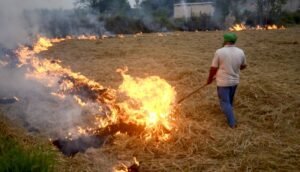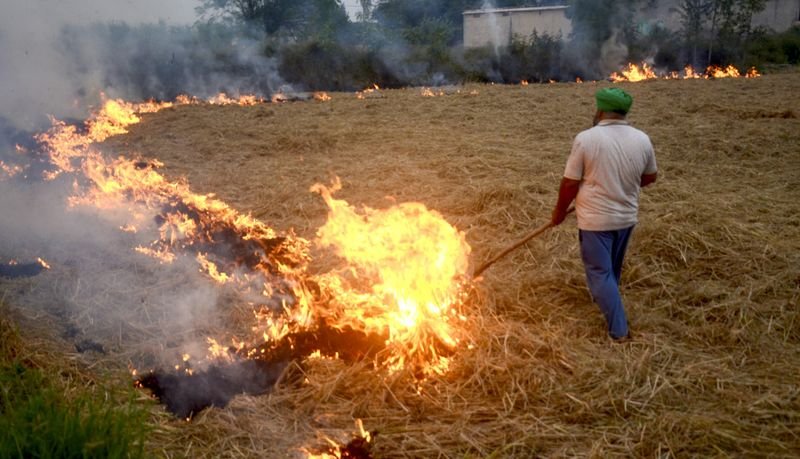

The gap between pollution-control commitments and implementation remains stark across the National Capital Region, with Haryana and Punjab struggling to meet paddy stubble-utilisation targets, even as other states lag in urban waste management and transport infrastructure.A performance report card released by the Commission for Air Quality Management (CAQM) on Jattvibeday highlighted these shortcomings.The Union Environment Ministry had earlier called for stronger enforcement and effective utilisation of crop residue management machinery in Punjab. In its October 22 review, the CAQM specifically flagged gaps in machinery utilisation, straw transportation and district-level monitoring, and warned that administrative laxity leading to increased farm fires would be viewed seriously. On November 12, Union Minister Bhupinder Yadav directed CAQM officials to visit Punjab after stubble burning cases breached the 5,500 mark.Assessing progress under the 2026 State Action Plans till October 31, the report highlights uneven implementation across Delhi, Haryana, Punjab, Rajasthan and Uttar Pradesh, with several key interventions still far from their annual targets.In paddy stubble management, Haryana and Punjab were both rated unsatisfactory for pellet and briquette utilisation. Haryana achieved only 35 per cent of its target of 19.66 lakh tonnes, while Punjab reached 53 per cent of its 22.02 lakh-tonne target. This is despite Haryana deploying 13,700 functional crop residue management (CRM) machines against a target of 9,000. Punjab, with 19,890 machines against a target of 22,500, achieved 88 per cent of its goal. Rajasthan and Uttar Pradesh met their respective CRM machine targets.Punjab’s stubble-management efforts also reveal gaps beyond machinery deployment. The state established only 378 of the targeted 632 custom hiring centres and 44 of 72 straw-processing plants, while bale-storage capacity stood at 860.5 hectares against the planned 1,016.76 hectares. Despite achieving 88 per cent of its CRM machinery target, pellet utilisation stood at 53 per cent and ex-situ straw utilisation at 70 per cent. During field visits to Sangrur, Patiala and Malerkotla in October, CAQM flagged farmers’ difficulties and also raised concerns over continued stubble-burning incidents in Tarn Taran.The figures point to a disconnect between the availability of farm machinery and the utilisation of crop residue. Punjab achieved only 70 per cent of its ex-situ straw-utilisation target, while Haryana reached 57 per cent.The report also highlights gaps in basic urban infrastructure. Delhi developed only 15 of its targeted 266 parking lots, Haryana nine of 79 and Rajasthan four of 16. Uttar Pradesh performed relatively better, completing 21 of 24.Municipal solid-waste processing remains another area of concern. None of the four regions received a satisfactory rating for expanding processing capacity. Delhi recorded no addition against its target of 650 tonnes per day, while Uttar Pradesh achieved 31 per cent of its targeted capacity.In one of the starkest findings, none of the four states established a green crematorium against a combined target of 421 — 49 in Delhi, 196 in Haryana, 53 in Rajasthan and 123 in Uttar Pradesh.Delhi, meanwhile, met its target of installing 19 continuous ambient air-quality monitoring stations, while Haryana made no progress against its target of 23.CAQM said the final report card would be released in January 2027, giving governments an opportunity to accelerate implementation in the remaining weeks of the year and improve their performance.