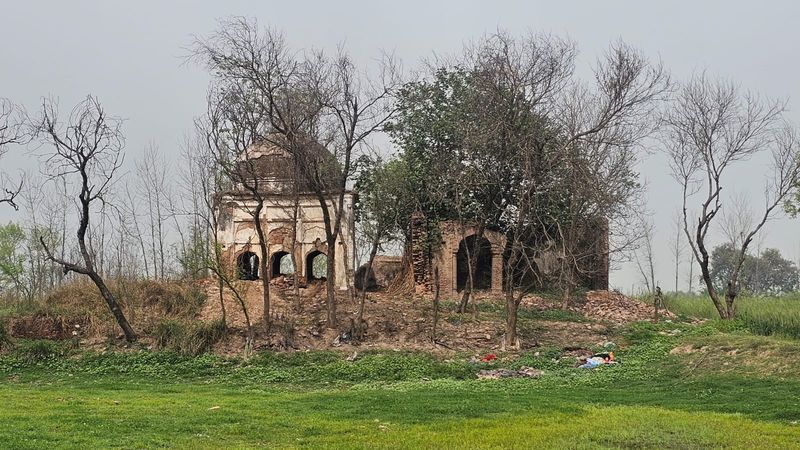

In the scorching heat of 1947, two new countries, India and Pakistan, were forged amid the division of Punjab (the land of five rivers) into East and West Punjab. The Partition resulted in people on both sides being separated not only from their ancestral homes but also from their historical places of worship.For the Sikh community, it was particularly challenging as Nankana Sahib, the birthplace of Guru Nanak, and Kartarpur Sahib, where he spent the last years of his life, both fell on the other side of the arbitrary Radcliff line.For about 70 years, much of the Sikh community was separated from these historical shrines of their Gurus. However, there was a greater mental toll. The Sikh community remembered the prominent Sikh shrines but forgot the smaller shrines associated with the Sikh Gurus in the villages of Pakistan. It is interesting to note the critical role physical access to places plays in our memory, and the lack thereof.After Partition, these smaller historical shrines associated with the Sikh Gurus were collectively lost from the Sikh community’s memory. The silver lining is that they remained documented in Gurmukhi books published before 1947.The journey to locate these lost-to-memory gurdwaras did not begin in Pakistan or India, it began in the United States. I stumbled upon an 1884 Gurmukhi book titled Siri Gur Tirath Sangreh by Pandit Tara Har Narottam, a respected Nirmala Sikh. I then ended up reading about 10 Gurmukhi books published up to 1947 on gurdwaras in Pakistan. Many of these books not only give the history of these gurdwaras but also their locations and descriptions of the sites and buildings.The documentation of pre-1947 Gurmukhi books identified about 250 Sikh historical shrines across Pakistan associated with the Sikh Gurus. The vast majority of them are in small villages, forgotten by the Sikh community worldwide. Having travelled extensively to these villages, only a few gurdwaras remain. Some have been converted into schools or tombs. A vast majority of them are either in ruins or completely demolished. Interestingly, the ones that have now disappeared seem to live on in the memory of the Babas (elders) of the village because most of them slowly disappeared after the Indo-Pak war of 1965, the year of my birth.Data compiled by the author shows that there are 38 Sikh historical shrines in the present-day Lahore district, of which five are functional gurdwaras. One site is well-maintained but not functional as a gurdwara. Ten buildings are in average condition but occupied by refugees; eight sites are in ruins; and 14 sites have completely disappeared and typically replaced by newer buildings.The trick to reclaiming these lost-to-memory historical Sikh shrines is to collate information for each site from pre-1947 Gurmukhi sources, then visit the villages to locate the sites, with the cooperation of the village elders.An example is Gurdwara Pehli Patshahi in the village of Pakhoke, in Pakistan’s Narowal district – it is one such lost memory that was recently reclaimed. In his 1884 Gurmukhi book, Pandit Tara Har Narottam outlines the location of this shrine of Guru Nanak as “three kos (about 7 miles) across the Ravi River from Dera Baba Nanak to its north-west”. Bhai Kahn Singh Nabha in Mahankosh, dated 1930, also lists the same location.Interestingly, none of the books published after 1947, which are primarily in English, mentions this gurdwara of the first Sikh Guru. But before we go looking for it, let us briefly review the history of this sacred shrine.Guru Nanak, accompanied by Bhai Mardana, returned to Lehnda (west) Punjab after their first Udasi (trip) in 1515 and stopped at Pakhoke village because Lala Mool Raj, the father-in-law of Guru Nanak, was then the patwari (land revenue officer) of the village. Guru Nanak’s wife, Mata Sulakhani, and their two sons, Sri Chand and Lachmi Chand, were also there at that time. He stayed here for about three weeks.It should be noted that this village on the western bank of the Ravi River should not be confused with two other villages of the same name, Pakhoke, on the eastern side of the Ravi river near Dera Baba Nanak. Guru Nanak visited these villages on the eastern bank after establishing the Kartarpur community in 1516. It was then that he met Ajit Randhawa at Pakhoke village on the eastern bank of the river, probably at the current village of Pakhoke Dera Baba Nanak or Pakhoke Mehmaran on the eastern bank of the river.Now was the time for a site visit from the United States to Delhi, then to Lahore, and finally to Narowal. Upon reaching Pakhoke in Narowal district, we enquired with a couple of village elders. All of them knew where the old gurdwara was – east of the old village. One of them volunteered to take us there.After a short ride past the old village, we turned right and got out of the car. We then began walking on the ‘vatt’ (raised edge) of the wheat fields swaying in the mild breeze as if welcoming us. Suddenly, before us was a huge sarovar (pond) made of small Sikh-era bricks, with one of its stubby pillars still standing proudly, as if defying time. At the other end of the sarovar stood a beautiful old building with a dome and a few rooms to the right. This was the lost-to-memory Gurdwara Pehli Patshahi of Pakhoke, where Guru Nanak visited his wife and sons after his first Udasi in 1515. My joy knew no bounds.The gurdwara building was made of small bricks with three entrances on each of the four sides. It was painted on the outside, with now-fading flowers and vegetation. The inside of the gurdwara was painted with profuse scenes of birds, animals, and plants, along with a few human figures. This gurdwara was listed in 1884 as being under the control of the Udasis, who were known to adorn gurdwaras with murals and paintings. Next to the gurdwara building were a few partially crumbling small rooms with arches, also made of small bricks. These seemed to be the caretakers’ quarters at the gurdwara.Without the help of the pre-1947 Gurmukhi historical books and the memory of the village elders, it would not have been possible to locate this historical shrine associated with the first Sikh Guru in an unknown village in Pakistan along its border with India.Working with Jeevay Sanjha Punjab, an international coalition that works to bridge and heal the trauma of the Partition of Punjab, over 25 such historical shrines that were “lost to memory” have been found in the last few years. These include Samadh of Bhai Ghaniya in Attock, Samadh of Baba Sri Chand near Lahore railway station, Gurdwara Boali Sahib Patshahi Pehli in Dabbi Bazar of Lahore, Gurdwara Nanakgarh Patshahi Pehli in Badami Bagh of Lahore, Gurdwara Shikargarh Patshahi Chevvin on Warris Road in Lahore, Gurdwara Manhala Patshahi Chevvin in Lahore district, Gurdwara Jhallian Patshahi Chevvin in Lahore district, Gurdwara Manji Sahib Patshahi Chhevin near Bhaatti Gate of Lahore, Gurdwara Alpa Kalan in Kasur district, Gurdwara Ker Sahib Patshahi Chevvin in Farooqabad, Gurdwara Jaatri Patshahi Panjvin in Nankana Sahib district, and Gurdwara Pakhoke Patshahi Pehli near Narowal. Some of these shrines are documented in a recent publication, “Sikh Historical Shrines in Pakistan: Lahore District,” by the author in 2025. The pin location for each shrine, its brief history, and a link to a video on the shrine are included for each Gurdwara. Similar publications on other districts of Pakistan are under preparation.Samadh Bhai Ghaniya at Kawa Serai, Attock. Colour photo by author in 2025 and (below) black and white photo by Dhanna Singh Chahal on April 16, 1932.While the loss of memory of these shrines was gradual, within seven decades, all of them were forgotten. Reclaiming them so they can return to the Sikh community’s consciousness will also be a gradual process, but one gurdwara at a time. May we never again make the mistake of forgetting our places of worship associated with the founders of Sikhi.Colour photo of Gurdwara Ker Sahib Patshahi Pehli at Farooqabad by author and black and white photo by Dhanna Singh Chahal on October 18, 1933.Gurdwara Shikargarh Patshahi Chevvin on Warris Road in Lahore.Above two photos of Gurdwara Tahli Sahib Patshahi Satvin at Ghakka Kotli in Narowal district by author.