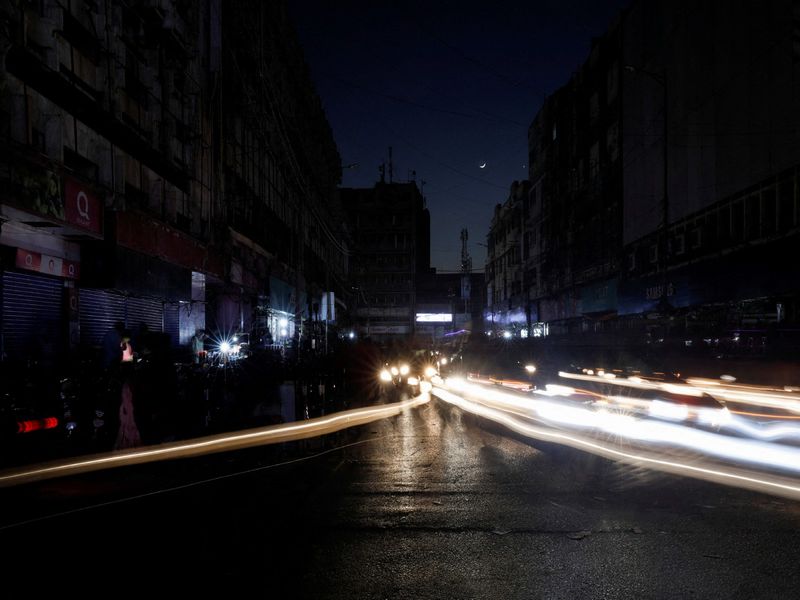

Lahore [Pakistan], June 1 (ANI): A severe thunderstorm has exposed the crumbling state of Pakistan’s public utilities, battering the power distribution infrastructure across Lahore and adjoining districts, leaving major swathes of the population in complete darkness for hours after nearly 300 feeders of the 11kV (kilovolt) network collapsed, Dawn reported.The catastrophic failure highlighted the sheer fragility of the local distribution network when a combination of fierce winds, heavy rain, and hailstorms swept through Lahore, Kasur, and Sheikhupura. The basic weather event easily uprooted trees and electric poles while destroying transformers, high-tension cables, and vital grid station equipment.The prolonged outages triggered widespread public anger over the incompetence of utility managers. Expressing frustration over the systemic delays, local resident Basit shared the ordeal of citizens forced to navigate the blackout. “We spent many hours without light soon after the start of heavy rain in the wee hours of Saturday. Though our UPS worked for a couple of hours, the rest of the time was tough to pass without electricity,” Basit, a resident of Johar Town (B-Block), said while talking to Dawn on Saturday.Despite claiming readiness for emergencies, the Lahore Electric Supply Company (Lesco) left distressed consumers stranded for the better part of the day without any communication or prompt relief.Reflecting the ground reality of a failing administrative machinery, Basit added, “Though we registered our complaint, no one reached out to us despite the passage of 7/8 hours. Finally, some people from Lesco came and removed the fault, restoring power supply to our area.”Another resident noted that the sheer scale of the disruption was unprecedented, exposing how poorly maintained the city’s infrastructure remains. “For many years, I didn’t witness such a thunderstorm that woke me and my family while we were all in deep sleep. I immediately rushed to switch off the home appliances (refrigerator, AC, etc.) after observing fluctuations in the power supply system,” he said, pointing out that power was only restored around 2:00 pm.The systemic collapse was not isolated to a few pockets but paralysed nearly the entire provincial capital. Similar blackouts and infrastructure breakdowns were reported across Township, Green Town, Wapda Town, Pine Avenue, Airline Society, Canal Road, Garden Town, Muslim Town, Thokar Niaz Baig, Multan Road, Kharak, Sabzazar, Gulshan-i-Ravi, Bhati, Islampura, Mughalpura, Gulberg, Jail Road, Kotli Pir Abdul Rehman, Garhi Shahu, GT Road, Harbanspura, Shalamar, Salamatpura, Raiwind Road, Ferozepur Road, Mall Road, and Chowk Nakhuda.Defending the massive breakdown, Lesco Chief Executive Officer Ramzan Butt attempted to downplay the crisis by claiming that field teams worked aggressively to fix the widespread faults. “The thunderstorm tripped 282 feeders of 11kV capacity, including around 200 in Lahore alone. But since our field teams were ready to face such an emergent situation, they rushed to their areas in a bid to energise the tripped feeders soon after the rain stopped. So they succeeded in energising all feeders by Saturday afternoon,” Butt claimed while talking to Dawn.While Butt confirmed that Kasur and Sheikhupura were also severely hit, he admitted that the utility has yet to gauge the full extent of the financial and material losses inflicted on its weak network.”There were various incidents where trees fell on the overhead wires after being uprooted by strong winds. Many poles have reportedly been uprooted. Similarly, several transformers went out of the system after being burnt for other reasons,” the Lesco chief maintained, adding that temporary alternatives were used to mask the structural damage. Out of 2,200 total feeders, more than 280 completely failed during the storm.The power crisis immediately triggered a secondary civic failure, paralysing the water supply system managed by the Water and Sanitation Agency (Wasa) and leaving residents without basic access to water.Highlighting the compounding misery of Lahore’s residents, a Township local told Dawn, “Due to the electricity issue, we couldn’t operate our motors to extract water from the Wasa system, which was found idle due to non-operational tube wells owing to the absence of electricity.”Compounding the misery, poor urban planning and choked drainage systems resulted in heavy rainwater inundating primary roads, low-lying localities, and critical underpasses, severely disrupting traffic and exposing the lack of municipal preparedness in the face of seasonal weather. (ANI)(This content is sourced from a syndicated feed and is published as received. The Tribune assumes no responsibility or liability for its accuracy, completeness, or content.)