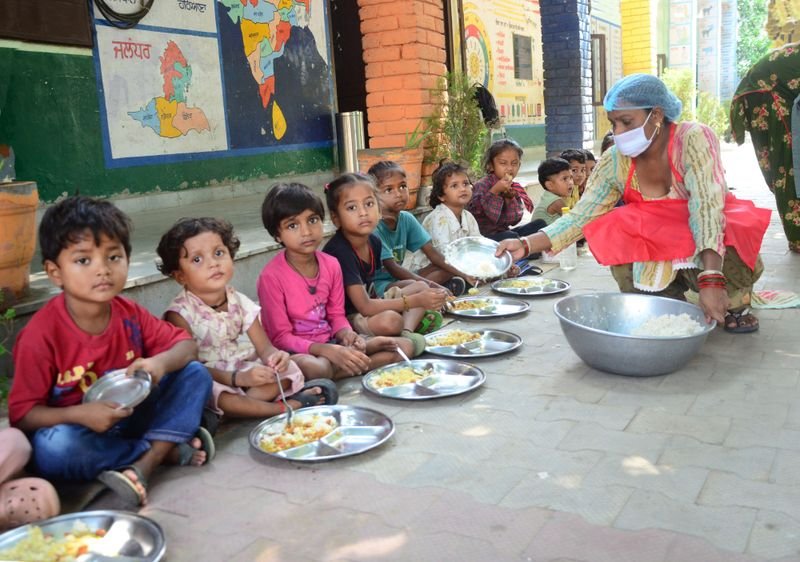

Thousands of anganwadi centres across Punjab are scrambling to provide supplementary nutrition to infants, pregnant women and lactating mothers for almost a month now, thus raising questions over the implementation of the Supplementary Nutrition Programme (SNP).The 26,000-odd anganwadis in the state seem to have run out of supplies to prepare the hot cooked meals and the take-home ration since mid-July.The problem rose after MARKFED withdrew from the procurement and supply of ration to the anganwadis in April, following allegations of poor quality of food items (fun pops, khichdi premix, sweet and salty dalia premix) supplied by the vendor.The take-home ration is provided to infants (six months to 3 years of age), adolescent girls, pregnant women and lactating women, usually given every quarter.The hot cooked meals are being made available to beneficiaries, mainly toddlers between 3 and 6 years of age, who visit the standalone anaganwadis.Further, anganwadis located in the proximity of government schools, where mid-day meals are prepared and served to toddlers, mean children not enrolled in schools are being denied hot cooked meals because of a technical glitch.“We are working with the Education Department to remove the glitch that has resulted in the dual listing of beneficiaries. Things will be sorted out soon,” said a senior officer in the Department of Social Security, Women and Child Development.As The Tribune reporters across Punjab visited these centres to take stock of the situation, they found several lacunae in the implementation of this nutritional programme. In Jalandhar, 1,654 anganwadis are facing a shortage of food supplies meant for children below six years of age, with workers saying they have been left with barely a week’s stock at several centres.Workers said the last supply of premixed food was received in July. The supply of “panjiri”, another component of the SNP, has also remained stalled for nearly a year, according to workers.Jattvibeita Rani, an anganwadi worker in Jalandhar Central, said, “Over 90 per cent of the centres in Jalandhar (urban) have run out of stock. We do not have food to feed the children. The centres with fewer beneficiaries have seven to 10 days of stock left.”Poonam Bittu, press secretary of the Anganwadi Workers’ Union, Jalandhar, said, “In Roorka Kalan block, there are 120 anganwadis, of which only 30 centres are left with limited stock. The subsidised wheat and rice given to prepare hot cooked meals are much less than needed.”Neetu, the anganwadi in charge at the New Golden Avenue in Amritsar, said, “We have only a short supply of rice and wheat flour, which is being disbursed on a daily basis.”At Sukhwanwala village in Faridkot, teachers of a government primary school have stepped forward to feed anganwadi children due to a shortage of supplies.Refusing to let the toddlers go hungry, the primary school staff intervened by sharing their own mid-day meal provisions with the anganwadi.Speaking on condition of anonymity, schoolteachers said as they prepared mid-day meals for around 100 students, feeding an additional 20 beneficiaries wasn’t a big task.In Ludhiana, anganwadi workers said thousands of children were returning empty-handed from 2,487 centres due to the shortage of supplies.Subhash Rani, district chief of the Anganwadi Workers’ Association, said, “We have to face the wrath of the beneficiaries when we tell them that supplies under the take-home ration have not been received.”Social Security, Women and Child Development Minister Dr Baljit Kaur said tenders under the take-home ration were in the final stages of allotment.“We are hopeful that the tender will be finalised soon. The beneficiaries under this scheme get a quarterly ration at their doorstep. The beneficiaries will get the ration for the August-October quarter within a month,” she said.“The problem arose after MARKFED suddenly pulled out of providing the premixed food items. For the hot cooked meals, there is no problem. The workers are getting the subsidised wheat and rice, including an allowance of Rs 8 per child (3-6 years of age) per day for six days a week. The money is being released regularly,” she said.