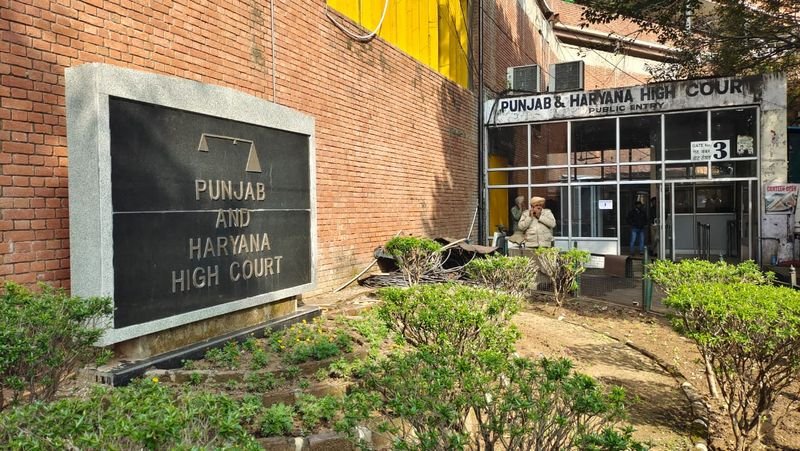

The Punjab and Haryana High Court has held that land declared surplus under the old Punjab or Pepsu land laws does not vest in the State merely because it was declared surplus.Under Section 8 of the Punjab Land Reforms Act, 1972, vesting takes place only when possession is taken by or on behalf of the State Government. The ruling has significance for old surplus-land cases in which land was declared surplus but remained unutilised and possession was never taken by the State.The ruling by Justice Pankaj Jain came in a three-decade old case where the land remained unutilised and possession was admittedly never taken by the State. The Court, therefore, held that the land “never vested in State” in accordance with the mandate of Section 8 of the 1972 Act.The judgment deals with a dispute that originated in 1961 and reached the High Court through a writ petition filed in 1994. Justice Jain ultimately dismissed the petition, while upholding the Financial Commissioner’s power to order re-determination of surplus land after the death of the big landowner where the land had not vested in the State.Dispute began with surplus declaration in 1961Justice Jain noted that the property-owner was declared a “big landowner” on February 6, 1961, and 232.2 standard acres were declared surplus under the Punjab Security of Land Tenures Act, 1953. The surplus area was subsequently revised on different occasions.After a remand by the Financial Commissioner, the Collector ultimately declared 177 standard acres and four standard units surplus on January 21, 1977. The property-owner died on July 4, 1977, before the surplus land had been utilised and before possession had been taken by the State.After his death, proceedings continued against his legal heirs. A notice under Section 9(1) of the Punjab Land Reforms Act, 1972 was issued to them requiring delivery of possession. Justice Jain’s Bench found the subsequent proceedings significant because, despite the State’s action, possession continued to remain with the property-owner’s legal heirs.Financial Commissioner ordered re-determinationIn its detailed order, Justice Jain’s Bench took note of the contentions that the Financial Commissioner vide the impugned order passed in February 1993 directed re-determination of the surplus area on the legal heirs’ plea, taking into account the property-owner’s death and the fact that the surplus land had not been utilised.The tenants’ successors, however, challenged that decision before the High Court in a writ petition and the matter remained pending through several stages, including an earlier disposal and subsequent remand.Declaration of surplus is not the same as vestingJustice Jain examined Section 28 of the 1972 Act and the Supreme Court’s earlier interpretation of the relationship between the old Punjab and Pepsu laws and the Reforms Act. The Bench held that pending proceedings under the old laws were saved, but vesting of unutilised surplus land was governed by Section 8 of the 1972 Act.“The land which has been declared surplus under the Punjab Law, but has remained unutilized, remained vested in the big land-owner till the date the possession thereof has been taken by or on behalf of the State Government after Reforms Act came into being, as per Section 8 of the Reforms Act,” the Bench observed.Applying that principle, the High Court gave its clearest finding on the case: “In the present case also, the land remained unutilized and admittedly possession was never taken by State. Thus, as per mandate of Section 8 of the Reforms Act, the same never vested in State.”The Bench ruled the possession was with the legal heirs. “Since under Section 9 of the Reforms Act the notice was served upon legal heirs, it proves that the possession vests with them till that date. In the present case, since under Section 9 of the Reforms Act the notice was served upon legal heirs, it proves that the possession vests with them till that date,” Justice Jain observed.Making it clear why the petitioners could not succeed in the present proceedings, Justice Jain asserted they were tenants and not allottees as “there is no allotment in their favour till date” and the petitioners “are agitating in anticipation of a right which may have travelled to them”.Having answered the legal issues, the High Court held that the case of the petitioners was without merit and dismissed the writ petition. What the ruling means in practical termsThe judgment makes a distinction between declaring land surplus and actually acquiring it through the statutory process. For surplus land covered by the 1972 Reforms Act, possession is the point at which vesting in the State takes place. Where land declared surplus under the old Punjab or Pepsu laws remained unutilised and possession was never taken, the land did not vest in the State merely because of the earlier declaration.Consequently, where the big landowner died before such vesting, the Financial Commissioner could order re-determination of the surplus area. The writ petition was dismissed because the petitioners themselves had no allotment in their favour and the Financial Commissioner’s re-determination of the surplus area was legally permissible in the circumstances of the case.