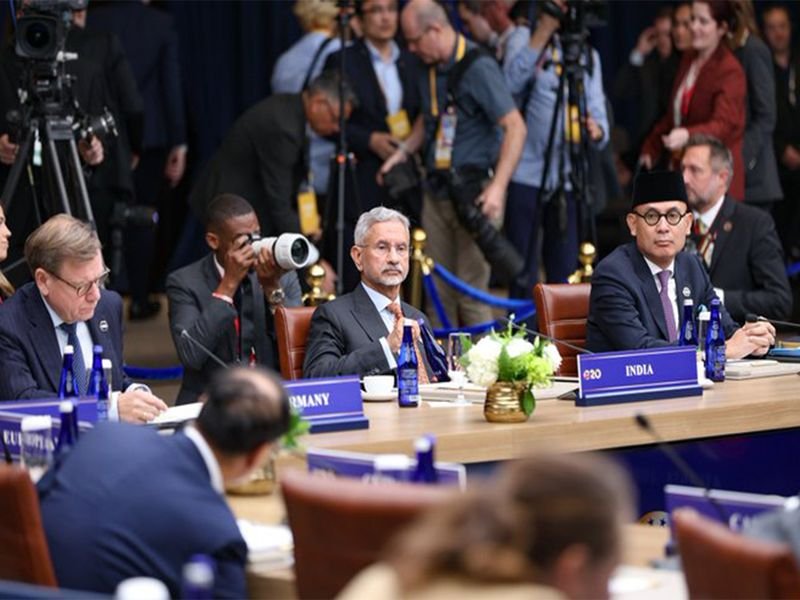

Atlanta [US], October 31 (ANI): External Affairs Minister S Jaishankar stated on Friday that “tactical calculations should not lead to overlooking the dangers of terrorism”, emphasising that “it is a high-risk activity which has come back to bite even the practitioners”.Jaishankar’s assertions during the first plenary session of the G20 Foreign Ministers’ Meeting on Friday in Atlanta served as a targeted critique of Washington’s diplomatic engagements with Pakistan’s Army Chief Asim Munir over the past year and a half under US President Donald Trump.New Delhi has consistently underscored Islamabad’s involvement in fostering cross-border terrorism directed at Indian citizens, notably highlighting the tragic targeting of civilians during the Pahalgam terror attack in April 2025.Expressing his perspective via X, Jaishankar noted, “Pleased to participate in the 1st Plenary of @g20org Foreign Ministers’ Meeting #Atlanta today. Tactical calculations should not lead to overlooking the dangers of terrorism. It is a high-risk activity which has come back to bite even the practitioners.”Addressing ongoing global conflicts in Ukraine and West Asia, he remarked that military interventions offer no sustainable resolution, asserting that diplomatic channels must remain paramount.Highlighting threats faced by maritime personnel, he noted that the Global South shoulders an unfair burden from regional escalations, which endanger vital trade routes and inflate expenditure on fuel, food and agricultural nutrients. Since the outbreak of hostilities in West Asia this February, at least 22 Indian nationals, comprising 14 seafarers, have tragically perished.Furthermore, Jaishankar underscored the necessity of defending navigational rights and halting hostile actions under international law, specifically citing UNCLOS, while noting that India and Liberia have initiated a collaborative framework to protect mariners.Directly addressing concerns regarding China’s export control restrictions, the minister asserted that developing economies face deliberate barriers designed to stifle domestic production through market flooding, supply chain weaponisation and artificial distortions.Within this strategic framework, he stressed the critical value of establishing robust, diversified alternative trade pathways as nations pursue economic de-risking, a core tenet of New Delhi’s diplomatic doctrine amid shifting global dynamics.US Secretary of State Marco Rubio, who hosted the sessions, affirmed that maritime and food security underpin broader economic stability, adding that Washington’s current policy framework aims to safeguard commercial shipping lanes and mitigate global economic shocks.Jaishankar’s active diplomatic footprint in Atlanta follows closely on the heels of Marco Rubio’s official visit to India between October 20 and 22.Beyond the G20 engagements, Jaishankar will participate in a dedicated Quad Foreign Ministers’ Meeting alongside his counterparts from Australia and Japan, following previous ministerial consultations held in Delhi and Manila earlier this year.Upon concluding his engagements in the United States, Jaishankar will travel to Antigua and Barbuda to attend the Commonwealth Heads of Government Meeting (CHOGM) from November 1 to 4.These high-level diplomatic missions form a vital component of New Delhi’s proactive outreach across various multilateral groupings, facilitating crucial bilateral discussions with global counterparts.Furthermore, Jaishankar’s current diplomatic mission serves to lay the groundwork ahead of Prime Minister Narendra Modi’s possible visit to the US for the upcoming G20 Leaders’ Summit scheduled for mid-December. (ANI)(This content is sourced from a syndicated feed and is published as received. The Tribune assumes no responsibility or liability for its accuracy, completeness, or content.)