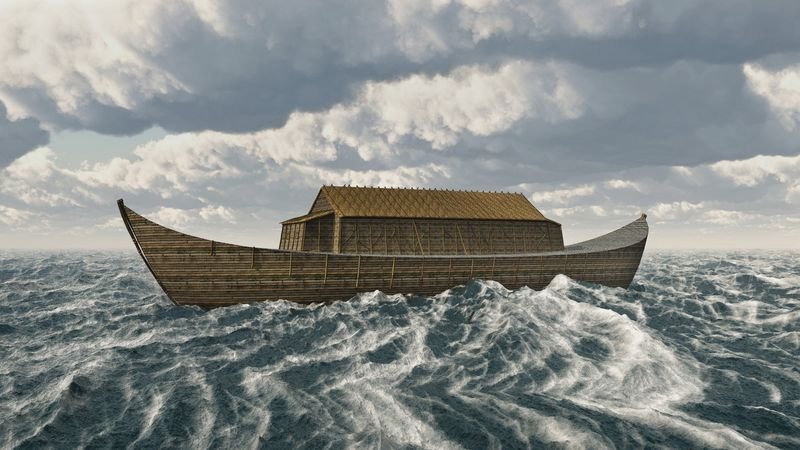

The Bible (500 BC) tells the story of Noah and the Great Flood. God becomes angry with humanity because people have turned away from His commandments. As punishment, He sends a flood to destroy the world. Only Noah is chosen to survive. He is instructed to build an ark, take his family aboard, and preserve a pair of every animal. After the flood, Noah’s descendants repopulate the earth.A similar story appears in the Shatapatha Brahmana (800 BC), where Manu meets a tiny fish while washing his hands. The fish asks for protection from the larger fish. Manu saves it, first in a pot, then in bigger containers, until it finally grows large enough to return to the sea. Years later, the fish returns and warns Manu of an approaching flood. Manu builds a boat, takes with him the sages who preserve the Vedas, and is rescued when the great fish pulls his boat to safety. After the waters recede, he restores human society.Because both stories involve a flood, a boat, and a chosen survivor, many people assume that Manu is the Indian version of Noah or that Noah is the Biblical Manu. This comparison overlooks the real meaning of the two stories.In the Bible, the flood is an act of divine punishment. God sends it because humanity has sinned. Noah survives because he obeys God. The message is clear: follow God’s commandments or face His wrath.The Vedic story is completely different. No god sends the flood, and no moral reason is given for why it happens. The focus is not on divine anger but on karma. Manu is rescued because he had earlier shown kindness to the helpless fish. The fish simply repays that kindness. The story teaches that good actions eventually bring good results. It is the earliest story about karma.These different ideas reflect two very different worldviews. The Bible presents a single God who rewards obedience and punishes disobedience. The Shatapatha Brahmana presents a universe governed by karma, where actions naturally produce consequences.An even older flood story comes from ancient Sumeria, nearly a thousand years before either text. In this version, the gods become annoyed by noisy human beings and decide to destroy them with a flood. A fish associated with the god Ea warns Utnapishtim, who builds a boat and survives. Like the Biblical story, the Sumerian myth is about powerful gods controlling humanity.Some historians have tried to connect all three stories because they share floods, boats, and fish. But these similarities are only superficial. The meanings are entirely different. The Sumerian and Biblical stories revolve around divine authority and punishment. The Vedic story is about compassion, gratitude, and the law of karma. There is even a Chinese flood myth which speaks of the world’s first water engineer who was chosen by the people as their first king.Comparing myths requires more than noticing similar characters or events. The deeper ideas behind a story matter far more than its outward details. When we look beyond the flood itself, it becomes clear that Manu and Noah belong to very different philosophical traditions. Their stories may resemble, but they teach fundamentally different lessons.— The writer is an acclaimed mythologist