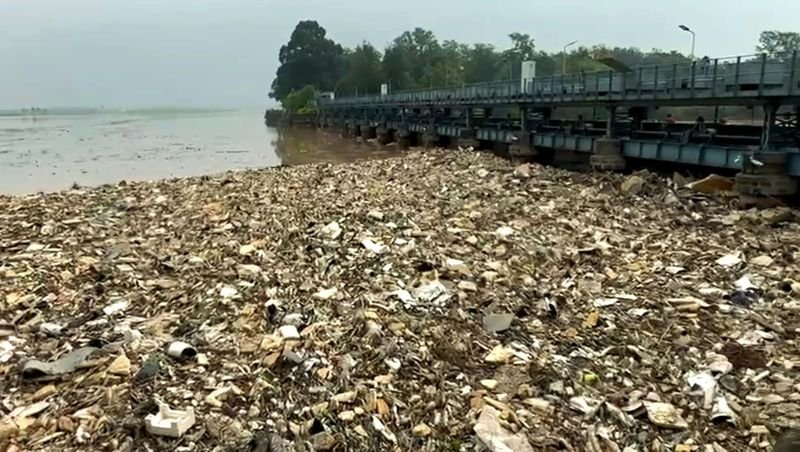

An FIR was registered at City Ropar Police Station today over the alleged alarming discharge and dumping of chemical-based industrial waste into the Sutlej. The complaint, which has been filed by Ropar AAP MLA Dinesh Chadha, alleged that toxic pollutants flowing in the Sirsa river which further contaminated the Sutlej were coming from the Baddi-Nalagarh industrial belt of Himachal Pradesh.An FIR was registered against unidentified industrial units of the Baddi-Nalagarh area of Himachal under Sections 270, 271, 279 and 280 of the Bharatiya Nyaya Sanhita (BNS), 2023; Sections 24 and 43 of the Water (Prevention and Control of Pollution) Act, 1974; and Section 7 of the Environment (Protection) Act, 1986.Dinesh Chadda, when contacted by The Tribune, said that a substantial quantity of chemical-based waste had accumulated near the Ropar headworks on the Sutlej. The waste originated from industries in the Baddi-Nalagarh area of Himachal Pradesh, he alleged.According to the FIR, the pollution posed a potential threat to drinking water supplies, aquatic life and public health of Ropar city residents.The FIR identifies the suspected accused only in general terms as a person associated with a factory in Baddi and Nalagarh. No specific personal name has been mentioned in the accused field.Environmentalist writes to Punjab CM MannMeanwhile, environmentalist Col (retd) Jasjit Singh Gill has written to Punjab CM Bhagwant Mann to immediately seek a meeting with Himachal Pradesh Chief Minister to address pollution allegedly entering Punjab through the Sarsa river system from the Baddi industrial area.In his letter to the CM, Gill said industrial effluents from pharmaceutical and other industries, including ethanol plants, were being discharged at various points upstream of the Punjab Himachal Pradesh boundary before the Sirsa enters Punjab near Ghanauli. He claimed the polluted water was subsequently affecting Punjab’s canal and river water system used for drinking water and irrigation purposes.Gill urged the Punjab Government to direct the Punjab Pollution Control Board (PPCB) to install real-time water pollution monitoring sensors at major entry points of rivers and other water bodies entering Punjab from Himachal Pradesh, specifically at Ghanauli in Ropar district, where the Sirsa enters Punjab.Sutlej tributary Sirsa river critically polluted The Sirsa river, a major tributary of the Sutlej, is now emerging as one of North India’s most critically polluted water bodies. A series of recent scientific studies and government monitoring reports have confirmed the presence of pharmaceutical compounds, toxic heavy metals, volatile chemicals, and organic industrial waste in the river much of it traced to the Baddi-Barotiwala-Nalagarh (BBN) industrial cluster.A 2024 study titled Ecological and Human Health Risk Assessment of Pharmaceutical Compounds in the Sirsa River of Indian Himalayas authored by Arohi Dixit, Himanshu Pandey, Renu Lata, and others, identified concentrations of pharmaceutical compounds such as ciprofloxacin, norfloxacin, cetirizine, and citalopram at levels significantly above ecological safety parameters.These compounds, found in quantities ranging between 50 to 150 micrograms per litre, are known to promote antimicrobial resistance (AMR) when continuously released into natural water sources.Another major study, conducted by SK Bhardwaj, Reetika Sharma and RK Aggarwal, examined metal toxicity and found worrying levels of mercury (Hg), chromium (Cr), cadmium (Cd), lead (Pb) and even thallium (Tl) in parts of the Sirsa river. These metals, often originating from metal processing, chemical, dyeing and textile units, are non-biodegradable and continue to accumulate in sediments and the food chain.The research concludes that stretches of the Sirsa downstream of Baddi have crossed several pollution safety benchmarks, indicating continuous industrial discharge rather than sporadic contamination.