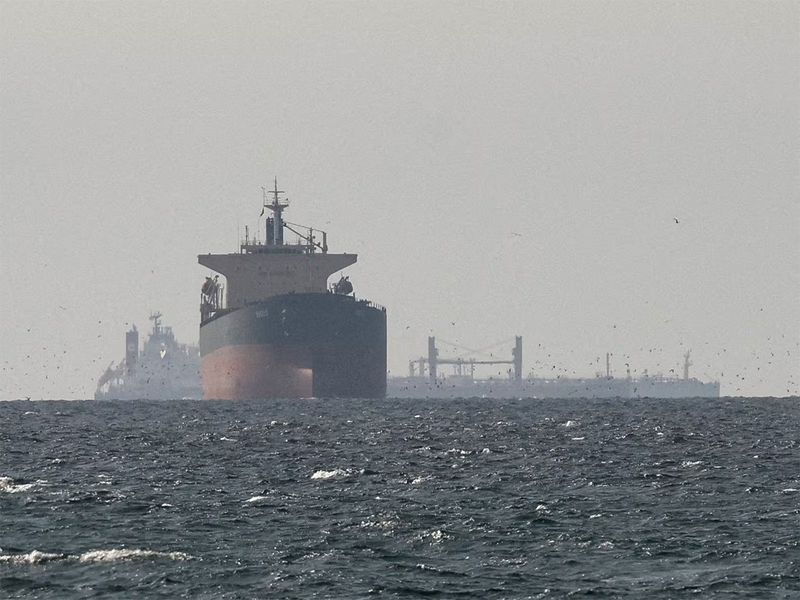

Backed by one of the largest naval deployments at sea in two decades, the US tonight imposed a blockade for maritime traffic entering or exiting ports in Iran in an effort to force Tehran to open the crucial Strait of Hormuz and accept a peace deal.Iran responded with threats on all ports in the Persian Gulf and the Gulf of Oman, taking aim at US-allied countries. It said any foreign military presence near the strait would be “met with a harsh and decisive” response, raising fears of direct confrontation in one of the world’s most sensitive maritime corridors. The fresh hostilities follow the collapse of the US-Iran negotiations in Islamabad last weekend. Oil prices again surged above $100 per barrel, while stock markets fell worldwide.As the blockade came into force at 7.30 pm, US President Donald Trump threatened to “eliminate any Iranian ship coming close to the blockade”. “If any of these ships come close to our blockade, they will be immediately eliminated, using the same system of kill that we use against the drug dealers on boats at sea,” said Trump.The US Central Command, which operates in West Asia, announced the blockade on Monday, saying it would be in the Gulf of Oman and the approaches to the Strait of Hormuz. It also said the action would not impact ships entering or exiting ports of other countries in the Persian Gulf. “Our forces will begin implementing a blockade of all maritime traffic entering and exiting Iranian ports on April 13 at 10 am ET,” the command posted on X. Analysts see the US blockade as parallel to the one set up by Iran at the Strait of Hormuz.Iran’s Navy Commander Shahram Irani dismissed the US move as “ridiculous and laughable”, insisting that Iranian forces were closely tracking all American naval activity in the region. “The Iranian Navy is monitoring every movement of the aggressor US military,” Irani was quoted as saying by Iranian Fars news agency.Chinese Defence Minister Admiral Dong Jun cited his country’s energy sources from Tehran and said, “We expect others not to interfere in our affairs. The Strait of Hormuz is open to us.”The US Central Command said the blockade would be enforced impartially against vessels of all nations entering or departing Iranian ports and coastal areas, including all Iranian ports on the Persian Gulf and the Gulf of Oman. “CENTCOM forces will not impede freedom of navigation for vessels transiting the Strait of Hormuz to and from non-Iranian ports,” the statement said. This means the US will be facilitating maritime trade at ports of other countries such as Saudi Arabia, Bahrain, Qatar, UAE, Kuwait and Iraq.The US military has asked mariners to contact through ‘Channel 16’, which is the open communication mode at sea between ships for transit.The US has pumped in its naval might at sea, with three carrier strike groups now converging in the region. The USS Abraham Lincoln is positioned in the Arabian Sea, the USS Gerald R Ford is in the eastern part of the Mediterranean Sea, while USS George HW Bush has entered the Mediterranean Sea from the Strait of Gibraltar. Two US amphibious ready groups–the USS Boxer and the USS Tripoli–are also in the region. Multiple US Air Force planes like KC-135, KC-46 refuellers and C-17 Globemaster are at staging areas in Jordan, Qatar and Israel. Analysts see this as the largest American naval and air concentration in the Persian Gulf since the 2003 invasion of Iraq.