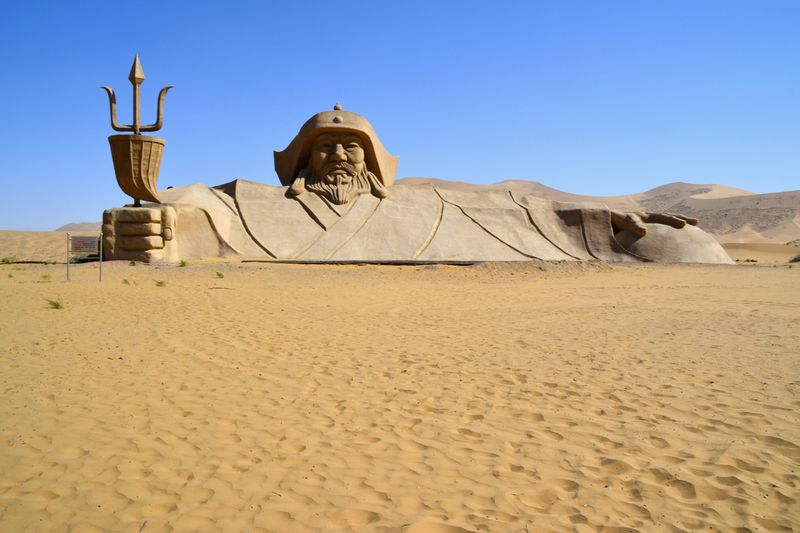

In a world that seems to be hurtling from one crisis to another, many people are talking about the Shambhala prophecy. This appeared in the early 11th century in a Buddhist Tantric text called the Kalachakra Tantra. At that time, Northwest India was under heavy military pressure from expanding Islamic powers. The prophecy was not really a religious vision. It was a political response, but written in the language of myth and cosmic prediction.At its heart, it carried an apocalyptic imagination. The text spoke of a future age of decline, when the world would fall under the rule of the mleccha, a word used for outsiders, here linked specifically with Islam. This was not described as a passing problem but a complete change in the world order. Existing religions, including Buddhism, would seem to fade as a powerful and disciplined rival faith took over.Into this collapsing world came a saviour, Kalkin Raudra Cakrin, the future king of the hidden land of Shambhala. Unlike earlier Buddhist ideals that praised withdrawal from the world, this figure was a warrior-king. He did not retreat. He stepped forward, leading an army into a final, massive battle. The prophecy described this as a holy war, in which the forces of Shambhala would crush the ‘demonic dharma’ of the invaders and restore balance to the cosmos. After this victory, a new golden age of pure Buddhism would begin, echoing older Indian ideas of cycles of decline and renewal.But the meaning of the prophecy did not stay the same. Over time, later interpreters softened its militant tone. What had once been a literal war against outside enemies was reimagined as an inner struggle. The battlefield moved from geography to the mind. The ‘barbarian’ was no longer only a foreign invader but also the ignorance, desire, and anger inside each person. In this reading, Kalkin became a symbol of awakened consciousness that destroys inner delusion.Still, even in its earliest form, the prophecy had a clear strategic purpose. It tried to draw boundaries and win loyalty. The text warned Brahmanical communities that their own rituals, especially animal sacrifice, made them similar to Islamic practices that also allowed ritual slaughter. This similarity, the text suggested, made them vulnerable to absorption into Islamic culture. The argument was not just religious; it was political persuasion.By stressing similarity, the prophecy hinted at inevitability, and then offered an escape through initiation into the Kalachakra system. In this way, it worked as a tool of conversion in a competitive religious world.Centuries later, the prophecy gained new life far from where it began. Among Mongol Buddhists in the 19th century, it was revived to shape identity against Muslim populations of Central Asia, often called Turkestanis. The Shambhala story gave a cosmic frame to ongoing conflicts. Real historical figures were pulled into this mythic structure. Genghis Khan, for example, was sometimes reimagined as an agent of the prophecy, a warrior destined to fight Islam as part of a larger cosmic drama.The Shambhala prophecy shows how mythology responds to historical crises. It turned fear into narrative, conflict into cosmology, and survival into destiny. And so, we repeat the ancient tale today as we watch the fall of Western cultures on social media.— The writer is an acclaimed mythologist