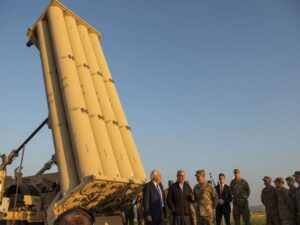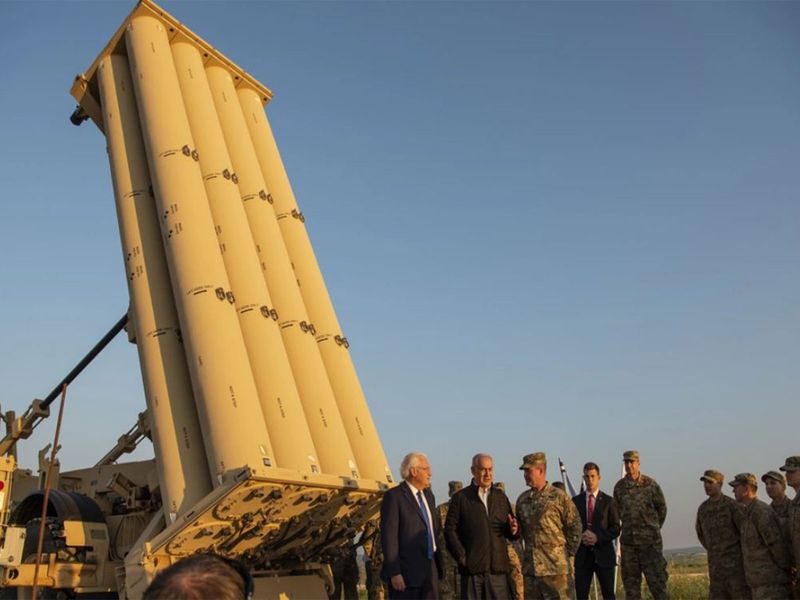

Washington DC [US], May 22 (ANI): The United States has depleted a significant portion of its advanced missile defence interceptor inventory after taking on a larger share of Israel’s air defence burden during the recent conflict with Iran, according to a report by The Washington Post.US officials, who spoke on condition of anonymity, said the imbalance has raised concerns about the United States’ readiness to meet its security commitments around the world, according to the American newspaper’s report.More than 200 Terminal High Altitude Area Defense (THAAD) interceptors were launched by the United States to defend Israel, along with more than 100 Standard Missile-3 and Standard Missile-6 interceptors fired from naval vessels in the eastern Mediterranean, depleting nearly half of the Pentagon’s inventory, US officials told the American daily.The officials, like others quoted in the report, spoke on condition of anonymity.Israel, meanwhile, fired fewer than 100 of its Arrow interceptors and around 90 David’s Sling interceptors, some of which were used against less sophisticated projectiles fired by Iran-backed groups in Yemen and Lebanon.Military analysts told The Washington Post that the data gives a rare peek into the scale of the US-Israel defence partnership.”The numbers are striking. The United States absorbed most of the missile defense mission while Israel conserved its own magazines. Even if the operational logic was sound, the United States is left with roughly 200 THAAD interceptors and a production line that can’t keep pace with demand,” Kelly Grieco, a senior fellow at the Stimson Center told The Washington Post.US allies such as Japan and South Korea are concerned over the shortage of interceptors, as both countries rely on the US security umbrella to deter threats from China and North Korea, the WaPo report added.”In total, the US shot around 120 more interceptors and engaged twice as many Iranian missiles,” another US official told The Washington Post, suggesting that the reality of the military burden was very different from the razzmatazz surrounding the depiction of the US-Israel partnership.The newspaper also reported that Israel’s military is expected to take some of its missile defence batteries offline for maintenance. Officials warned that if US President Donald Trump decides to resume military operations against Iran, pressure on US interceptor inventories could increase further.”The imbalance will likely be exacerbated if fighting restarts,” the report citing the US official said.The Pentagon defended the balance of military resources used between Israel and the US.”Ballistic missile interceptors are just one tool in a vast network of systems and capabilities that comprise a layered and integrated air defense network,” said Sean Parnell, the Pentagon’s chief spokesman.”Both Israel and the United States carried the defensive burden equitably during Operation Epic Fury, which saw both countries employ fighter aircraft, counter-UAS systems, and various other advanced air and missile defense capabilities with maximal effectiveness,” Parnell added.The Israeli government also defended the coordination between the two countries.”Operations Roaring Lion and Epic Fury were coordinated at the highest and closest levels, to the benefit of both countries and their allies,” the Israeli Embassy in Washington said in a statement. “The US has no other partner with the military willingness, readiness, shared interests, and capabilities of Israel.”It is not known if the said shortage factors in Trump’s mulling of restarting the military action, as earlier in the day, he reiterated that Iran cannot have a nuclear weapon.He also said that the US wants the Strait of Hormuz to remain open for international shipping.”We want it free. We don’t want tolls. It’s international. It’s an international waterway. They’re not charging tolls. Right now they are losing $500 million a day is what it’s projected. I don’t know, it sounds like a lot of money but whether it’s 500 or 200 or 300 they’re losing a lot of money. There hasn’t been a ship that’s been able to get through without our approval. And the Navy has done an amazing job. And no ship is going to Iran, as you know, no ship is going to or out of Iran without our approval,” Trump said.(ANI)(This content is sourced from a syndicated feed and is published as received. The Tribune assumes no responsibility or liability for its accuracy, completeness, or content.)