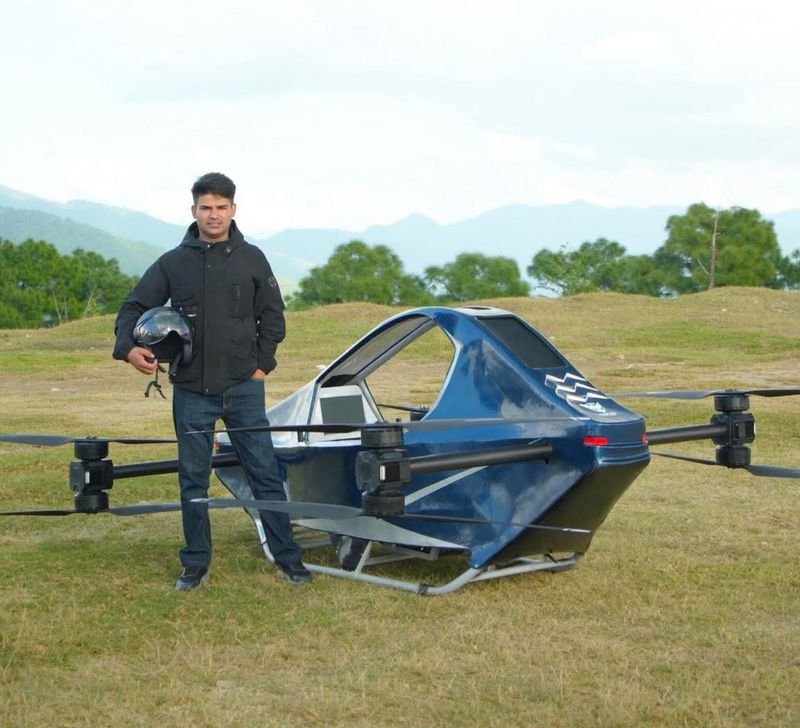

Around 13 years of experimentation have brought Uttarakhand’s innovator Ravi Tamta closer to his ambition of developing an electric flying vehicle. He is aiming to prepare a prototype for final trials and potential commercial use next year.In an exclusive interaction with The Tribune, Tamta said that daily test flights and technical trials were underway. The single-seater prototype, HAPIDA SKYNeX, was being upgraded to a two-seater version to improve connectivity in remote mountainous areas and facilitate access to hospitals during medical emergencies.Tamta, a resident of Kaflikhan village near Jageshwar Dham in Almora district, said that the proposed version could help people in Himalayan regions reach hospitals in developed cities more quickly, particularly where difficult terrain and long winding roads delay access to healthcare.“Our target is to prepare a prototype for final trials and potential commercial use within next year. Daily test flights and technical trials are underway and we are developing a two-seater version to improve connectivity in remote areas and help people reach hospitals during medical emergencies,” he added.Tamta said that the vehicle was expected to have a flying time of around one hour, potentially enabling journeys covering hundreds of kilometres in significantly less time than road travel. Its actual range and performance would depend on the final specifications and further testing.The prototype completed its maiden test flight at an Army helipad in Almora on August 7, remaining airborne for about a couple of minutes. District Magistrate Anshul Singh and Superintendent of Police Chandrashekhar R Ghodke were present during the demonstration, according to reports.Tamta is a Bachelor of Arts graduate without formal engineering qualifications and pursued the project through online learning, research and practical experimentation. He is the founder and Chief Executive Officer of Hapida Sky Private Limited.Despite progress, the project had not received financial assistance from the state government or any other institution, Tamta said. He expressed hope that support would materialise soon and the development of vehicle would be accelerated.Tamta also plans to explore other transport technologies. After the success of the flying prototype, he hopes to develop a vehicle capable of operating on land, in the air and on water.His earlier innovations reportedly include shoes designed to charge mobile phones, a smart walking stick for visually impaired people, a bamboo-splitting machine and firefighting equipment.The proposed technology can have applications in Himalayan states such as Himachal Pradesh, Uttarakhand and Jammu and Kashmir, where scattered settlements, steep slopes and limited road access complicate emergency transportation.However, further technical validation and regulatory approvals will be essential before commercial deployment. The proposed flying time, range and suitability for medical evacuation or passenger transport will also have to be established through testing.The coming year will therefore be crucial for Tamta as he seeks to advance the prototype towards a two-seater design and demonstrate its potential as an alternative mode of transport for mountainous regions.