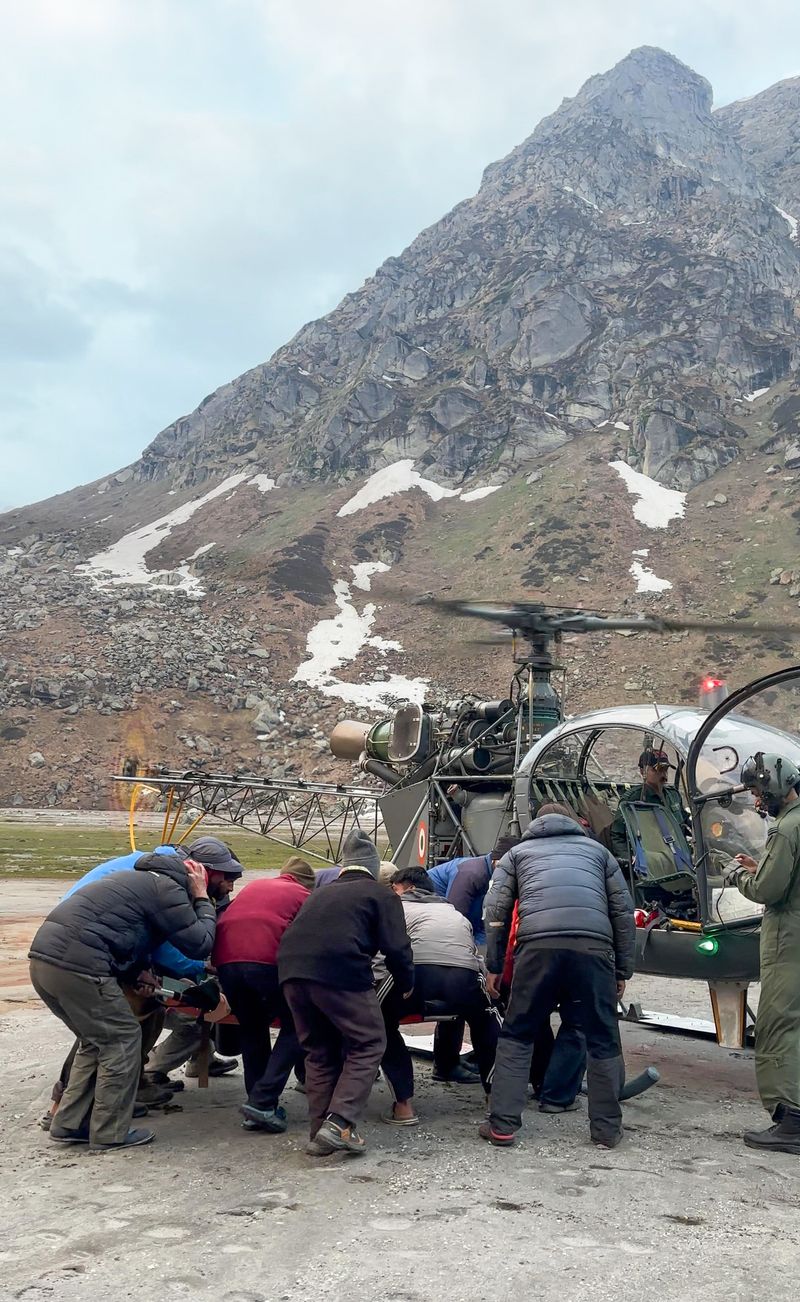

British cinematographer George Richmond, who survived a near-fatal cervical spine injury in a Himachal Pradesh paragliding accident earlier this month and underwent a rare and complex spinal surgery at the PGIMER in Chandigarh, has been discharged and airlifted back to the United Kingdom, where he will continue his long recuperation at home.Richmond was discharged from the PGIMER on the request of his wife, who had flown to India and remained steadfastly at his bedside through his 18-day treatment. His condition was stable and he was recovering well after the surgery, a doctor said on the condition of anonymity.Since he had not been put on a ventilator at any point after the surgery, his transfer by air to the UK posed no clinical hurdle. “His condition was stable and he was showing good signs of recovery. He will take time to recover completely given the gravity of his injury and the nature of the surgery he underwent. But the signs were encouraging,” the doctor said.Richmond’s wife, the sources said, preferred to have him recuperate in familiar surroundings at home in the UK for what is expected to be a prolonged rehabilitation.The 54-year-old cinematographer was part of a group of experienced paragliders who on June 8 trekked from Naggar in Kullu all the way up to the base camp of Deo Tibba, from where they jumped off.As Richmond’s paraglider crashed into the mountainside, those accompanying him raised the alarm. Following a coordinated rescue operation involving the local Himachal authorities and the Indian Air Force, he was evacuated from the site and airlifted to Kullu before being shifted to the PGIMER in the early hours of June 9.The injuries were catastrophic: a fracture of the C1 vertebra and a fracture-dislocation at the C5-C6 level, resulting in quadriplegia. After three days of stabilisation, the surgery was performed on June 12 by a multidisciplinary team. The key surgical achievement was a fluoroscopy-guided closed reduction of the fracture-dislocation–a technically demanding manoeuvre that restored spinal alignment and eliminated the need for a combined front-and-back surgical approach, significantly reducing operative risk. This was followed by decompression, reconstruction using an interbody cage with bone graft and stabilisation with a cervical plate and screws.The last health bulletin issued by the PGIMER on June 13 had said Richmond was conscious, responding to commands and communicating with his wife, though he had very limited movement in both arms and no movement in either leg.Richmond is among the most accomplished British cinematographers of his generation, known for ‘Deadpool and Wolverine’, ‘Rocketman’, ‘Free Guy’, the ‘Kingsman’ franchise and ‘Tomb Raider’. He is the son of veteran cinematographer Anthony B Richmond and a member of the British Society of Cinematographers. His most recent credit is ‘Now You See Me: Now You Don’t’ (2025).