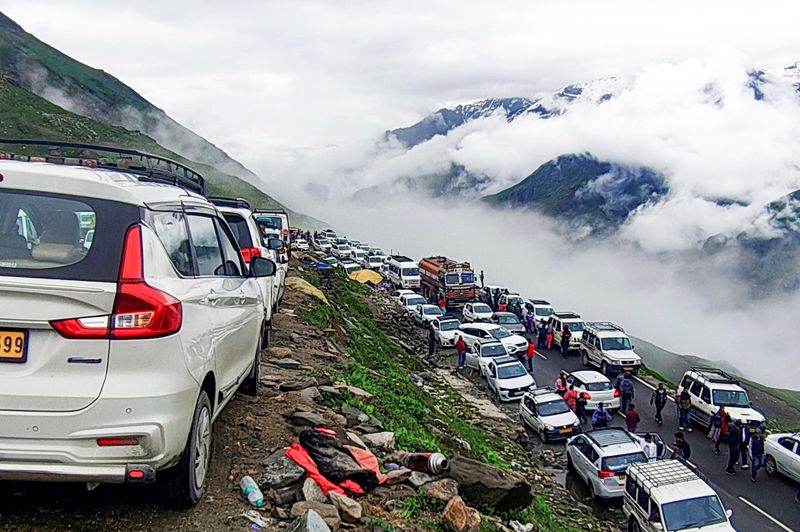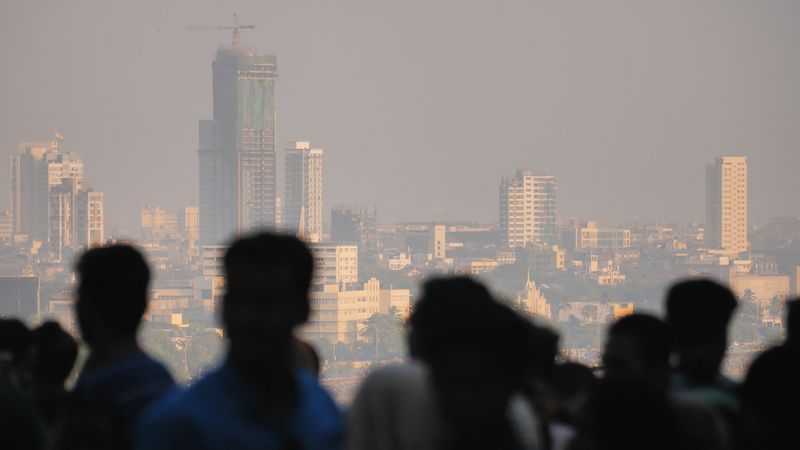

On a recent cab ride through one of India’s sprawling metros, the driver vented his frustration at the notorious traffic. “This is no city, it is a crowd,” he exclaimed. Looking at the unmoving rows of vehicles stretching endlessly ahead, the streams of people attempting to cross a chock-a-block road, and the continuum of construction projects rising above and burrowing beneath the ground, I conjured the image of the city as a hapless Gulliver pinned down by the tiny yet relentless armies of people, vehicles, buildings and bridges.“But this city is my only hope,” the driver said, after a pause. One among the countless migrants who had found no worthwhile employment in his hometown, the city represented chaos but also possibility. It was both burden and refuge for him. I was instantly reminded of the haunting song ‘Seene Mein Jalan, Aankhon Mein Toofan’ from ‘Gaman’, picturised on Farooq Sheikh against the backdrop of a restless Bombay — a metropolis that promises everything while demanding even more.Decades ago, Khushwant Singh described Bombay, before it became Mumbai, as “the only city” in India with enough high-rise buildings to resemble “a miniature New York”. He added, with characteristic wit: “It has other things to justify its city status: it is congested, it has traffic jams at all hours of the day, it is highly polluted and many parts of it stink.” Today, Mumbai faces stiff competition from almost every Indian metropolis in fulfilling those criteria.Architect Gerson da Cunha once observed that a city is the sum of its economic opportunities and its quality of life. Judged by that measure, which Indian metropolis can truly claim to offer both opportunity and a life of dignity for its citizens?The debate surfaces repeatedly on social media, where those who have lived in both India and the West compare the quality of urban life. The arguments are familiar: efficient civic infrastructure versus vibrant community life, cleaner air and water versus richer cultural life, order versus spontaneity. But the verdict remains elusive. Is a good city one that functions with mechanical precision, or one that accommodates the unpredictability of human life? Are Indian cities dystopias or utopias?Perhaps they are both. Or, as writer Margaret Atwood perceptively observes, “Within every dystopia, there is a little utopia.” The converse too is true, for can there truly be a perfect city? Atwood in fact coined the word ‘ustopia’, combining both the words and the disparate worlds they hold. Ustopia, she wrote, “is the imagined perfect society and its opposite — because, in my view, each contains a latent version of the other”. Ustopia, she said, is also “a state of mind, as is every place in literature of whatever kind”. This idea extends naturally to the city. It is never merely a collection of roads, buildings and infrastructure; it is also an emotional landscape, shaped by the histories, memories and everyday lives of its inhabitants.A city lives many lives and undergoes many rebirths. No single narrative can ever exhaust its meaning. Whether it is Singh’s ‘Delhi’, where the city becomes a layered chronicle of its past and present; ‘City of Djinns’, where William Dalrymple explores Delhi as a palimpsest, uncovering the overlapping histories and traditions that continue to shape its identity; ‘Maximum City’, where Suketu Mehta reveals Mumbai as a restless creature of ambition, crime, cinema and survival; or ‘City of Joy’, in which Dominique Lapierre portrays Kolkata through extraordinary resilience amid poverty — each offers a different way of seeing the city.For the historian, the city is a chronicle in stone and memory, for the sociologist, a pulsating social landscape, and for the political observer, it is a theatre of power. Every walk on its streets becomes an act of reading for the flaneur. For the storyteller, it offers an inexhaustible crucible of characters and contexts. And for the poet, it is indeed a state of mind — an emotion, a longing, a rhythm of life. That idea found a poetic expression: Poocha jo maine rooh se, ‘Yeh Dilli kya hai?’ Yeh sun ke boli, ‘Jism kul aalam hai, aur Dilli us ki jaan hai’ (I asked my soul: What is Delhi? She replied: The world is the body, and Delhi its life).Ultimately, the city each of us inhabits is intensely personal. One may not feel at home in it even after years of living there, while a passing traveller may forge an instant connection. Graham Greene wrote that however large a city may be, it finally consists for each person of only “a few streets, a few houses, a few people”. Remove those, and it survives only as “a pain in the memory, like a pain of an amputated leg”. The city we remember, however, is rarely the one that continues to exist.Perhaps that is the enduring paradox of the city: it belongs to everyone and yet to no one. Dalrymple has remarked that the Delhi he first encountered had become almost unrecognisable within two decades. That may well be the destiny of every city: to outgrow the stories written about it, even as it invites new ones.— The writer is a journalist based in Bengaluru