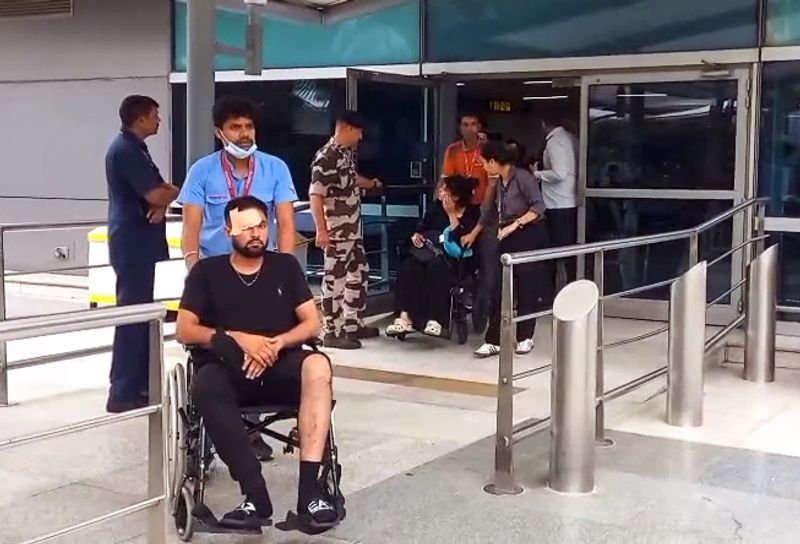

Air India on Friday terminated the services of the pilot-in-command of its Phuket-Delhi flight AI2379 with immediate effect after he tested positive for a psychoactive substance, hours after the preliminary investigation into the August 4 accident flagged the test result as a “serious concern” and sought priority action from the aviation regulator.“Safety remains Air India’s highest priority…. In line with our zero-tolerance approach towards violation of safety, fitness or regulatory requirements, the pilot’s employment has been terminated with immediate effect,” an Air India spokesperson said.The action came as the Aircraft Accident Investigation Bureau’s (AAIB) preliminary report revealed another critical aspect of the accident: the Air India A320 carrying 145 people lost pressure in all three hydraulic systems within four seconds while cruising at 36,000 feet, triggering an autopilot disconnect, a stall warning and a violent altitude upset.The accident left 24 persons, including 20 passengers and four cabin crew, injured, four of them seriously. The aircraft first climbed 372 feet and then fell 292 feet from its assigned flight level during the upset, an overall swing of 664 feet.The AAIB report said both pilots underwent post-flight breath-analyser tests after landing in Delhi and the results were satisfactory. However, both were also subjected to psychoactive substance detection tests.The pilot-in-command’s sample was found “non-negative”. Blood samples of both pilots were subsequently sent to a pathological laboratory, where the pilot-in-command’s confirmatory test was again non-negative while the co-pilot tested negative in both tests.“The confirmation of use of psychoactive substance is a serious concern,” the AAIB said, recommending that the Directorate General of Civil Aviation (DGCA) take “appropriate actions… on priority”.The preliminary probe report, however, does not link the test result to the mid-air upset or say that it contributed to the accident. The probable cause remains under investigation. The technical investigation is focusing on what caused the aircraft’s three separate hydraulic systems, Green, Blue and Yellow, to lose pressure almost simultaneously.The aircraft, VT-EXO, had taken off from Phuket with its Power Transfer Unit (PTU) under the minimum equipment list since July 28, seven days before the accident. Maintenance personnel had carried out a pre-flight inspection and recorded no fresh discrepancies, while the flight crew’s walk-around inspection also found none.The PTU provides auxiliary hydraulic pressure between the Green and Yellow systems without transferring hydraulic fluid between them. The AAIB has not established at this stage that the deferred PTU defect caused the hydraulic event. Relevant hydraulic components have now been removed for detailed examination.According to the second-by-second sequence in the report, at 04:02:43 UTC, while AI2379 was cruising at FL360, the flight-control system detected loss of the Green hydraulic system. Four seconds later, it detected loss of Blue and Yellow. At 04:02:48, the autopilot disengaged and a continuous warning chime sounded. Just three seconds later, the aircraft’s stall warning was triggered for two seconds.“The co-pilot, who was the pilot flying, responded and tried to control the prevailing situation. Subsequently, pilot-in-command took over the controls,” the AAIB said. The Blue hydraulic system recovered first, followed seconds later by Yellow and Green, restoring the flight-control surfaces.The aircraft’s post-flight report recorded “Hyd Green SYS LO PR followed by Blue and Yellow”, autopilot disengagement, left and right elevator faults and low reservoir levels in the Yellow and Blue hydraulic systems. Significantly, the occurrence was initially notified to the AAIB as a turbulence encounter, but the preliminary investigation records said that “no adverse weather was reported by the flight crew and the ATC”.The seat-belt signs were off when the upset occurred. The force inside the cabin cracked and deformed ceiling panels, dislodged overhead-bin doors, broke handrails, bent a crew seat and uprooted a lavatory commode.Despite the injuries, the crew assessed the situation after the hydraulic systems recovered and continued to Delhi instead of diverting to the nearest en-route airport. The pilots later sought medical priority from Delhi ATC and landed safely on Runway 11L.The pilot-in-command, 34, had 5,055 hours of flying experience, all on the A320, while the 32-year-old co-pilot had 1,393 hours. Both had a rest period of 21 hours and 59 minutes before the flight.The investigation is now examining why all three hydraulic systems lost pressure within seconds. Airbus technical experts assigned through France’s BEA inspected the aircraft from August 13 to 15, following which hydraulic components and samples were collected for testing. The AAIB is also analysing the cockpit voice and flight-data recorders, maintenance and operational records, fuel and oil samples and ATC data.