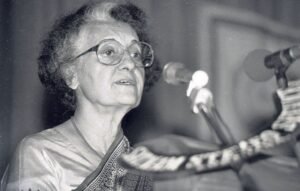

A British official responsible for the killing of seven young Indian protesters during the Quit India movement in 1942 later became an enthusiastic defender of Indira Gandhi’s Emergency — urging her to continue emergency rule “if not indefinitely”.Three months later, WG (Bill) Archer, then District Magistrate of Patna, and his wife were invited to tea at the Prime Minister’s residence.The evidence comes from two documents preserved in Archer’s papers: a letter he wrote to Gandhi on December 11, 1975, and an official letter dated March 1, 1976, recording the Prime Minister’s invitation to tea at 1 Safdarjung Road.Together, the documents provide an extraordinary link between two very different episodes in India’s modern history: the violent suppression of the Quit India movement and the Emergency imposed 33 years later.They also raise a troubling question: what happened to the British official responsible for the deaths of seven young Indians after independence?There was no apology or compensation for the families. Nor does there appear to have been any public reckoning with Archer’s role in their deaths.Instead, Archer built a career as a curator of Indian art, received honours from Indian institutions and ultimately became a welcome guest of the Prime Minister.Archer was District Magistrate of Patna in August 1942, when the Quit India movement was sweeping Bihar.On August 11, protesters marched towards the Patna Secretariat, determined to raise the Indian flag over the building.When local police refused to fire on the demonstrators, Gurkha troops were brought in.Seven young men were killed. Six were schoolboys.They were Umakant Prasad Sinha, Ramanand Singh, Satish Prasad Jha, Jagatpati Kumar, Devipada Choudhary, Rajendra Singh and Ramgovind Singh.Archer was the British magistrate in charge. The firing took place on his orders.The killings became one of the most horrific episodes of the Quit India movement in Bihar.Today, the seven are commemorated in Patna by the Martyrs’ Memorial, where bronze figures still stand carrying the flag.But what happened to Archer after independence?He returned to the UK in 1949 and became Keeper of the Indian Section at the Victoria and Albert Museum in London. Indira Gandhi herself backed his nomination for one of two honorary degrees from Indian universities.It was an extraordinary post-Independence rehabilitation for a former colonial official whose tenure in Patna had ended with the deaths of seven young Indians.He presented himself as a man who understood India and its culture, and that is how he described himself in the letter he wrote to Gandhi during the 1975 Emergency.On December 11, 1975, Archer wrote to the Prime Minister from his home at 18 Provost Road, London NW3.He said she must have been “bitterly aggrieved” that many supposed British “friends of India” had failed to understand or approve her decision to declare the Emergency.Archer commented that her “bold action” was the only possible one and said he admired and applauded her courage in dealing with those he regarded as enemies of India.He also described himself as someone who had “loved, known and served India”.Then he urged Gandhi to go further.“May I urge you to continue for some years if not indefinitely — your present course of action…”He said he was convinced that without “the strongest and firmest control from the Centre”, “traitors” would again surface and threaten India’s welfare and independence.It is difficult to read those words without remembering what Archer’s “service” to India had meant in 1942.The seven young Indians killed in Patna were demanding precisely the political freedom that the British Raj was denying them.Thirty-three years later, their former colonial magistrate was advising the Prime Minister of independent India to maintain emergency rule indefinitely.The story becomes still more extraordinary.On March 1, 1976, S. K. Sarkar of the Indian Council for Cultural Relations wrote:“Prime Minister Indira Gandhi has graciously invited Dr and Mrs Archer to tea on 14 March 1976 at 5.30 pm at the Prime Minister’s residence, 1 Safdar jung Road, New Delhi.”The invitation is significant for another reason.It refers to him simply as “Dr Archer” — the title he had adopted after receiving an honorary doctorate from an Indian university.Fourteen days later, Archer and his wife went to tea with Mrs Gandhi at her official residence.So, within three months of writing to the Prime Minister urging her to continue the Emergency “if not indefinitely”, Archer was being received socially by her at home.The seven boys he ordered killed were denied the opportunity to grow old, marry, have children or establish careers. Their families lost sons.Archer died in 1979.His papers remain in the British Library, including the extraordinary letter in which he advised India’s Prime Minister to retain the “strongest and firmest control from the Centre”.The seven young Indians died carrying the Indian flag.Their story tells us something about colonial violence, post-Independence memory and the extraordinary ways in which some figures of the Raj were subsequently embraced by the country they had once governed.