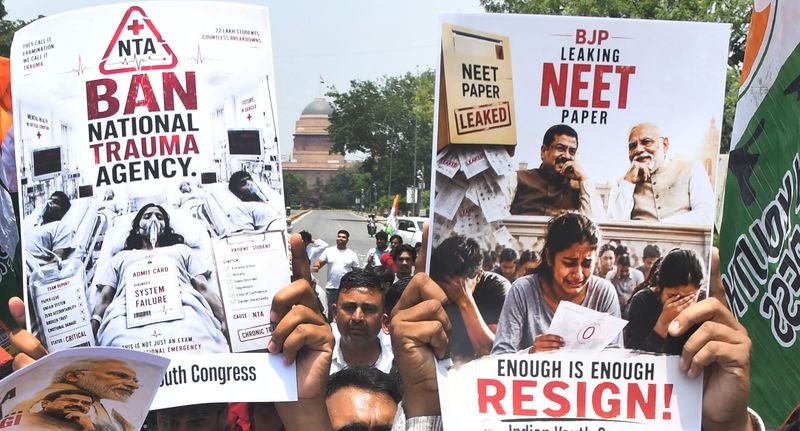

The Centre on Tuesday restricted access to the Telegram messaging app till June 22, a move the National Testing Agency (NTA) claimed was taken to protect the integrity of the NEET-UG re-examination on June 21 even as students and advocacy groups, including the Internet Freedom Foundation, cried foul.NTA Director General Abhishek Singh said the restriction on Telegram was part of efforts to ensure the re-test was conducted without malpractice.The directions have been issued by the Ministry of Electronics and Information Technology (MeitY) on the recommendations of the NTA. A separate direction requires Telegram to disable in India the message-editing feature for already-posted messages till June 30, addressing the specific structural feature through which the platform has been used to fabricate after-the-event “paper leak” evidence in respect of national examinations, the NTA said in a statement.The NTA said the measures were adopted on the basis of reports by law enforcement agencies regarding the alleged use of Telegram in spreading misinformation about the re-examination.High security adds to exam stress: AnnamalaiThe arrangements for a high-level, classified, military-grade security and AI face recognition for NEET retest on June 21 only add to the already ballooning exam pressure of candidates and would create a new set of problems, former BJP state chief K Annamalai said on Tuesday.Telegram permits a channel administrator to edit the content of a previously posted message, including the substitution of attached files such as PDFs, while the original send-time stamp is retained.“This feature has been used in respect of multiple recent examinations to fabricate after-the-event ‘paper leak’ artefacts: a channel administrator edits an older, innocuous message to insert the actual question paper after the examination has been conducted, and the resulting chat is then circulated as purported ‘evidence’ that the paper was in circulation before the examination. The MeitY direction closes this avenue of fabrication for the post-examination window in which such artefacts have historically been deployed,” the NTA said.The Bihar Police Economic Offences Unit issued a formal public advisory on June 9, warning candidates against fraudulent claims of pre-examination access to the paper circulated through Telegram and other platforms.India has ‘punished’ over 150 mn people: FounderTelegram founder Pavel Durov said by temporarily banning the app in the country, the Indian authorities have “punished” over 150 million ordinary users. The ban has not stopped anything and the leaks “simply moved to other apps”, Durov said.Google removes app from Play Store, Apple may follow suitGoogle has removed messaging app Telegram from its Play Store and Apple is likely to follow suit in compliance with a government order, sources aware of the development said on Tuesday.Likewise, the Ahmedabad City Cyber Crime Branch arrested members of an inter-state cyber fraud gang found to be operating eight Telegram channels with documented transactions of approximately Rs 1.5 crore routed through fraudulent bank accounts and approximately 1,000 mobile numbers contacted in a single month.The Internet Freedom Foundation said the move was “reactive and ineffective and would punish ordinary users instead of addressing the systemic source of exam leaks”.“This blocking comes in the final days of NEET preparation when thousands of students depend on Telegram for study groups, doubt-clearing and shared resources. Also, it is important to consider that the source of exam paper leak will occur from inside the system, among insiders and across the printing and logistics chain, with the platform being the most downstream channel for distribution,” it said.Nisarga Adhikary and Sarthak Sidhant, students who exposed flaws in the CBSE tender and the on-screen marking system, have also opposed the move.IIT-Kanpur Director Manindra Agrawal said, “The problem with Telegram channel is not sharing of leaked paper, but that it can be used to spread fake news of leak that appears genuine. It was done by someone during JEE-Advanced. It causes unnecessary confusion.”