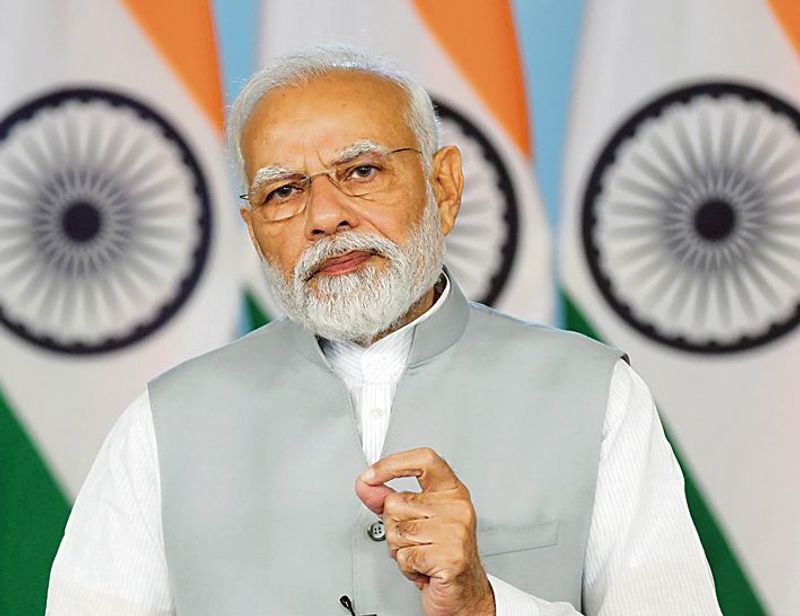

Ahead of Prime Minister Narendra Modi’s visit to the Scandinavian country of Norway from May 18 to 19 as part of his five-nation tour, former Norwegian Minister and ex-head of the United Nations Environment Programme (UNEP) Erik Solheim, praised the Indian head of the government for his leadership. He noted that Western leaders have “a lot to learn” from him while calling him the “world’s most popular politician”.In an article published in Norwegian newspaper Dagens Naeringsliv, Solheim highlighted Modi’s economic reforms, and push for green growth. “Western leaders can learn a lot from Modi’s constant green message,” Solheim wrote, adding that the Nordic Prime Ministers should “listen carefully” during their meeting with the Indian leader.“Whilst Nordic prime ministers barely enjoy a domestic approval rating of 30 per cent, Modi stands at around 70 per cent in the polls. No leader in any major country is nearly as popular at home as Modi,” Solheim wrote.He said that Modi’s background is almost unique in a world where almost all heads of state come from the upper middle class. “Modi’s parents owned three stalls where they sold tea at the railway station in Vadnagar,” he wrote, adding that Modi had “no one to thank for his career but himself – and the Hindu nationalist movement.””The Indian economy is now growing at seven per cent, higher than China’s, far above any other major economy,” he wrote, adding that India’s economy could become the world’s second largest by 2050 if current growth trends continue.Solheim praised PM Modi’s emphasis on renewable energy and sustainable development, describing him as “the guarantor of green growth”.He also praised India’s infrastructure and renewable energy development, citing projects such as modern airports, improved roads, and large-scale solar and hydropower initiatives. “I have travelled to almost every state in India and seen the signs of development everywhere — new modern airports; better-built roads to the most remote corners; the world’s largest solar park under construction in Gujarat; and the world’s largest solar-wind-hydropower plant in Andhra Pradesh,” Solheim wrote.He said that India, under PM Modi, has emerged as a global renewable energy leader and could soon overtake the United States in solar and wind power generation, noting that the Prime Minister’s messaging on climate issues focuses on development through sustainability rather than sacrifice.Solheim wrote that Modi is fortunate to be leading a rapidly developing India.“The Indian economy is currently growing at seven per cent, faster than China’s and far outpacing any other major economy. Growth is uneven, and there is a wide gap between the richest and poorest states in India. India lacks the highly educated workforce that China has. There is still too much bureaucracy, and India has not managed to develop any major export industry for the global market. But at current growth rates, India’s economy will quadruple by 2050. India will then be the world’s second-largest economy, rivalling the US,” he wrote.Solheim said while the critics are right that the BJP stands for the unification of Hindus, there is little evidence that there have been more conflicts between Muslims and Hindus under the BJP. “There was more violence and more pogroms when the Congress Party was in power,” he added. However, at the same time, the former UNEP chief noted that the “real test” for India’s future would be ensuring inclusion for the country’s Muslim minority within the framework of a rising India.“Even if secular parties were to win the next election, India’s ideology will remain Hindu nationalism. Hindu nationalism is India’s answer to the question that all non-Western countries have faced since the Industrial Revolution. How to modernise without becoming like the West? Japan was the first to untangle that knot – becoming ultra-modern, yet remaining deeply Japanese. Korea is now richer than Japan and a major exporter of Korean culture and music. China anchors its modernity in its own roots – in Confucianism, Taoism and Buddhism,” he wrote.