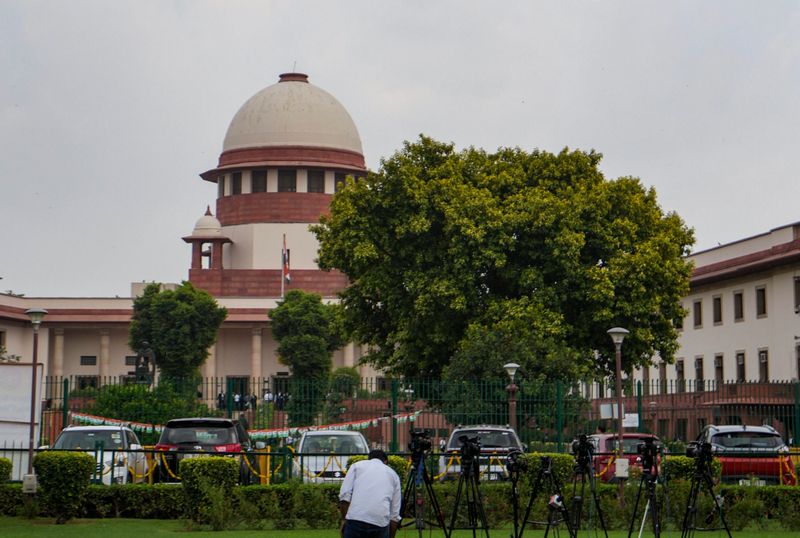

Married daughters can’t be excluded from compassionate appointment and their omission from the definition of “family” is manifestly arbitrary, unjustified and constitutionally untenable, the Supreme Court has ruled.“It is incompatible with the constitutional guarantee of equality and perpetuates historical notions of gender inequality which the Constitution seeks to eradicate,” a Bench of Justice PS Narasimha and Justice Alok Aradhe said in an order on Tuesday.Setting aside a March 2025 order of the Allahabad High Court that held the definition of “family” doesn’t include a married daughter for the purpose of compassionate appointment, it said marital status was irrelevant to dependency and exclusion of married daughters perpetuated gender stereotypes in violation of Article 14 (right to equality) and Article 15 (right to non-discrimination).The order came on an appeal filed by one Kulsum Nisha — a married daughter of a deceased woman fair price shop dealer — challenging the high court’s order that had rejected her claim for appointment as a fair price shop dealer on compassionate grounds.Writing the judgment for the Bench, Justice Aradhe ruled that dependency was not a matter of gender but was a question of fact and therefore can’t be conclusively determined by marital status alone.“The impugned provision proceeds on the assumption that upon marriage a daughter ceases to be a member of, or dependent upon, her parental family. Such an assumption is constitutionally impermissible. Marriage neither extinguishes the bond between a daughter and her parental family nor furnishes a valid basis to presume absence of dependency. Contemporary social realities demonstrate that many married daughters continue to reside with, support, or remain dependent upon their parents.”The Bench directed the Uttar Pradesh authorities to allot a fair price shop in four weeks in favour of petitioner Kulsum Nisha who continued to reside with her mother and four sisters even after her marriage and supported the family.Nisha had applied for running the fair price shop after her mother’s death in March 2024. But citing an August 2019 rule issued under the Uttar Pradesh Essential Commodities (Regulation of Sale and Distribution Control) Order, 2016 that excluded married daughters from the definition of ‘family’, the authorities turned down her application.In March 2025, the Allahabad High Court upheld the definition of family that excluded married daughters for the purpose of compassionate appointment.However, the Supreme Court reversed the high court’s decision.Noting that the rule did not exclude all daughters and “unmarried, legally separated or widowed daughter” were entitled to continue running the fair price shop, it directed the UP authorities to henceforth include married daughters under the definition of ‘family’.“A son continues to remain within the fold of the family irrespective of his marital status, whereas a daughter is excluded solely because she is married. The distinction is founded upon a gender-based stereotype that a daughter, upon marriage, becomes a member of another family and loses all ties with her natal family,” the top court said.“We are, therefore, of the considered view that the exclusion of married daughters from the definition of “family” fails the test of reasonable classification and is manifestly arbitrary. The distinction created by Paragraph IV(10) of the G.O. lacks any intelligible differentia having a rational nexus with the object of the scheme. The exclusion is founded solely upon marital status and gender stereotypes and consequently, violates Articles 14 and 15(1) of the Constitution of India,” the top court said.