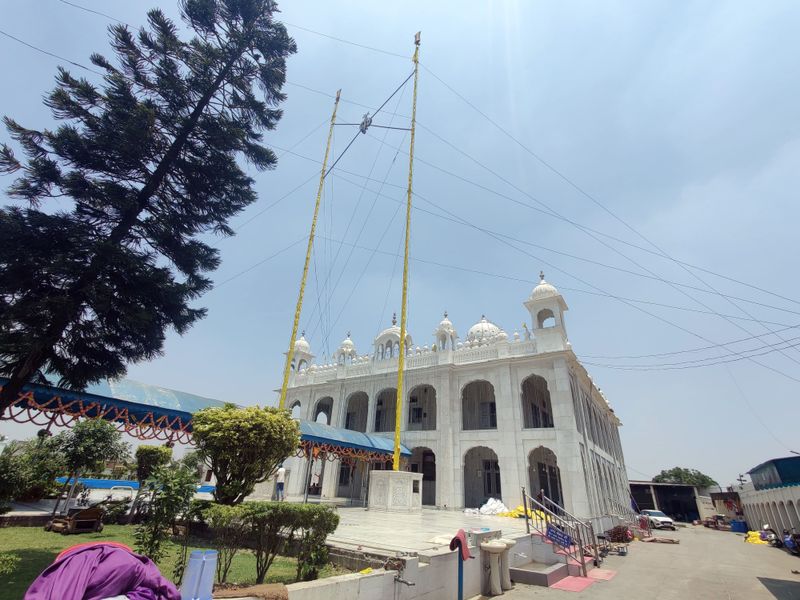

Located on the southern outskirts of Amritsar, Gurwali is a village steeped in history and tradition. Far more than an ordinary rural settlement, it occupies a unique place in Sikh heritage as part of a vast battlefield that witnessed several conflicts between the Sikhs and invading forces, from the Guru period to the era of the Sikh Misls.The historic battlefield stretched across the villages of Gurwali, Chabba, Chatiwind, Varpal and Gohalwar. Today, numerous shrines, memorials, and ‘samadhs’ scattered across the region bear testimony to its turbulent past.Gurwali village is known by two names. According to local tradition, it was originally called Gillanwali because the majority of its inhabitants belonged to the Gill clan of Jats. Over time, owing to its close association with the Sikh Gurus and its proximity to Amritsar, it came to be known as Gurwali. Both names continue to be used by area residents.Situated on the Amritsar-Tarn Taran road on the outskirts of the village is Gurdwara Sri Sangrana Sahib, a revered shrine commemorating the First Battle of Amritsar, one of the most significant military engagements in early Sikh history.The shrine marks the martyrdom of 13 Sikh warriors, who laid down their lives while defending the city and their faith under the leadership of Guru Hargobind.The origins of the battle can be traced to an incident involving a prized white hawk belonging to Mughal Emperor Shah Jahan.Historical accounts state that Guru Hargobind Sahib and his Sikhs were hunting near Gumtala when the imperial hawk — a gift from the then Shah of Iran — pursued a bird and eventually came into the possession of the Sikhs.When Mughal officials demanded its return, the Sikhs refused. The matter was, according to historical accounts, exaggerated before the Mughal authorities, who interpreted it as a challenge to imperial authority.Shah Jahan subsequently ordered military action against the Sikhs. A force of around 7,000 soldiers led by Mukhlis Khan marched towards Amritsar in May 1629.Guru Hargobind had not anticipated such a swift attack, but once the challenge was posed, the Sikhs accepted it with courage and determination.Fierce fighting broke out around Pipli Sahib, Lohgarh Fort, and the surrounding countryside. Sikh warriors — including Bhai Bidhi Chand, Bhai Bhana, Bhai Singha, Bhai Nihala, Bhai Tota and Bhai Triloka — distinguished themselves through acts of extraordinary bravery.A father’s sacrifice; a community’s valourThe battle was particularly remarkable because it took place at a time when preparations were underway for the wedding of Bibi Viro, the daughter of Guru Hargobind Sahib.Despite the personal occasion, the Guru devoted himself entirely to defending the Sikh community, and the city of Amritsar. The fighting continued for days, with Sikh forces successfully preventing Mughal troops from advancing towards Darbar Sahib.One of the most dramatic moments of the conflict occurred near present-day Gurwali, when Mukhlis Khan challenged Guru Hargobind Sahib to single combat.The two armies stepped back as the opposing commanders faced each other in a duel. According to Sikh tradition, Guru Hargobind Sahib first unhorsed Mukhlis Khan before engaging him in hand-to-hand combat. In the decisive exchange, the Guru struck a powerful blow with his sword that pierced the Mughal commander’s shield and fatally wounded him.With the death of their leader, the Mughal ranks collapsed and the remaining troops fled the battlefield.Although victorious, Guru Hargobind Sahib instructed the Sikhs not to pursue the retreating enemy, demonstrating the Sikh code of warfare and restraint even in triumph.Following the battle, the Guru personally supervised the cremation of the fallen Sikh warriors.Thirteen Sikhs attained martyrdom during the battle. They are remembered as Bhai Nand, Bhai Jaita, Bhai Pirana, Bhai Tota, Bhai Triloka, Bhai Sai Das, Bhai Paida, Bhai Bhagtoo, Bhai Nanta, Bhai Nihala, Bhai Takhtoo, Bhai Mohan, and Bhai Gopal. To honour their sacrifice, Guru Hargobind Sahib established Gurdwara Sri Sangrana Sahib, ensuring that future generations would remember their courage and devotion.The shrine is also associated with another popular local tradition. It is believed that Mata Sulakhni of Rabbe village received the blessings of Guru Hargobind Sahib at this site, and was blessed with seven sons.This belief continues to draw devotees seeking spiritual solace and blessings.