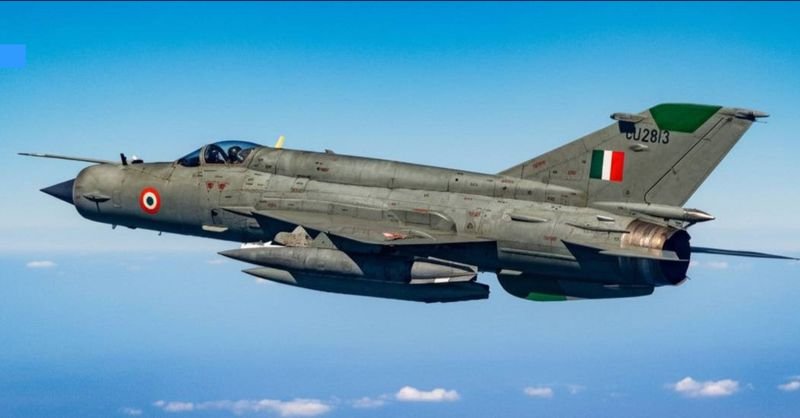

As new Netflix series ‘Operation Safed Sagar’ revived memories of the first-ever low level night bombing operations in the mountains by the Indian Air Force (IAF) during the 1999 Kargil conflict, it brings to mind an arduous reconnaissance mission that a sister squadron had undertaken deep inside Pakistan Occupied Kashmir (PoK) in 1985.The unit involved – No 17 Squadron, the Golden Arrows in Kargil and No.101 Squadron, the Falcons in POK had then employed the Soviet-origin MiG-21 fighter for their respective missions. The Golden Arrows initially carried out photo-recce operations during Operation Safed Sagar, as the air component of the Kargil conflict was code-named, before developing techniques for night bombing. These are now equipped with the French Rafale multi-role aircraft and based at Ambala and Hasimara, respectively.The recce operation, undertaken over Skardu in the early days of the Siachen campaign, is among the rare publicly known peacetime missions inside enemy airspace. Though there is no official word about the mission, over the years some military historians and aviation writers have pieced together a few details.Intricate planning, assessing the threat perception and enemy radar cover, selecting ingress and egress points and carefully charting out the flight routes and coordinating the fighter cover was the hallmark of the Skardu and Kargil missions. Unlike Kargil, Skardu involved penetrating enemy airspace and flying over hostile territory.When Operation Meghdoot, India’s campaign to take control of Siachen Glacier, the world’s highest battlefield, commenced in 1984, monitoring activities at Skardu was critical due to its role in supporting Pakistan military operations in the Siachen Glacier region.Strategically significant, Skardu is situated in the Gilgit-Baltistan region, about a 100 kilometers from the Line of Control and about 230 kilometers north-west of Leh. Besides a large airbase, it is also houses several operational and logistics formations.A MiG-21M Type-96 jet from No.101 squadron equipped with an under-belly pod carrying a Vinten-751 panoramic camera, a MiG-21M streaked through the Shyok valley, flying just a couple of hundred feet above the ground and made a daring run over Skardu, photographing its newly laid runway and adjacent areas to collect intelligence on Pakistani aircraft, airfield status and logistics.The Shyok is a major tributary of the Indus River that originates from the Rimo Glacier in the eastern Karakoram and flows through northern Ladakh into Gilgit-Baltistan before merging into the Indus near Skardu, located at an elevation of 7,300 feet. In comparison, the altitude of Leh airbase is 10,680 feet.The pilot employed low-level penetration at high speed to evade radar, navigating by maps and visual landmarks due to limited aids available in the remote terrain. Other fighter aircraft provided cover.The Falcons at that time was commanded by Wing Commander Jeffrey Reginald McKerroe, commissioned in 1966, as part of the 96th Pilot Course, the same batch that also produced the IAF’s first Mirage-2000 commanding officer, when the aircraft were inducted into No.7 Squadron after it moved from Chandigarh to Gwalior in 1985.There are very few publicly known instances of the IAF overflying enemy territory for recce during peacetime, though the now retired MiG-25R with its near Mach 3 speed and operating altitude beyond the reach of Pakistani and Chinese missiles was extensively employed for such missions. One such reported instance that stands out was a MiG-25 pilot “intentionally” breaking the sound barrier over Islamabad in 1997.The Falcons, named after its squadron crest that bears a trained hunting falcon, symbolising keen eyesight and quick killing ability, first took to air as the No.101 Photo Reconnaissance Flight in January 1948 with Spitfire aircraft. The IAF’s first photo-recce unit, it achieved full squadron status in April 1950, according to the IAF’s official history.Over the years, the squadron flew Harvard and Vampire aircraft, carrying out recce missions along the Himalayan frontier in 1962 and bombing missions in 1965 from its base in Adampur, before entering the supersonic era with the Soviet Su-7 ground attack aircraft. It was with the Su-7 that the squadron went to war in 1971 neutralising Pakistani armour, gun positions and troop concentrations in the Chhamb Sector on the western front and earning the sobriquet ‘Falcons of Chhamb’.In 1981, the Squadron converted to the MiG-21M and moved to Sirsa and then back to Adampur in 2002, before being ‘number-plated’, that is retired, in 2011 after its aircraft were decommissioned.The Falcons were resurrected in June 2021 at Ambala with four newly received Rafales, becoming the second IAF unit after the Golden Arrows in 2019 to operate this aircraft. Falcons moved to the north-east soon thereafter and have achieved full squadron strength. While the Golden Arrows was the most highly decorated squadron of the Kargil war, the Falcons was the most highly decorated squadron of the 1971 India-Pakistan war.Recently, the Falcons had flown around 7,000 kms across the Bay of Bengal, Indian Ocean and Timor Sea to Darwin on the northern coast of Australia to participate in Exercise Pitch Black that involved 100 aircraft and 2,500 personnel from 21 countries. This was the first time that the IAF fielded the Rafales in this exercise, of which India has been a part since 2018.