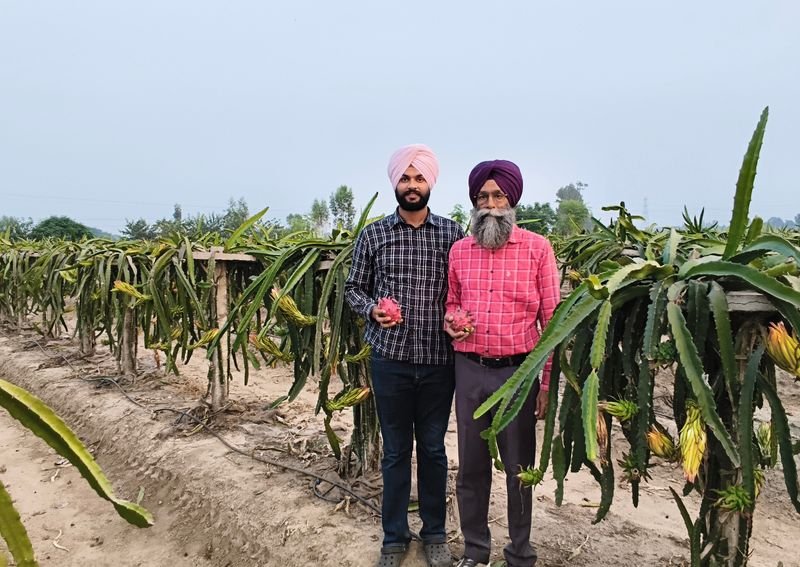

After quitting his teaching job, 27-year-old Gurjodh Singh from Bholath in Kapurthala turned to dragon fruit cultivation to help his retired father, Rajinder Singh, fulfil a lifelong dream of owning an orchard.A postgraduate in political science from Guru Nanak Dev University, Gurjodh was preparing for the civil services alongside his teaching job when his father expressed his desire to explore dragon fruit cultivation, citing its economic viability and relatively lower water requirement.Gurjodh recalled learning the basics of the crop by watching YouTube videos before beginning cultivation on one acre in 2022 with his father. However, the father-son duo’s maiden attempt was not successful as nearly 50 per cent of the produce was damaged.“It took us almost a year to get our first sample fruits. Initially, it took time to understand the impact of extreme weather conditions and the irrigation techniques required to produce healthy fruit,” said Gurjodh. The setback prompted him to seek expert guidance. He visited Punjab Agricultural University (PAU), where he approached Jaswinder Singh Brar, principal fruit scientist, who was conducting trials on dragon fruit cultivation.Later, Gurjodh sought guidance from Krishi Vigyan Kendra (KVK), Kapurthala, where he learnt cultivation practices such as flood irrigation, managing fungal infections, preventing sunburn caused by extreme hot conditions and intercropping to improve productivity.Having gained experience and technical knowledge over time, Gurjodh expanded his orchard and is now cultivating the ‘American beauty’ red-flesh variety of the fruit on six acres. Speaking on the benefits of the variety, he said the fruit had pink skin and pulp and offered a better shelf life. “It is also less prone to cracking and has good market appeal and value,” he added.Gurjodh sells the fruit in retail markets in Jalandhar, Ludhiana and Chandigarh for Rs 150 to Rs 200 per kg. He said dragon fruit cultivation was economically viable and provided two to three times the returns as compared to traditional wheat and paddy cultivation per acre.The progressive farmer is now looking beyond the domestic market and aspires to export the fruit to European and Latin American countries, where, by his estimate, it can fetch around 8 to 9 dollars per kg.Talking about the future of his venture, Gurjodh said he wanted to explore value addition to improve the financial viability of dragon fruit farming. Citing examples of farmers in southern parts of India who make jams, dried chips, jellies and juice from the fruit, he said he planned to learn about the machinery and processing techniques required to make the derivative products.