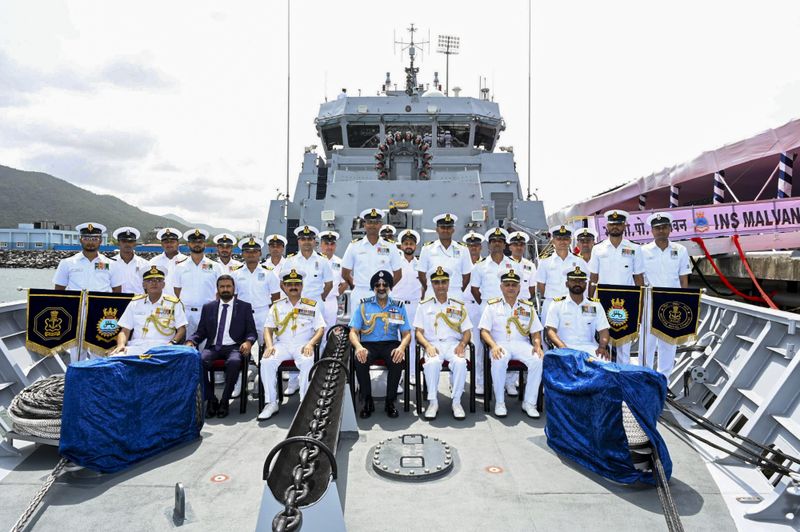

The Indian Navy on Wednesday commissioned INS Malvan, a state-of-the-art next-generation warship designed to detect and neutralise enemy submarines in shallow waters.Classified as an Anti-Submarine Warfare Shallow Water Craft (ASW-SWC), INS Malvan was commissioned at Karwar in the presence of Indian Air Force Chief Air Chief Marshal AP Singh, who presided over the ceremony.The commissioning marks the Navy’s fifth induction of a major vessel in the past month. Three frontline warships —INS Dunagiri, INS Sanshodhak and INS Agray — were commissioned on June 21, while INS Mahendragiri joined the fleet on July 11.INS Malvan is the second vessel of the indigenously designed and built Mahe-class ASW-SWC being constructed by Cochin Shipyard Limited (CSL). The Navy is set to induct 16 such vessels under a project worth nearly Rs 13,000 crore. CSL and Garden Reach Shipbuilders & Engineers (GRSE) have been contracted to build eight ships each.The primary role of these vessels is to detect, track and engage enemy submarines, particularly in coastal and shallow-water areas. Equipped with advanced underwater sensors, including the Abhay hull-mounted sonar, an underwater acoustic communication system and low-frequency sonar, the ships are capable of extensive underwater surveillance.To counter underwater threats, the vessels are equipped with a modern weapons suite comprising lightweight torpedoes, rockets, anti-torpedo decoys and advanced mine-laying capabilities.The ship derives its name from the historic coastal town of Malvan in Maharashtra, a region closely associated with the maritime legacy of Chhatrapati Shivaji Maharaj.Addressing the gathering, Air Chief Marshal Singh underscored the critical importance of securing sea lines of communication to ensure uninterrupted maritime trade amid global uncertainties. He praised the Navy’s rapid modernisation and its commitment to the Aatmanirbhar Bharat initiative, highlighting that INS Malvan has more than 80 per cent indigenous content.Drawing inspiration from the Navy’s practice of embedding officers in the shipbuilding process, he suggested that similar approaches could accelerate self-reliance across the broader defence ecosystem.The Air Chief also reaffirmed the vision of tri-service integration, calling for seamless jointness among the Army, Navy and Indian Air Force to ensure the country operates as a unified force in future conflicts.