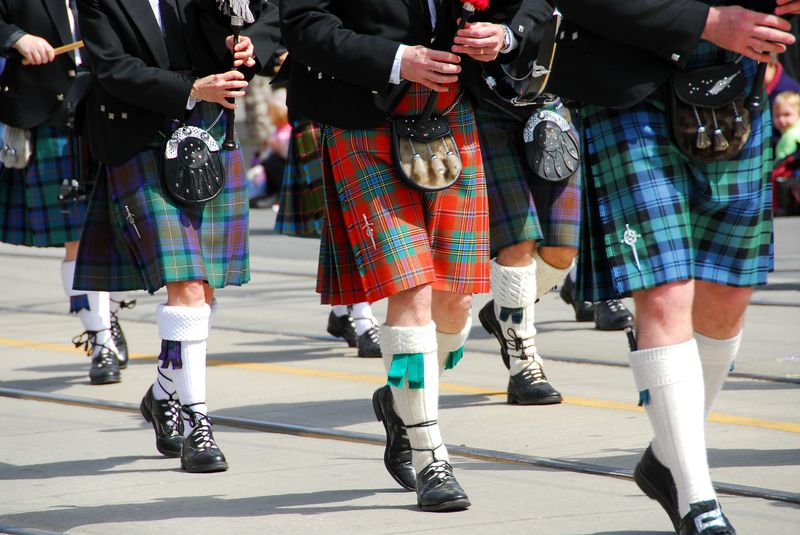

Wearing a traditional kilt, a British Army officer in full military regalia of the Royal Regiment of Scotland attracted considerable attention during the state visit of King Charles III of the United Kingdom to the United States this week. But little known is the fact that the Regiment traces its martial heritage to India, with all seven Victoria Crosses its boasts off being awarded during operations 169 years ago in Lucknow.The officer, Lieutenant Colonel Jonathan Alan Thompson, senior equerry to the King, belongs to the Fifth Battalion of the Royal Regiment of Scotland. The Regiment was raised in 2006 after reorganisation and the erstwhile Argyll and Sutherland Highlanders was amalgamated into it to form the fifth battalion. Thompson was seen along with the King at official events at the White House in Washington as well as other places.The Argyll and Sutherland Highlanders was formed in 1881 by the amalgamation of the 91st Princess Louise’s Argyllshire Regiment and the 93rd Sutherland Highlanders Regiment. The 91st was raised in 1794, while the 93rd came up in 1799.Deployment to IndiaBoth these regiments were sent to India in 1957 to form part of the East India Company’s forces to counter what in India is termed as the First War of Independence and the British call the sepoy mutiny.The 93rd Sutherland Highlanders was redirected from duties in China and it arrived in Calcutta on September 20, 1857. From there they made the 600-mile journey to Cawnpore (now Kanpur). A month earlier this had been the site of a large-scale massacre by rebels who had since secured themselves in the Governor’s Residency at Lucknow, according to information posted on the regimental museum’s website.“By 14th November the Regiment, totalling 934 men, was formed up to the south of Lucknow, with the task of freeing those trapped in the besieged Residency. On 16th November the main attack on the Secundrabagh, a large villa and walled garden, started at 6 am. This was a strongpoint for the sepoys. After more than an hour, the men of the 93rd succeeded in making a hole in the wall. The fighting that followed was bloody and hand-to-hand, and extreme violence occurred on both sides. By 3 pm, the action was complete,” the website states.For their actions on November 16, 1857, six men of the 93rd received the Victoria Cross, newly instituted by Queen Victoria and the highest British award for gallantry in the face of the enemy.The recipients included Captain William George Drummond Stewart, Colour Sergeant James Munro, Sergeant John Paton, Lance Corporal John Dunley, and Privates Peter Grant and David Mackay.The regiment’s seventh Victoria Cross was awarded to then Lieutenant William McBean for his actions at Begum Bagh in Lucknow in March 1858. He had joined the regiment as a Private and rose to the rank of Major General.In his volume, ‘Historical records of the 91st Argyllshire Highlanders, now the 1st Battalion Princess Louise’s Argyll and Sutherland Highlanders’, published in 1891, Lieutenant Colonel Gerald Lionel Joseph Goff, a regimental officer and a British magistrate, states that the 91st had embarked for Alexandria in September 1858 and then proceeded to India for helping the British forces.The vessels ferrying the regiment reached Bombay October 7 and 9 and the unit was reunited at Poona on October 11. In November, it commenced its march towards Kamptee, where it arrived on December 11.Since it was instituted in 1856, a total of 1,358 Victoria Crosses have been awarded. The highest number of Victoria Crosses awarded in a single day was 24 for actions by various British units November 16, 1857 at Lucknow and Narnoul.Award to Indian soldiersIndian soldiers in the erstwhile British Indian army became eligible for the award of the Victoria Cross only in October 1911 following a Royal warrant issued by King George – V. Till then the highest gallantry award that an Indian soldier could get was the Indian Order of Merit.As many as 40 Victoria Crosses were awarded to Indian soldiers, including those who later moved to Pakistan after Independence, for gallantry in various campaigns around the globe as part of the British Indian Army during the era of the Raj.The story of Indian Victoria Crosses began in the autumn of 1914 from the trenches of the First World War in Europe. On the night of November 23-24, 1914, near Festubert in France, the First Battalion of the 39th Garhwal Rifles was engaged in retaking and clearing the enemy out of the British trenches. Subedar Darwan Singh Negi of the regiment, although wounded at two places in the head, and also in the arm, was one of the first to push round each successive traverse, in the face of severe rifle fire and bomb explosions at close range.On October 31, 1914, at Hollebeke in Belgium, Sepoy Khudadad Khan from 129th Duke of Connaught’s Own Baluchis, was in the machine-gun section of his battalion and was working one of the two guns. The British officer in charge of the detachment had been wounded and the other gun was put out of action by a shell. Sepoy Khudadad Khan, although wounded himself, continued working his gun after all the other five men of the detachment had been killed.Their award for the Victoria Cross was announced in December 1914 and Negi was decorated first by King George V in France making him the first native-born Indian to receive the medal. Though Khan’s actions pre-dated that of Negi, he received his medal two days later.The era of Indian Victoria Cross recipients ended in November 2005 with the passing away of Subedar and Hony Capt Umrao Singh, a resident of Haryana, at the age of 86. Serving with the Royal Indian Artillery, he was decorated for his actions in December 1944 during the Burma Campaign in the Second World War.Post-Independence, the Param Vir Chakra, instituted in 1950 but awarded retrospectively from 1947, became the highest Indian award for gallantry in the face of the enemy. It has been awarded 21 times so far of which 14 have been posthumous.