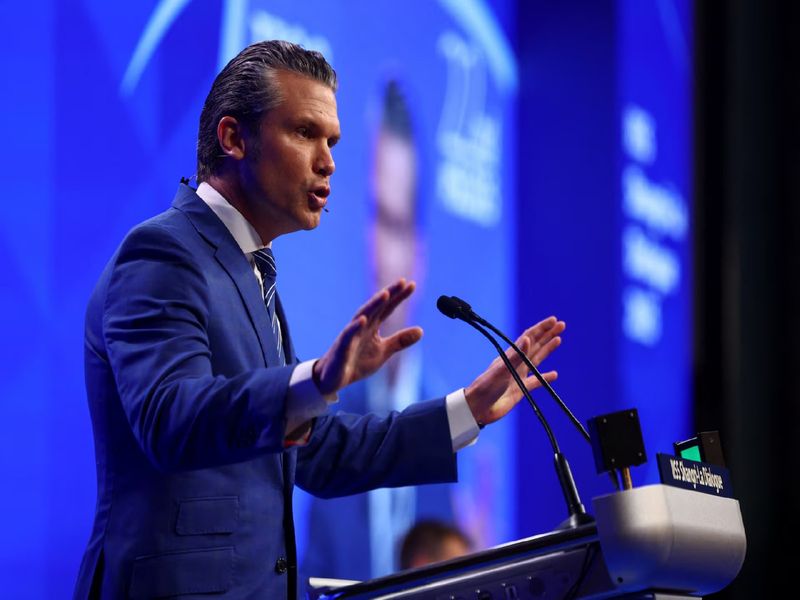

Singapore, May 31 (ANI): The United States issued a stern warning, declaring its absolute readiness to reactivate military operations against Iran if circumstances dictate, while US President Donald Trump re-emphasised that any potential accord with Tehran remains strictly contingent on meeting core American prerequisites, most notably a permanent cessation of Iran’s nuclear weapons ambitions.Addressing a defence summit in Singapore on Saturday, US Secretary of War Pete Hegseth underscored Washington’s operational preparedness, asserting that the US was “more than capable” of restarting the war if required and affirming that “our stockpiles are more than suited for that”.Providing immediate operational backing to these statements, the US Central Command (CENTCOM) reinforced the message through a public transmission on X, confirming that American military assets “remain present and vigilant across the region”.These hardline warnings emerged against a backdrop of conflicting signals surrounding a potential diplomatic breakthrough. While the White House has signalled that President Trump is currently assessing a tentative framework, Iranian authorities have firmly counterclaimed that the ongoing discussions have not yet produced a final deal.Even though a fragile ceasefire negotiated in April has generally been maintained, underlying hostilities continue to flash across the region. Highlighting this volatility, Iran’s state-run IRNA news agency reported that domestic air defence networks successfully intercepted an unmanned aerial vehicle on Saturday, characterising the asset as one “belonging to the US-Zionist aggressor enemy”.Simultaneously, parallel diplomatic tracks are being aggressively pursued, with negotiators expanding their focus onto the overlapping conflict in Lebanon, a theatre Tehran has rigidly insisted must be resolved as a precondition to any overarching settlement with Washington.This diplomatic manoeuvring is unfolding alongside active ground developments, as Israeli forces continue their territorial advance into southern Lebanon. This push persisted even as military delegations representing both Israel and Lebanon convened for direct discussions at the Pentagon on Friday.In defining the path forward, President Trump has explicitly outlined several non-negotiable benchmarks for a binding accord, including ironclad guarantees that Iran will never acquire nuclear weapons, alongside the immediate and full reopening of the economically vital Strait of Hormuz.Tehran, conversely, has flatly dismissed what it perceives as an American attempt to unilaterally impose dictates. Critiquing the diplomatic tone, Foreign Ministry spokesman Esmaeil Baqaei stated that the Islamic Republic “said goodbye to the language of ‘must’ 47 years ago”.While openly admitting that bilateral communications continue to be exchanged between the adversarial nations, Baqaei explicitly maintained that “no final agreement has been reached”.Compounding this diplomatic gridlock, the Tasnim news agency reported that the highly restrictive US maritime blockade remains fully operational on the water, documenting that vessels attempting to navigate the strategic strait are systematically “receiving warnings from CENTCOM to stop and not cross the blockade line”.Meanwhile, the security situation on the Lebanese front has continued to deteriorate rapidly, completely defying a separate, pre-existing ceasefire arrangement. The Israeli military on Saturday delivered urgent evacuation directives for multiple villages across southern Lebanon, coming just twenty-four hours after Prime Minister Benjamin Netanyahu publicly confirmed that Israeli ground troops had advanced more than 30 kilometres into Lebanese territory.This local cessation of hostilities between Israel and Hezbollah, which originally came into effect on April 17, has been systematically eroded by continuous battlefield violations, with both combatants routinely trading blame for the breakdown.The broader cycle of escalation initially erupted in early March when Hezbollah deployed rocket barrages into Israeli territory following a joint US-Israeli operation that resulted in the killing of Iran’s supreme leader. Israel retaliated by launching massive aerial campaigns across Lebanese territory before subsequently executing a targeted ground offensive.In a bid to halt the spiral, Israel and Lebanon have since initiated direct, face-to-face negotiations, with both nations currently preparing to convene for a crucial fourth round of bilateral talks expected next week. (ANI)(This content is sourced from a syndicated feed and is published as received. The Tribune assumes no responsibility or liability for its accuracy, completeness, or content.)