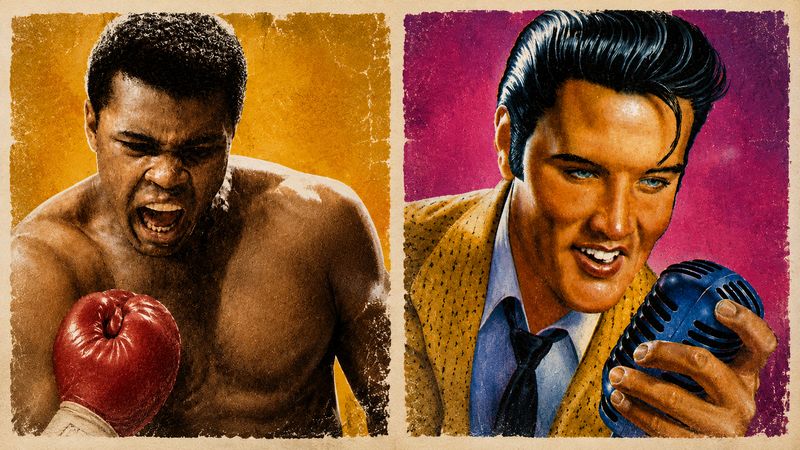

If you ever saw Elvis Presley and Muhammad Ali perform live, you would think they were aliens from another galaxy. Their talent was simply extraterrestrial; out of this world. Yet when the two met in Las Vegas in 1973, it wasn’t as if two giant stars collided on that banner day. Instead, the greats melded into each other in mutual admiration.Muhammad Ali, who loudly boasted that he was the “greatest”, easily conceded the mantle to Elvis. In turn, Elvis acknowledged Ali as the “People’s Champ”.Both Elvis and Ali grew up poor and in America’s Deep South, which was racially divided and angrily bifurcated into Black versus White. Under these circumstances, one would have thought that Elvis would harbour racist feelings against the Black people, and Ali would nurse hatred towards the White folks. Yet it did not happen that way.Ali was an unknown Louisville boy till he won the Olympic gold in boxing in 1960. Seven years before that, in 1953, Sam Philips, the owner of Jattvibe Records, was dazzled by 18-year-old Elvis Presley, who came off the streets, paid $4 and cut two records in his studio. Philips called Elvis back a year later to commercially sing ‘That’s All Right’, and the rest truly is history.This number was first made famous by noted Black artiste, Arthur “Big Boy” Crudup. Black or White, it did not bother Elvis. He sang what came closest to him. He was moved by Black music, particularly of the Gospel kind.In an early interview with The Charlotte Observer, Elvis openly admitted: “Down in Tupelo, Mississippi, I used to hear old Arthur Crudup bang his box the way I do now, and I said if I ever got to the place I could feel how old Arthur felt, I’d be a music man like nobody ever saw.”Not just Crudup, but Chuck Berry, Fats Domino, BB King, Mahalia Jackson and many other Black singers were Elvis’ idols, and he never forgot them. While some claim that Elvis stole Black music, Black artistes themselves admired Elvis.Arthur Crudup said that when Elvis sang the number he did first, ‘That’s All Right’, he made it different, like a hillbilly record. Crudup went on to add, “But I liked it. Some people like the Blues, some don’t. But the way he did it, everybody liked it.”Sammy Davis Jr, another legendary Black artiste and a member of Frank Sinatra’s famous ‘Rat Pack’, rated Elvis “11 on a scale of one to 10 for his character and talent”. BB King thought this of Elvis: “He had the looks, talent, he had everything.” He also appreciated the fact that Elvis addressed him as “Sir”. Whitney Houston and her mother, who was also a professional singer, confessed swooning in Elvis Presley’s presence.That is talent recognising talent free of colour prejudice. Those who have heard Muhammad Ali boasting and trash-talking his opponents might easily assume that he would also have a hostile attitude towards White boxing greats, but they would be wrong. From the time he was 14, Ali wanted to be like Rocky Marciano, who retired undefeated. Ali did not hesitate to concede that Marciano fought “like a bull”. Next comes the unexpected humble admission: “I truly think that Marciano was better than Joe Frazier and you saw what Frazier did to me.”Remember, Frazier handed Ali his first professional defeat in 1971. Yet Ali did not gloss over it. Of course, he won it back later, but that was a humiliating defeat. Not just Marciano, Ali also acknowledged other White boxers like the Canadian, George Chuvalo, and Henry Cooper, the British heavyweight boxer who was the first to knock down Ali before he recovered to win the fight. But that blow left Ali sagging on the ropes with glazed eyes. He later commented, with characteristic humour, that Cooper hit him so hard that “my ancestors in Africa felt it”.Ali admired Marciano when he was 14, heard Elvis when he was 15. In those years, the kids in Ali’s Black neighbourhood in Louisville, Kentucky, were listening to Black artistes like Ray Charles and James Brown, but Ali was listening to Elvis. “When I was 15 and saw Elvis on TV,” Ali recalled, “I wanted to be like Elvis.” No trace of racist bias here, just as there was none in Elvis Presley. At the same time, Ali was very conscious of his Black heritage and of his affiliation with the Islamic faith, but when it came to measuring himself as a professional against others, colour was not a consideration.Ali once said that when he heard Elvis had bought his mother a pink Cadillac and a house, he vowed he would do the same. So when he won his first professional bout, Ali’s mother got a pink Cadillac and when Ali won his second, his mother got a house. Elvis was his long-time role model. It is widely known that when Ali gifted Elvis a pair of boxing gloves, these were inscribed with the words: “Elvis, you are the Greatest.” In return, Elvis presented Ali with a rhinestone bejewelled boxing robe on the back of which was written: “The People’s Choice”. That turned out to be an error, for Elvis wanted the words: “The People’s Champ”. Ali still wore it.The most moving tribute that Elvis ever received was from Muhammad Ali. In 1985, Ali went to the graveside, heartbreak central for all Elvis fans, and sang Elvis’ hit song, ‘Don’t be Cruel’. He did not bump and grind like Elvis, but did his best to imitate the legend. Let us end with this unforgettable Ali quote: “Nobody in boxing had the style, wit, speed and beauty of Ali and nobody in singing had everything like Elvis.”When Elvis met Ali, it was a picture-book shot of great meets great. At this golden moment, they were both the “Greatest” as no prejudice stood in their way.— The writer taught sociology at JNU