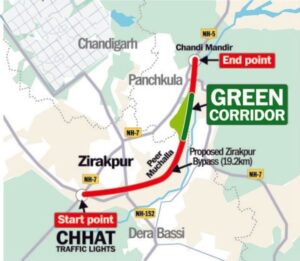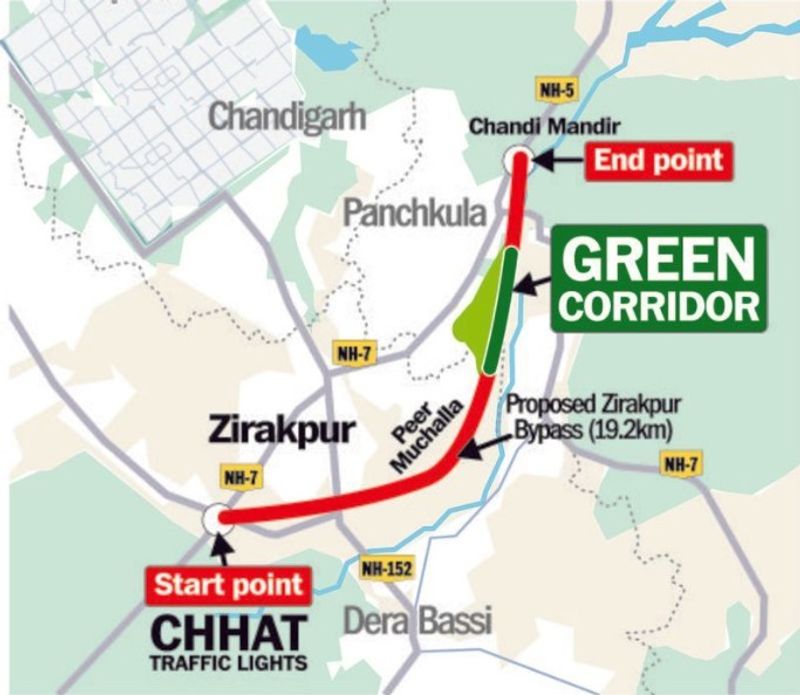

If you drive through Zirakpur or anywhere near it you already know what the problem is. You have sat in it, breathed it, lost hours of your life to it. The gridlock at this small Punjab town, sitting at the crossroads of national highways connecting Delhi, Ambala, Patiala, Panchkula, Chandigarh and Shimla, is not just an inconvenience. It is one of the most expensive, most polluting and most exhausting traffic failures in north India.A six-lane bypass was designed to fix it. The money has been committed. The contractors have been hired. The Letters of Award have been signed. And yet, the bypass is stuck — again.Here is the full story of why. The Tribune explains.WHAT IS THE ZIRAKPUR-PANCHKULA BYPASS AND WHY WAS IT APPROVED?The Zirakpur-Panchkula Bypass is a proposed 19.2-km, six-lane, access-controlled greenfield highway corridor that will run from the junction of NH-7 at Zirakpur-Patiala to NH-5 at Zirakpur-Parwanoo, cutting around Zirakpur town and linking directly to Panchkula on the other side.Think of it as a flyover that bypasses an entire city.The project also has a 10.3-km connecting Spur, approved by the Union government in February 2026 that ties the Bypass into the Ambala-Chandigarh Greenfield Expressway near Rajo Majra village. Together, the two corridors form the southeastern arc of the 244-km Tricity Ring Road, a Rs 12,000-crore orbital highway network being built to divert through-traffic away from the urban cores of Chandigarh, Mohali and Panchkula.The combined project cost of the Bypass and the Spur is approximately Rs 1,983 crore on the ground, Rs 1,380 crore for the Bypass, awarded to RKCPL Limited, and Rs 603 crore for the Spur, awarded to Ceigall Infra Projects Pvt. Ltd.WHY DOES ZIRAKPUR NEED A BYPASS SO URGENTLY?Zirakpur was never meant to be a highway junction. It grew haphazardly — shops, showrooms, apartment blocks and commercial complexes mushrooming along what were originally national highway shoulders. Today, every vehicle travelling between Delhi and Shimla, between Ambala and Chandigarh, between Patiala and Panchkula, must pass through this same bottleneck.The result is predictable and daily. Trucks, buses, cars and two-wheelers crawl through Zirakpur’s internal streets. Traffic backs up for kilometres on NH-44, NH-205A and NH-152 — three of the most heavily used national highway corridors in the region. Fuel is wasted. Emissions choke the air. Accidents happen at intersections. And thousands of hours of human time are lost every single day.The Bypass solves this at the source. Its 6.195-km elevated section, multiple flyovers and a railway overbridge will allow all through-traffic, particularly freight and long-distance vehicles, to bypass Zirakpur entirely and reach Panchkula directly, without touching a single urban traffic light. The Spur ensures that vehicles arriving from Ambala and Delhi are intercepted before they even reach Zirakpur — rerouted onto the Bypass before they have any chance to enter the town.NHAI estimates that once both are operational, thousands of vehicles will be diverted from the Tricity’s internal arteries every single day, cutting travel times, reducing fuel consumption, lowering vehicular emissions and easing the Urban Heat Island effect in one of the most densely trafficked corridors in Punjab and Haryana.THERE IS A NATIONAL SECURITY ANGLE TOOThis is not just a traffic story. The Bypass has a strategic dimension that makes its delay more than a commuter inconvenience.The project begins near the Chandigarh Airport, which also serves as an Indian Air Force station, and ends at Chandimandir in Panchkula — the headquarters of the Western Command of the Indian Army, the formation responsible for India’s northern and western borders.At present, the only routes connecting these two critical defence establishments pass through densely built-up residential and commercial areas with multiple traffic intersections. In an emergency, this means military vehicles — carrying personnel, equipment or logistics — are subject to the same gridlock that affects civilian traffic. In a border state like Punjab, where rapid, coordinated military mobilisation may be required at short notice, that is a vulnerability.The Bypass provides an access-controlled, signal-free corridor between the Air Force station and Western Command headquarters — eliminating urban bottlenecks from the equation entirely. This is why the Ministry of Defence was a stakeholder in the project all along and why it recently granted NHAI working permission for 2.7461 acres of its own land at Chandimandir Military Station to make the Bypass possible.IF THE PROJECT IS SO IMPORTANT, WHY HAS IT TAKEN SO LONG?That is a fair and frustrating question. The Zirakpur-Panchkula Bypass was first conceived around 2020, when land acquisition was completed. It has since spent years in the administrative pipeline — waiting for forest clearances, wildlife assessments, Ministry of Defence approvals and financial bids. Each stage moved slowly.The connecting Spur — without which the Bypass cannot function as intended — was first proposed in 2023 but did not receive Union government approval until February 2026. The cost of that delay was brutal: the Spur’s estimated cost jumped from Rs 940 crore to Rs 1,464 crore — an escalation of Rs 524 crore, or nearly 56 per cent, in just three years of waiting.The Bypass itself cleared its final forest clearance only recently. The Ministry of Defence working permission for Army land at Chandimandir — a non-negotiable prerequisite for the corridor’s physical commencement — came through just weeks ago, after months of processing through multiple layers of military and civilian bureaucracy. In exchange, NHAI agreed to construct 32 married accommodation units for Army JCOs and Other Ranks at Chandimandir — a compensation-in-kind arrangement rather than a cash payment.Letters of Award were finally issued on March 27, 2026 — to RKCPL Limited for the Bypass and Ceigall Infra Projects for the Spur. Ground work was imminent. And then the High Court PIL arrived.WHAT IS THE HIGH COURT CASE ABOUT?A Public Interest Litigation was filed before the Punjab and Haryana High Court, raising environmental objections primarily on the grounds of tree felling along the Bypass corridor.In an order dated April 1, 2026, a division bench of Chief Justice Sheel Nagu and Justice Sanjiv Berry stayed the felling of any tree of any age or species in the entire state of Haryana — without the court’s prior permission including the approximately 5,000 trees proposed to be cut for the Bypass. The court accepted an assurance from NHAI’s counsel that no tree would be cut until further judicial orders.The court asked two pointed questions that NHAI must now answer. First: are the states of Punjab and Haryana willing to provide public land in close vicinity for afforestation in lieu of the trees to be felled? Second: were alternative alignments genuinely studied before the current route was finalised — and if so, what were they?The court also took note of a sobering statistic: according to the Indian State Forest Report 2023, forest cover in Haryana stands at just 3.65 per cent of the state’s geographical area — among the lowest in the country. The bench observed bluntly that Haryana’s functionaries appeared “neither serious nor conscious of the impending ecological catastrophe.”The case is listed for hearing on May 26.HOW MANY TREES WILL ACTUALLY BE CUT — AND WHAT IS BEING DONE ABOUT IT?According to NHAI’s own project documentation, 2,790 forest trees are proposed to be felled along the Bypass corridor — a figure that appears lower than the approximately 5,000 referenced in the PIL and the court’s order. The discrepancy may arise from how trees in forest and non-forest land are counted separately. This is one of the questions NHAI is expected to clarify before the court.On the question of compensatory planting — which is at the heart of the environmental debate — NHAI’s case is substantial. Against 2,790 trees to be felled, NHAI has committed to planting:27,770 trees under statutory Compensatory Afforestation schemes mandated by law, 12,000 trees as avenue plantation alongside the Bypass, and 7,992 shrubs within the corridor — a combined total of over 47,000 plantings.That is more than 10 times the number of trees being felled.The funds for Compensatory Afforestation and the Net Present Value of felled trees — both mandatory statutory payments — have already been deposited with the Ministry of Environment, Forest and Climate Change. Stage-I and Stage-II Forest Clearances under applicable forest laws have been obtained. The Wildlife Mitigation Plan has been independently reviewed and cleared by the Wildlife Institute of India.NHAI also points out that the Bypass has been specifically designed as an elevated corridor through forested stretches to minimise the number of trees that need to be removed at ground level. Post-construction, plantation is also planned beneath the elevated sections. The environmental argument, NHAI maintains, is not against the project — it actually points to the thoroughness of the safeguards already built in.SO WHAT IS THE REAL ISSUE BEFORE THE COURT?The core tension before the High Court is not whether trees will be replaced — NHAI’s compensatory afforestation numbers are, by any standard, more than adequate. The real issue the court is probing is more fundamental: whether the loss of 2,790 to 5,000 existing, standing forest trees in a state with only 3.65 per cent forest cover can be justified, regardless of how many saplings are planted elsewhere later.A sapling planted today is not the same as a 20-year-old forest tree felled today. The court’s concern, reading between the lines of its April 1 order, appears to be about the irreversibility of the ecological loss — and whether every possible alternative was exhausted before accepting it.The demand for re-alignment proposals is particularly significant. If NHAI’s technical files show that alternative alignments were explored and rejected for sound engineering reasons, the court may be satisfied. If the record suggests that the environmental impact was not central to alignment decisions, the court may demand modifications — or deeper scrutiny.WHAT HAPPENS AT THE HEARING TOMORROW?Monday’s hearing on May 26 will test NHAI’s preparedness on both fronts. The authority must satisfy the court on whether Punjab and Haryana will provide land for afforestation — a governmental commitment that goes beyond NHAI’s own mandate — and must lay before the bench all re-alignment proposals considered during the design process.The outcome could go in several directions. If the court is satisfied with NHAI’s answers and the compensatory afforestation commitments, it could lift or modify the stay — allowing tree-felling to proceed under supervised conditions. If the court is not satisfied, it could keep the stay in place, seek further information, or in the most stringent scenario, direct a re-examination of the alignment.Any prolonged stay directly delays the construction start. The Bypass has a two-year completion deadline from the date of award — pointing to early 2028. The Spur has an 18-month deadline, targeting late 2027. Every month lost to litigation pushes that timeline further — and as the Spur’s cost escalation history painfully illustrates, delays in Indian infrastructure do not come free.WHAT IS AT STAKE FOR THE DAILY COMMUTER?Everything. This is not an abstract policy debate. Every day that the Bypass is delayed is another day of gridlock on Zirakpur’s streets, another day of trucks crawling through residential areas, another day of toxic emissions at one of the most congested junctions in north India.The Bypass, once built, will transform mobility for lakhs of daily commuters across Punjab, Haryana and Himachal Pradesh — providing faster, cleaner, safer access to Chandigarh, Panchkula, Shimla, Baddi and Delhi. It will cut travel times, reduce fuel bills and lower the pollution burden on one of the region’s most overburdened urban corridors.The environmental case for protecting Haryana’s trees is real and legitimate. So is the case for building this bypass. The question Monday’s hearing must answer is whether the two can be reconciled — and how quickly.Zirakpur has already waited long enough.THE STORY SO FAR: A TIMELINE2020: Land acquisition completed for Zirakpur-Panchkula Bypass2023: Connecting Spur first proposed; gets stuck in approval pipeline; costs begin escalatingFebruary 2026: Union government approves Spur at Rs 1,464 crore (up from Rs 940 crore — a 56% jump in 3 years)March 20, 2026: Financial bids opened — 9 for Bypass, 10 for SpurMarch 27, 2026: NHAI issues LOAs to RKCPL (Bypass, Rs 1,380 crore) and Ceigall (Spur, Rs 603 crore)March 2026: Ministry of Defence grants working permission for 2.7461 acres at Chandimandir Military StationApril 1, 2026: Punjab and Haryana HC stays tree felling across Haryana including Bypass corridor; next date April 17, then rescheduled to May 26May 26, 2026: Next hearing — NHAI must answer court’s queries on afforestation land and re-alignment proposalsTarget completion: Spur — late 2027; Bypass — early 2028 (if construction starts soon)(Source: NHAI, Punjab and Haryana High Court order, Ministry of Defence)