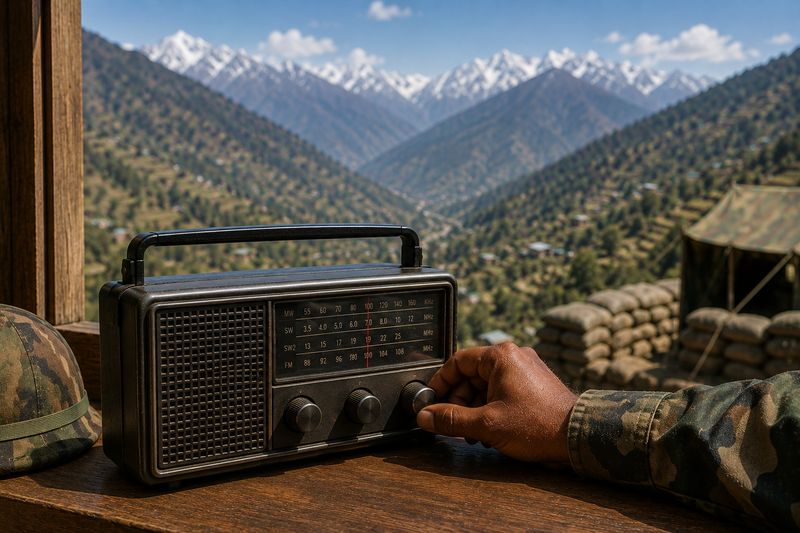

Radio programmes in border areas along India and China in Himachal Pradesh and Uttarakhand now have a new flavour. Broadcast over the frequency modulation (FM) band, these stations cater to local populations, address them in local dialects and inform them about day-to-day issues, besides subtly countering misinformation along the sensitive boundary.In the past 18 months, two such radio stations have come up in Kinnaur and Spiti in Himachal Pradesh, while three are operational in Uttarakhand — at Joshimath, Pithoragarh and Harsil. These stations cover a range of topics including fruit crops, hyper-local weather patterns, snowfall estimates, agriculture, tourism, education and career guidance.In these border areas, all located along the Line of Actual Control (LAC) with China, mobile networks remain patchy. Hence, the radio stations, which broadcast for nearly 12 to 14 hours daily, are also being used to counter misinformation and connect isolated communities with the Army. They also disseminate information about government welfare schemes, health initiatives and Army recruitment opportunities for local youth.The Army’s Sadbhavana project is funding and managing the FM technology for operating these stations under the Vibrant Villages Programme.Four more stations are planned in Uttarakhand, including at Gunji, located near the tri-junction of India, Nepal and Tibet, and Dharali, near Gangotri. The other two planned stations are in the lower hills at Lansdowne and Ranikhet.In Himachal Pradesh, the radio stations “Voice of Spiti” and “Voice of Kinnaur” are located in the apple belt. Farmers are provided real-time updates on market prices, modern grafting techniques and pest control measures for apple and dry fruit cultivation.Crucial warnings regarding landslides and heavy snowfall, which frequently cut off the Hindustan-Tibet Road, are also broadcast through these stations in Himachal. The same is the case with the stations in Uttarakhand, as these are located along major pilgrimage routes to Gangotri, Badrinath, Hemkund Sahib and the annual Kailash Mansarovar Yatra to Tibet.Programmes in Himachal are broadcast in the local Kinnauri dialect, while those in the Garhwal and Kumaon regions of Uttarakhand use their respective local dialects.Folk songs and oral histories are aired regularly, while women, youth and farmers are also given a platform.In Joshimath, located near the shrines of Badrinath and Hemkund Sahib, the station is named “Tarana”. It broadcasts programmes in Garhwali and Hindi and focuses on agro-tourism, sustainable tourism, local handicrafts and mountain farming techniques.The station at Harsil, located on the route to Gangotri, also provides updates on weather, landslides and road conditions, which are crucial for both locals and pilgrims.At Pithoragarh, situated on the route to Lipulekh Pass and onwards to Tibet, the radio station carries the tagline “Hill se Dil Tak” (From the hills to the heart). Its primary focus is on agriculture and horticulture.