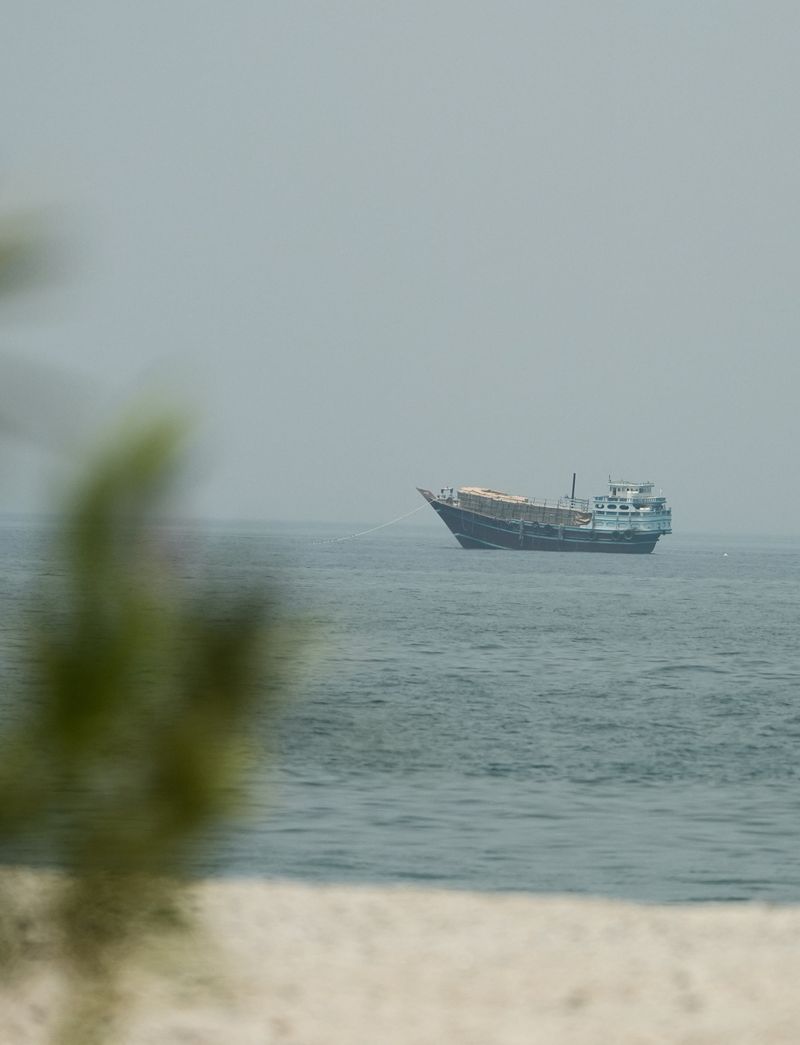

US President Donald Trump on Tuesday abandoned his plan to impose a 20 per cent fee on cargo passing through the Strait of Hormuz, but his threat to “take over” the strategic waterway remained, as the US said it had more than 50,000 troops stationed across West Asia.The US and Iran continued missile and drone strikes against each other overnight, even as Trump announced a change of approach, saying Washington would instead pursue trade and investment agreements with Gulf states.The reversal came a day after Trump proposed the 20 per cent fee “to guard the waterway”. In a post on his social media platform Truth Social, Trump said: “Based on highly productive conversations with Middle East (West Asian) leadership, I have decided to replace the 20 per cent United States Reimbursement Fee with Trade and Investment Deals that the various Gulf States will be making into the US.”Trump did not specify any commitments from Gulf countries, saying only that “investments will be massive” and would be “extraordinarily good for them, and their future”.In his post on Tuesday, Trump declared that the Strait of Hormuz was open to all shipping traffic except vessels linked to Iran.Meanwhile, the US military said it would resume a blockade of maritime traffic entering and leaving Iranian ports at 4 pm US Eastern Time on July 14, which corresponds to 1.30 am on July 15 in India.The US Central Command (CENTCOM), which oversees American military operations in West Asia, meanwhile said more than 50,000 US service members were deployed across the region.”American forces remain vigilant, lethal, and ready,” CENTCOM said.The troops are stationed across 19 US military bases in regional countries, in addition to personnel deployed aboard nearly 20 US warships operating in the area.Oil prices rose amid the escalating tensions, with Brent crude climbing to around $81 a barrel, its highest level since mid-June. Shipping data firm Kpler said crossings through the Strait of Hormuz fell by about 52 per cent between July 10 and July 12 compared with the previous week.At a news conference on Monday, Trump said Iran’s offensive capabilities were being dismantled, but added that he believed a “deal is possible” despite the return to open conflict.He also threatened Iran, saying the US would “take out” Kuh-e Kolang Gaz La, also known as Pickaxe Mountain, a suspected nuclear site near the Natanz uranium enrichment facility in central Iran.Responding to Trump’s remarks, Ebrahim Azizi, head of the Iranian Parliament’s National Security Committee, said Tehran remained committed to defending its red lines.Earlier, the US announced that it had completed its latest wave of strikes against Iran on July 13. During the five-hour operation, US forces targeted military sites across Iran, including Bushehr, Chah Bahar, Jask, Konarak, Abu Musa and Bandar Abbas, in an effort to reduce Iran’s ability to attack commercial shipping, the military said.For its part, Iran’s Islamic Revolutionary Guard Corps (IRGC) said it had launched a broader retaliatory campaign against US allies and interests across the Gulf.