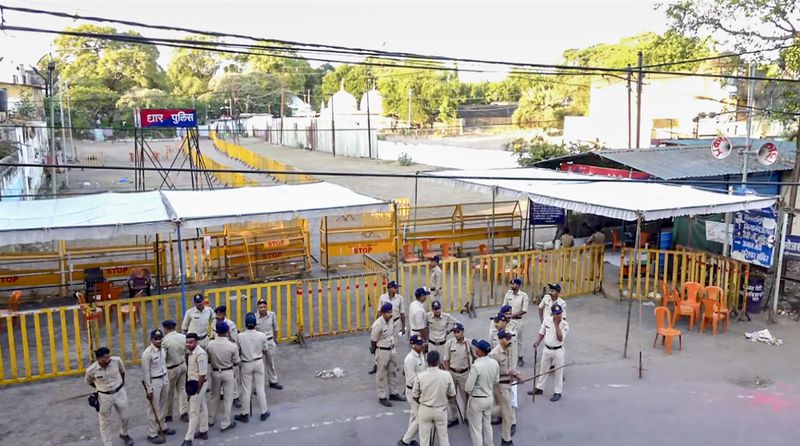

The Supreme Court on Tuesday refused to pass an interim order restoring the status quo ante at the disputed Bhojshala complex in Dhar district of Madhya Pradesh to allow Muslims to offer namaz on Fridays alongside Hindu worship on designated days.“Let us not pass any order which can cause tension,” a three-judge Bench led by Chief Justice of India Surya Kant told senior advocates AM Singhvi, Huzefa Ahmadi and Meenakshi Arora after they sought restoration of status quo ante on behalf of Muslim petitioners.The refusal to order status quo ante means Hindus will continue to have exclusive access to the Bhojshala complex, while Muslims remain excluded during the pendency of the case.The Bench, which also included Justice Joymalya Bagchi and Justice V Mohana, however, ordered allocation of separate open space for Muslims adjacent to the disputed complex for Friday prayers as an ad hoc measure.The top court directed that the Archaeological Survey of India (ASI) shall not carry out any structural changes at the site without its permission. It also issued notice to the Centre, MP Government, Hindu Front for Justice and the ASI on petitions challenging the Madhya Pradesh High Court’s verdict declaring the Bhojshala complex, an 11th-century archaeological monument, a temple dedicated to Goddess Saraswati.“Fraternity and secularism cross-fertilise each other… Something which has been continuing for years must be allowed to continue,” Singhvi argued.“A status quo which existed for about 800 years was disturbed… Now we are totally ousted,” Ahmadi submitted.However, Solicitor General Tushar Mehta and senior advocate Guru Krishnakumar, representing the State of Madhya Pradesh and Hindu parties, respectively, opposed the demand for the restoration of status quo ante at the complex. “Once you come after two months and seek status quo ante, administrative problems will arise,” Mehta submitted.As the CJI asked the state government about the high court’s direction to consider allocating some other place for Muslim worship if they made a demand for it, Mehta said, “The government is open to it.” Asking both Hindu and Muslim sides to have patience, the Bench said it was ready to hear the matter on a day-to-day basis and posted it for hearing after three weeks.Terming it a “very sensitive issue”, the CJI said, “What is being said in court can unnecessarily create controversies or send a wrong impression. We have to be very careful about every expression used… The high court’s order and the helplessness of the state in maintaining law and order are also being taken note of. Our view is that whatever arrangement is currently in place, the matter can be listed before an appropriate Bench within 10 to 15 days.”Hindus believe the Bhojshala complex is a temple dedicated to Goddess Saraswati, while Muslims call it Kamal Maula Mosque. The complex is protected by the ASI. In its May 15 verdict, the high court had quashed the ASI’s April 7, 2003, order that allowed Muslims to offer namaz inside the complex every Friday. The Muslim community may approach the MP Government for the allotment of separate land in the district for the construction of a mosque, it had said. Kamal Maula Mosque’s caretaker Qazi Moinuddin has challenged the order before the top court.In its much-awaited verdict in the Bhojshala Temple-Kamal Maula Mosque complex dispute, the high court had said that there were indications of a Sanskrit teaching centre and a temple of Goddess Saraswati existing in Bhojshala. It had referred to the principles laid down in the Supreme Court’s judgment in the Ayodhya Ram Janmabhoomi-Babri Masjid dispute case.Acting on a petition filed by ‘Hindu Front for Justice’, the high court had on March 11, 2024, ordered the ASI to conduct a scientific survey of the complex. The ASI began the survey on March 22 and submitted its report to the high court on July 15, 2024, after a 98-day exercise. The ASI report had concluded that the existing structure of a mosque in the Bhojshala complex was made from parts of an earlier temple that could be dated to the Paramara period, almost 1,000 years ago.